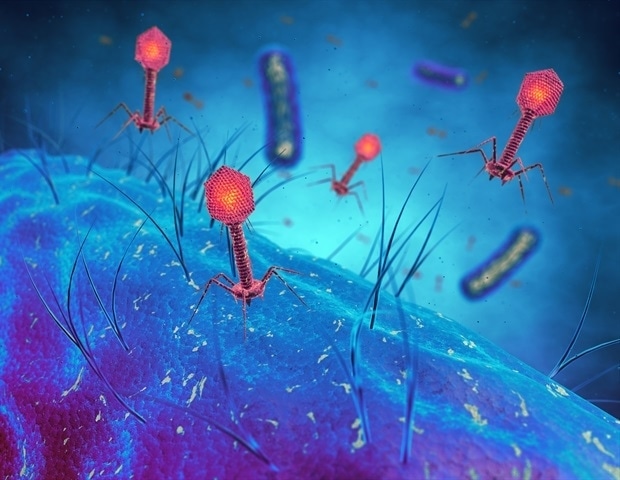
Researchers in Japan have identified a specific mechanism by which bacteriophage proteins can disable a critical bacterial transporter, potentially offering a blueprint for a new generation of antibiotics.
The study, published in PLOS Biology on October 27, 2026, details how a protein called SglPP7 interacts with MurJ, a protein that bacteria rely on to transport the lipids necessary for building their cell walls. As reported by News-Medical, this discovery could provide a foundation for developing drugs to combat increasingly common drug-resistant bacteria.
Bacteriophages, or “phages,” are viruses that naturally infect bacteria. To replicate, they hijack the host’s cellular machinery, sometimes injecting small proteins that shut down essential bacterial processes to cause cell death. While scientists have known that various phage proteins can inhibit the MurJ transporter, the amino acid sequences of these proteins vary significantly, leaving the exact molecular strategy unclear.
Structural basis for inhibition of the lipid flippase MurJ by phage lysis protein SglPP7 suggests convergent evolution with other Sgl peptides https://t.co/0fmzhkFc39
A research team led by Assistant Professor Hidetaka Kohga at the Nara Institute of Science and Technology (NAIST) used cryo-electron microscopy to observe the MurJ–SglPP7 complex at near-atomic resolution. Their findings show that SglPP7 sits along a lipid-binding groove in MurJ and inserts a short C-terminal tail into a deep internal cavity.
This physical interaction stabilizes MurJ in an outward-facing conformation. By locking the protein in this position, the phage prevents the back-and-forth structural changes MurJ needs to complete lipid transport. Without this movement, the bacteria cannot maintain their cell walls.
“These findings suggest convergent evolution toward a common target through diverse inhibitory mechanisms,” says Dr. Kohga.
The researchers compared SglPP7 to two other known phage proteins, LysM and SglCJ3. Despite the proteins binding to MurJ in different ways, all three were found to stabilize a similar conformation of the transporter.
This research could affect public health, though it is in its early stages. The ability to understand how diverse proteins can converge on a single essential target allows scientists to move beyond searching for random molecules and toward intentional design.
By mapping these precise interactions, researchers may eventually be able to engineer artificial phage proteins with highly targeted antibacterial activity. This could lead to treatments that specifically dismantle the defenses of resistant pathogens without harming beneficial bacteria.
“By revealing how phage proteins inhibit MurJ, this study provides a foundation for drug discovery targeting this transporter,” explains Dr. Kohga. “Although still at the basic research stage, these findings could contribute to the development of new antibacterial agents against drug-resistant bacteria.”
The study involved a collaborative effort at NAIST, including co-authors Kaito Hosoda, Sixian Wu, Hiroyuki Tanaka, Dr. Hideki Shigematsu, Assistant Professor Ryoji Miyazaki, Associate Professor Min Fey Chek, and Professor Tomoya Tsukazaki. Their work, detailed in the primary research published in PLOS Biology, utilized targeted protein mutations, bacterial cell lysis, and computer simulations to verify the interaction’s impact on MurJ’s behavior.
Related reading

How the Gut-Brain Dopamine Pathway Shapes Our Food Preferences
A slow dopamine pathway shapes food preferences Scientists have identified a specific dopamine pathway that explains how the...

BNPB Identifies Three Companies Suspected of Burning Land in South Papua
Indonesia's National Disaster Mitigation Agency (BNPB) has identified three companies suspected of deliberately burning land in South Papua,...
Purslane Nutritional Profile: Omega-3 Content, Health Benefits, and Safety
The nutritional potential of purslane Purslane, a succulent often dismissed as a common garden weed, is attracting scientific...
IVF Leads to Faster Live Births Than IUI for Unexplained Infertility
IVF achieves faster live births than IUI for unexplained infertility In vitro fertilization (IVF) leads to faster live...