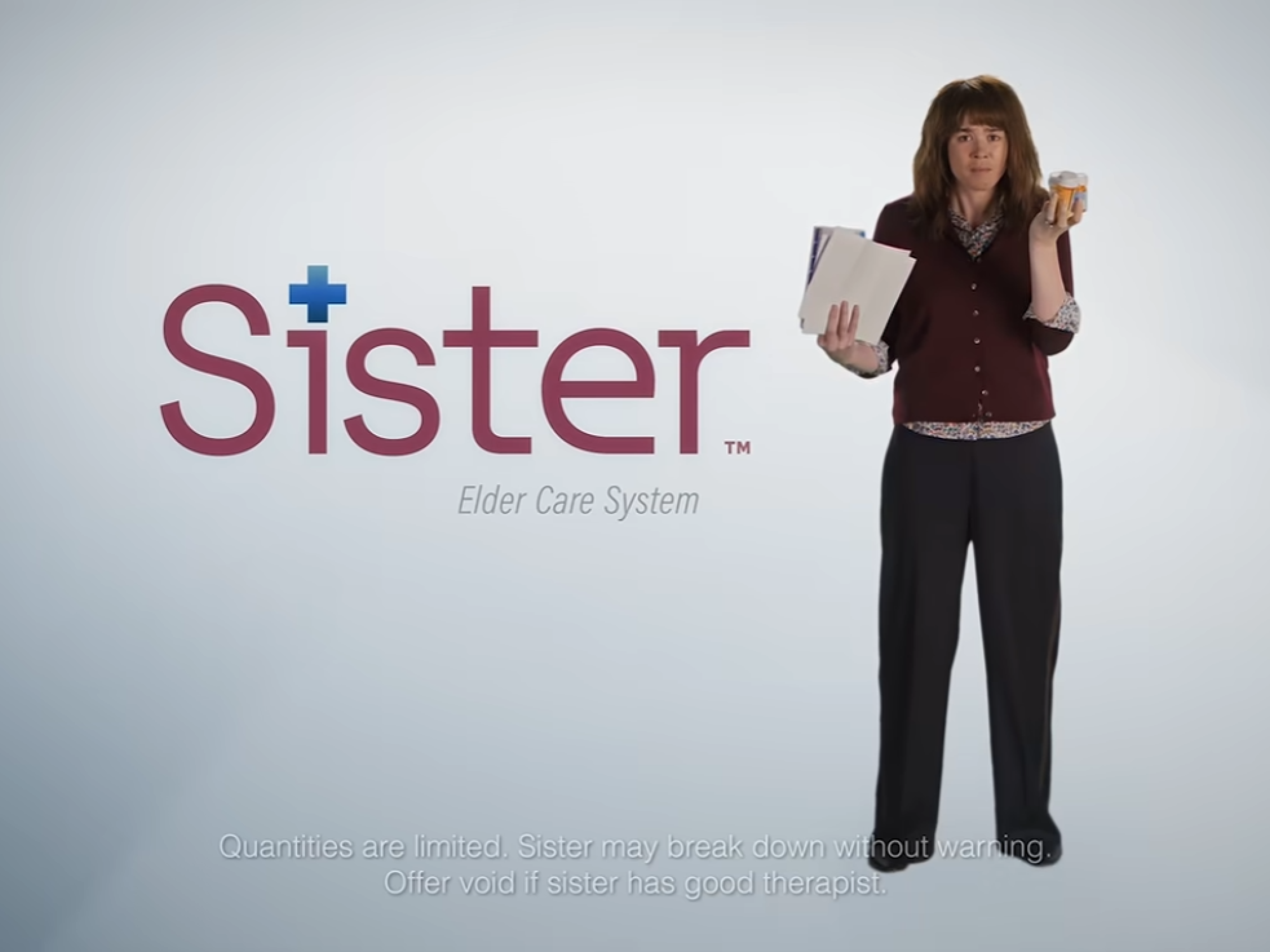
On November 14, John Mulaney hosted Saturday Night Live for a seventh time and debuted a pre-taped commercial parody that reframed the unpaid labor of daughters as a free, on-demand eldercare service called “Sister.”
The sketch opens with Mulaney’s character resting a hand on his aging father’s shoulder. “My dad means the world to me,” he intones, “but a private health aide could cost thousands a week. I didn’t know where to turn.” Enter Jane Wickline as the titular product: a weary woman with rolling luggage.
“Sister is a live-in 24/7 elder care provider that is completely free, and also your sister,” the voiceover explains. Mulaney beams: “Now I don’t have to worry about Dad getting the care and attention he needs, because my sister will do it, and I can get back to my life and the stuff I like to do.”
Brilliant from start to finish. Every single moment rang true for this oldest sister. But the fact that it has male writers behind it gives me hope for other people’s brothers!
Andrew Dismukes appears as another brother delivering a testimonial: “I love my mom more than anything. That doesn’t mean I want to help her in the bathroom. Sister doesn’t either. But she will, whereas I won’t.”
A doctor, played by Kenan Thompson, later deadpans that “years of internalized sexism have warped Sister’s brain into thinking that caretaking is her responsibility and, somehow, not yours.” The clip amassed more than 1.2 million YouTube views in its first 24 hours, NBC reported, and topped 4 million within two days, Common Dreams noted.
The Laughter Masks a Measured Reality
The satire lands because the data backs the premise. Men accounted for only 20 percent of caregiving in the early 2000s, rising to 42 percent by 2018, Statistics Canada shows.
Yet the intensity and type of care remain highly gendered: women are more likely to provide personal care — bathing, dressing, feeding, toileting — while men gravitate toward home maintenance and outdoor work. Women also spend more time at it, averaging 10 hours a week compared with six for men, The Conversation reported.

Demographic pressure is tightening the vise. Canada now records its highest-ever labor-force participation for women aged 25–54, at 85 percent, federal data indicate. Globally, the International Labour Organization estimates 708 million women are kept out of the workforce entirely by unpaid care responsibilities, while the United Nations tallies 16 billion hours of such work performed daily by women and girls. Families are shrinking; the pool of default daughters is evaporating.
Workplace Exit Is the Hidden Cost
In Canada in 2018, one in 20 full-time employees providing unpaid adult care left or intended to leave their job; another one in seven cut their hours, The Conversation reported. The fallout hits pensions, benefits, career trajectory, and long-term financial security.
Research cited by the American Association of Retired People finds employers can expect a return of two to four dollars for every dollar invested in carer-inclusive policies — flex time, telework, paid leave, support groups — through reduced absenteeism, lower presenteeism, and better retention.
McMaster University has partnered with the Canadian Standards Association to publish a voluntary Carer-Inclusive and Accommodating Organizations Standard and handbook, “Helping worker-carers in your organization.” Provincial groups such as the Ontario Caregivers Organization and Family Caregivers of British Columbia offer additional infrastructure, but adoption remains uneven.
Regional Numbers Sharpen the Picture
New York alone counts 4.1 million family caregivers delivering $58 billion in uncompensated care annually, according to the Association on Aging in New York. Caregiver out-of-pocket costs have surged 59 percent to more than $11,000 a year.
One in three U.S. caregivers belongs to the “sandwich generation” — disproportionately women aged 35–55 juggling children and aging parents simultaneously. County Offices for the Aging serve clients for 7–9 years at under $10,000 per year; a nursing home costs $150,000. Wait lists for home care, meals, case management, transportation, and legal services exceed 80,000 statewide.
Written with @mikeyfuntime and the great Simon Rich (with an assist from Chase Rosenberg). Dedicated to my sister Heidi https://t.co/kn9f7ZVvKp
The Sketch’s Provenance and the Reaction It Sparked
“Sister” was written by Mikey Day, Streeter Seidell, and Simon Rich — a former SNL writer who returned for Mulaney’s episode — with an assist from Chase Rosenberg. Seidell posted the clip on X with a dedication: “to my sister Heidi.”
The male authorship surprised many viewers; Yahoo reported that the men’s interpretation of a sister’s sacrifices made countless caregivers feel seen. Comments ranged from “I am sister” to “This was so real it almost gave me a stroke from rage.”
Sociologist Jessica Calarco, writing for MS NOW, argued the sketch indicts a neoliberal model that privatizes care onto individual families rather than treating it as a public good. She pointed to the Netherlands, where universal health care couples with tax-subsidized long-term care insurance to guarantee low-fee nursing-home and in-home services.
“The politics of personal responsibility incentivize all of us to push the work of care downstream, from men to women, and from women in more privileged positions to other women — often Black, Latina and immigrant women,” Calarco wrote.
This is hard to watch because it's true. These unfair, sexist gender roles are so engrained in our society – caregiving is no exception. As a caregiver to my dad, I think it's important to talk about what caregiving looks like as a son and as a father. We don't have to accept… https://t.co/ET5jNCcmYg
Policy Voices Enter the Frame
Sen. Andy Kim (D-NJ), a caregiver to his father, posted on social media: “This is hard to watch because it’s true. These unfair, sexist gender roles are so engrained in our society — caregiving is no exception. As a caregiver to my dad, I think it’s important to talk about what caregiving looks like as a son and as a father. We don’t have to accept these norms.”
Rep. Gwen Moore (D-Wis.) pledged legislation to expand the Earned Income Tax Credit for unpaid caregivers, calling the $1 trillion in annual unpaid family care “work that must be valued.” Economist Nancy Folbre told Common Dreams she hoped the sketch would “finally kick off a serious discussion about all the things we can do to help reduce this burden for caregivers,” including long-term care insurance modeled on Washington State’s program.
A Counterpoint in the Mailbag
Not every family follows the script. Jackie Hughes of Culver City wrote to the Los Angeles Times to recognize her brother Bill, who served as primary caregiver for both their parents “willingly, without complaint, and did a superb job.” The letter underscores that while the statistical tilt is real, individual families still write their own endings — sometimes defying the default.

The Punchline Is the Policy Vacuum
“Sister” works because it sells a product that already exists in millions of homes — unpaid, invisible, and treated as a birthright. The sketch’s virality proves the hunger for recognition. What follows is whether workplaces, legislatures, and families themselves will rewrite the terms of service.
“Families shouldn’t have to navigate complex care needs alone, and women shouldn’t be expected to shoulder that work by default,” said Becky Preve, executive director of the Association on Aging in New York. The sketch has aired. The conversation has started. The structural response is still waiting.
Mulaney first rose to prominence as a writer for Saturday Night Live from 2008 to 2013, where he co-created the recurring character Stefon with Bill Hader. He became a member of the SNL Five Timers Club in 2022 after his sixth turn as host; the “Sister” sketch aired during his seventh hosting stint. Mulaney has won three Primetime Emmy Awards for Outstanding Writing for a Variety Special, most recently for Baby J in 2023.
Disclaimer: The cultural analyses and financial data presented in this article are based on available public records and industry metrics at the time of publication.
Sister has a friend in me! Family members (predominantly women) perform about $1 trillion in unpaid caregiving work every year. I introduced legislation to expand Earned Income Tax Credit for unpaid caregivers, providing direct support to those who care for loved ones. https://t.co/YkpMJ4va64
Related reading

Scottish Government Plans First Kilt Bond Issuance This Financial Year
The Scottish government plans to issue its first sovereign bonds, nicknamed "kilts", within the current financial year, aiming...

Jessie Buckley Wears Archival Prada at Ivors Composer Awards
Jessie Buckley returned to the red carpet on Tuesday at London's Grosvenor House, marking a stylistic pivot as...
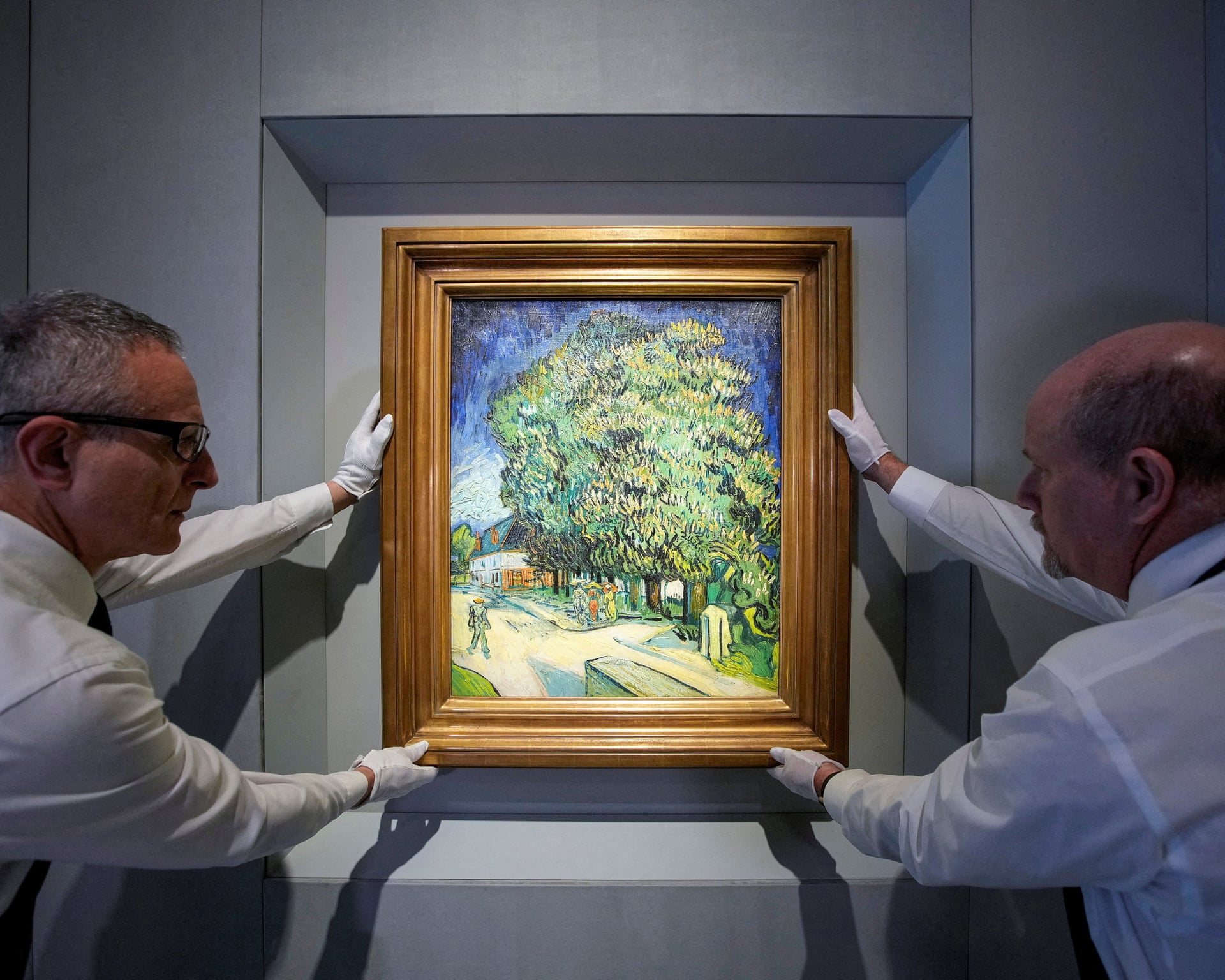
The 1890 Painting, Created in Auvers-sur-Oise During the Artist’s Final Months
The 1890 painting, created in Auvers-sur-Oise during the artist’s final months, surpassed the previous auction benchmark of $117.2...

Netflix Transforms Toronto’s Sherway Gardens Into ‘Win the Mall’ Production Set
Netflix transformed a vacant wing of Toronto's Sherway Gardens into a 400,000-square-foot production set for its upcoming reality...