A Wearable Shield Against Amputation
“If you have any inclination to be an inventor or start a start-up, take the IBL course.” That’s the advice from Christopher Tuckerman, one of the students to enroll in South Dakota Mines’ Innovation-Based Learning program. Along with fellow students Drake Van Steenwyk and Logan Merriam, Tuckerman didn’t just study engineering; he’s trying to invent a solution to a medical problem. They took their first step toward a medical breakthrough when they enrolled in Mines’ first IBL course in the spring of 2026.
These three students are developing a wearable device to help prevent amputations for people with peripheral artery disease, a condition affecting more than 21 million Americans and leading to approximately 150,000 amputations every year. The project isn’t a theoretical classroom exercise; it’s a startup, Re-Flux Medical LLC, with a prototype and plans to showcase it at business competitions from South Dakota to Florida.
Students Meet in a Boardroom
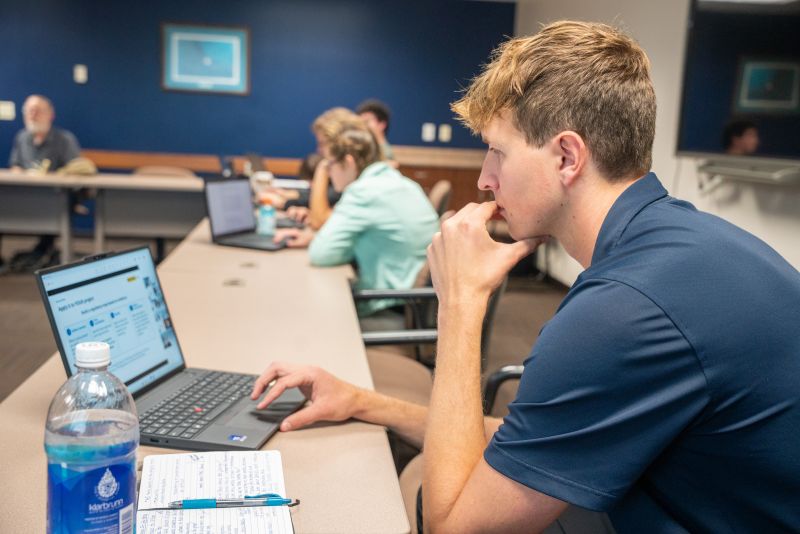
IBL courses at South Dakota Mines are a departure from the traditional lecture hall or lab. Students meet in a boardroom for a discussion-based environment where they’re treated as colleagues, not just pupils. “It’s much more discussion-based,” said Mitchell Sueker, Ph.D., assistant research professor in Mines’ Innovation-Based Learning Hub. “We treat students like colleagues and emerging professionals, rather than simply engineering students. This encourages them to confidently share their ideas while preparing them for the expectations of industry.”
The course structure pushes students to find real, unsolved problems. Teams observe an industry, define a problem, and then confront a critical question: is this a meaningful issue that isn’t being adequately addressed? This focus on viability is a core part of the curriculum. Throughout the process, teams grapple with the business side of innovation, discussing product viability, industry standards, funding, and patents.
Courses Solve Known Problems
Laura Brunmaier, Ph.D., an assistant research professor who facilitated the pilot course, describes IBL as “an entrepreneurial crash course for scientists and engineers.” The goal isn’t to make a product for its own sake, but to solve a known problem. The first team tackled the critical issue of PAD amputations, which they discovered often stem not from a lack of medical intervention, but from a lack of blood flow monitoring.
Their solution is the Re-Flux EIT (Electrical Impedance Tomography), a wearable band designed to “close the monitoring gap.” The EIT itself is currently fully simulated in silico, with hundreds of simulated trials run daily to optimize the technology for its benchtop testing phase,
said Van Steenwyk, a biomedical engineering grad student.
From Theory to Tangible Impact
Other IBL teams at South Dakota Mines are developing a “smart” intravenous pump and improving the portable shelters used by wildland firefighters to survive burn-over threats. This real-world focus is a cornerstone of the university’s mission to prepare students to be leaders in science, technology, engineering, and math (STEM).
Sueker emphasizes that the lessons learned in IBL are about more than just technical skills. We’re working with diverse sets of thinking and diverse skill sets,
he said. It teaches them to work with other people, solve problems, and then resolve any conflicts that are inevitably going to arise.
The program lets students make mistakes in a safe space. They learn from failure in a safe space before getting into industry, where failure could have larger consequences,
Sueker explained.
For students like Van Steenwyk, the experience is transformative. IBL gave me a challenge where I could set the bar … and create meaningful change, not just in my schooling but also in my professional portfolio,
he said. And because I am a biomedical device specialist, my devices have immediate, real-world impact that I can feel proud of.
The Path Forward
Re-Flux Medical will exhibit its prototype at business plan competitions and inventor expos in the coming months, and the IBL program is now open to all Mines students.
Worth a look
SEIU Emerges as Rhode Island’s Most Powerful Union After Election Sweep
There’s a new sheriff in town in Rhode Island labor politics, and his name isn’t a union at...

Columbus company Pursuit made Amy Acton’s victory speech suit
Ohio Gov.-elect Amy Acton wore a white suit from a Columbus-based company for her victory speech. The suit...

Millbrook Townhomes Offer Smart Living in Salem Utah
Millbrook Townhomes Hit Salem Market as Viridian Community Expands D.R. Horton has unveiled the Millbrook, a new two-story...

North Dakota farmer Ralph Steenson died in 2002 plane crash
A North Dakota Farmer's Final Flight "He had a great zest for life," Brenda Steenson said of her...