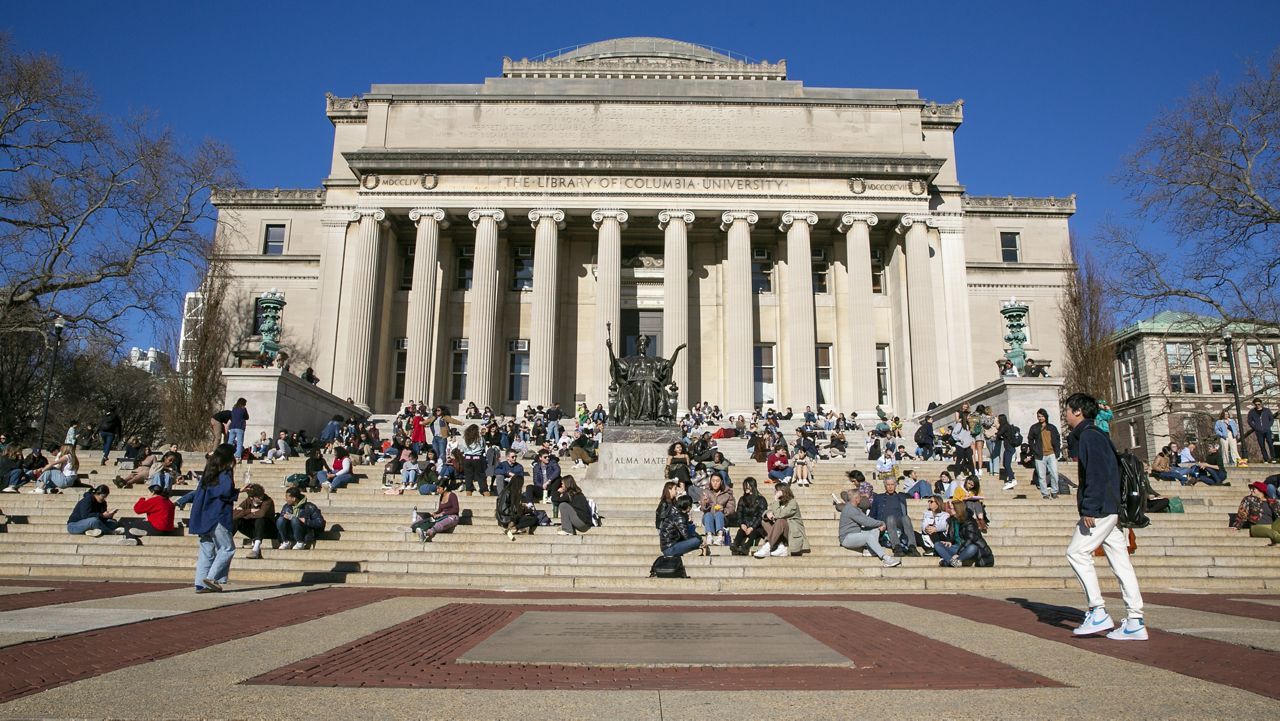
“They’re being deprived of a life here in New York City, which is what they came for,” Lenna Nepomnyaschy said outside Columbia University’s locked gates.
“They didn’t go to Wisconsin. They came to New York City because this is what they wanted.”
The remark captured the mood at a tense community meeting where students and Morningside Heights residents confronted university officials over the continued lockdown of College Walk, the historic pedestrian spine connecting Broadway and Amsterdam Avenue at West 116th Street.
The pathway has required ID checks at a side entrance since the Gaza war protests last spring, a restriction that survived a court test last week when a judge ruled the public holds no right to cross the campus thoroughfare. Residents filed an appeal Tuesday.
Loftin Flowers, of Columbia University, acknowledged the friction. “I think we all look forward to that committee being able to make a series of concrete recommendations in short order about how we can become more open,” Flowers said at the session.
The ruling and the appeal have turned a security protocol into a referendum on the porous boundary between an elite private institution and the dense neighborhood that surrounds it. For decades, College Walk functioned as a de facto public street — a shortcut for commuters, a dog-walking route for locals, and a symbolic front porch for the university. The shift to badge access shattered that norm.
“Columbia is successful when Morningside Heights is successful and when the relationship between the neighborhood and the university is good.”
Eli Northrup, State Assembly Member-elect, said
Northrup’s district covers the area. He argued the lockdown undermines the mutual dependence that has defined the neighborhood for a century. Local businesses rely on foot traffic from the campus; the university relies on the neighborhood’s housing, restaurants, and transit to attract students and faculty. Severing the most direct pedestrian link frays both sides.
Students at the meeting drew a distinction between building security and campus permeability. “I do think that the buildings inside should probably still be badge access, but that’s it,” one student said.
The sentiment reflects a broader unease: dormitories and libraries can lock down without sealing the quad itself. Alumni echoed the point. “I used to be a student here, and they were always open. It was super convenient,” a former student said outside the school.
Columbia has maintained that the restrictions were a necessary response to encampments and building occupations that disrupted operations and raised safety concerns. The administration has pointed to the favorable court decision as validation of its property rights. Yet Flowers’ promise of a committee review suggests the university recognizes the reputational cost of a permanently gated campus.

The appeal, filed Tuesday in state court, argues that decades of uninterrupted public use created an implied dedication of the path as a public thoroughfare.
Legal observers note the case hinges on whether College Walk’s history meets the high bar for a prescriptive easement in New York — a standard that requires proof of open, notorious, and continuous use for at least ten years under a claim of right. The university counters that permissive use, granted by a private landowner, never ripens into a public right regardless of duration.
Founded in 1754 as King’s College by royal charter of George II, Columbia University is the oldest institution of higher learning in New York and the fifth oldest in the United States.
It was renamed Columbia College in 1784 after the American Revolution and moved to its current Morningside Heights campus in 1896, becoming Columbia University. The university was the first school in the United States to grant the MD degree and administers the Pulitzer Prize annually.
For now, the side entrance remains the only way through. The committee Flowers referenced has no public deadline. Northrup said he would press for legislative remedies if the university does not move voluntarily. “This isn’t just about a walkway,” Nepomnyaschy said. “It’s about whether this place belongs to the city or just to the endowment.”
Related reading
Burlington Diocese Urges Families to Ask Youth Where God Is Calling Them
“Speak, Lord, for your servant is listening,” the boy Samuel answered in the night, and the ancient text...

North Little Rock Parks Staffer Creates Free-Book Nook for Kids at Community Center
North Little Rock Parks and Recreation staffer Rachel Collins has turned a corner of the department’s office at...

VA Signs First Wyoming NADL Agreements With Wind River Tribes
The Department of Veterans Affairs (VA) Native American Direct Loan (NADL) program recently signed the first NADL Memoranda...

NDOT Begins Pilot Installing Retractable Bollards on Broadway
Nashville began threading steel barriers into Lower Broadway on Thursday, a physical answer to a crash that killed...