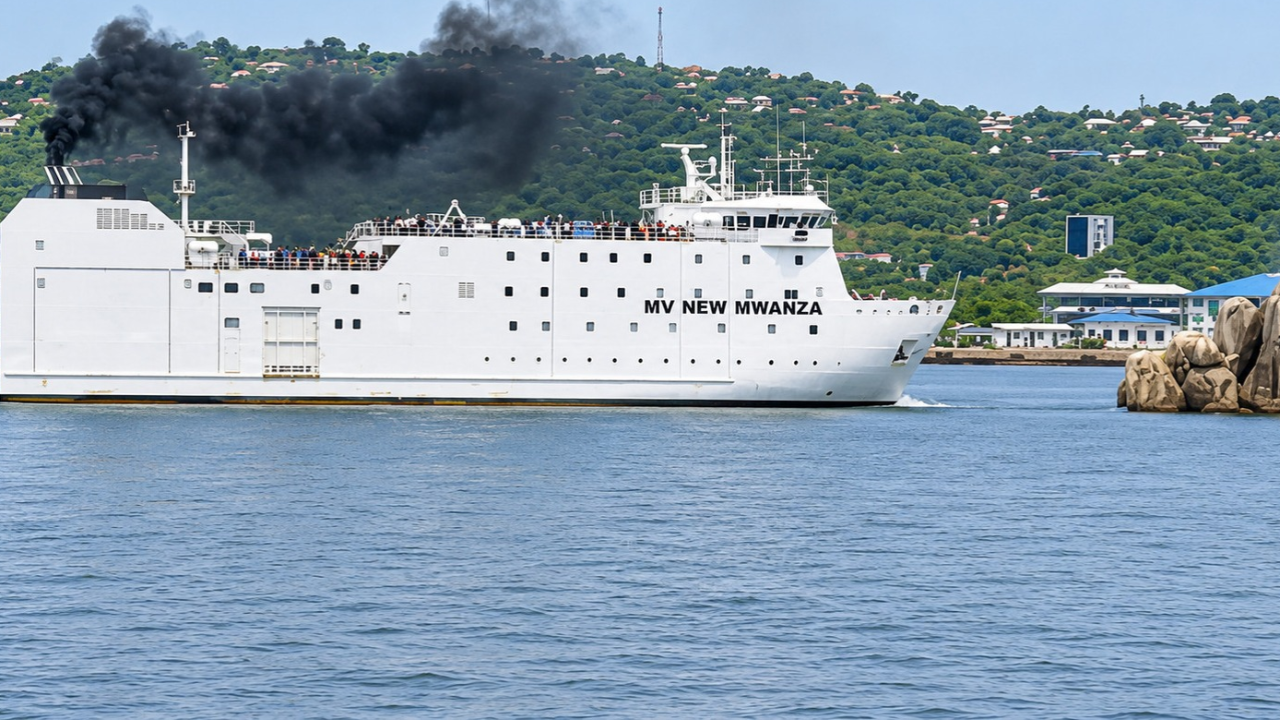
Tanzania’s newest flagship ferry, the MV New Mwanza, struck Bismarck Rock on Lake Victoria Wednesday morning during technical trials, prompting the government to launch a 14-day investigation into the collision.
The impact occurred around 10 a.m. on November 18 near the Kamanga area of Mwanza, as the vessel maneuvered to avoid an oncoming passenger ferry from Sengerema. Witnesses described a loud bang and thick black smoke billowing from the ship’s funnels, though Regional Commissioner Salum Hamduni characterized the event as a minor accident and confirmed no injuries or deaths.
“I would like to assure you that, so far, according to the experts’ examination, our ship is safe,” Hamduni told journalists, adding that the investigation team — drawing from the Ministry of Transport, defence and security organs, and other state authorities — must establish the exact cause and extent of damage within two weeks.
The MV Mwanza passenger vessel struck a rock on Lake Victoria at around 10.30am on Wednesday while transporting stakeholders from the transport sector on a tour of the lake.https://t.co/TRaQgIfSmG pic.twitter.com/0NCDtKXTag
“The ship was about to hit a passenger ferry coming from Sengerema. The person operating the ferry reversed, and that was when the MV Mwanza hit a rock. Had he not reacted quickly and reversed, the MV Mwanza would have hit two rocks, causing them to fall.”
said Bakari Mwigela, a witness who spoke to People Daily Digital.
A flagship vessel on the eve of service
The MV New Mwanza represents a massive investment in Lake Victoria’s transport infrastructure. Built by Korean contractors Gas Entec Ship-Building Engineering and Kang Nam Corporation alongside Suma JKT, the vessel was commissioned in January 2026 at a reported cost of Sh120.56 billion (approximately $46 million). Prime Minister Mwigulu Nchemba presided over the launch.

Designed as a roll-on/roll-off passenger ferry, the ship stretches nearly 60 meters with a 14.6-meter beam, featuring two vehicle and cargo decks plus an enclosed passenger lounge. It is rated to carry 1,200 passengers, 400 tonnes of cargo, and more than 20 vehicles, slashing the Mwanza–Bukoba journey to six or seven hours from the current eight to ten.
Wednesday’s trials came after an extended period in dry dock. The vessel was carrying Ministry of Transport experts and Tanzania Shipping Agencies Corporation (TASHICO) staff — attendees of the 19th Joint Transport Sector Review Meeting — rather than fare-paying passengers, Hamduni confirmed.
Shadow of past disasters
The collision immediately evoked memories of Lake Victoria’s deadliest maritime tragedies. In September 2018, at least 227 people died when a ferry capsized on the lake. The 1996 sinking of the MV Bukoba claimed around 800 lives en route to Mwanza. Overloading has frequently been blamed for such disasters.
Wednesday’s incident involved no capsizing and, critically, no passengers. But the dramatic footage circulating on social media — showing a massive white hull grinding against the iconic rock formation — has shaken public confidence in the lake’s newest and most expensive vessel before it has even begun commercial operations.
Competing narratives on the cause
While witnesses point to an evasive maneuver, the official cause remains undetermined. Hamduni declined to comment on the captain’s actions or the sequence of events, insisting such questions require the investigation team’s expertise. “Residents should wait for the investigation team’s report,” he said, dismissing unofficial online accounts as improper sources.

Tuko.co.ke reported the vessel was constructed locally by Songoro Marine Transport, a detail not mentioned in the primary government account, which credited the Korean consortium. The discrepancy highlights the layered contracting structure behind the project.
Fourteen days for answers
The investigation team has until early December to deliver its findings. Until then, the MV New Mwanza — Africa’s largest freshwater passenger ship — sits idle, its maiden commercial voyage on hold, while the region watches and waits for an explanation of how a brand-new, state-of-the-art vessel came to grief on a rock that has been a known navigational landmark for generations.
Keep reading
Undue Hardship and the Problem of Hypothetical Costs After Groff v. DeJoy
The Supreme Court's decision in Groff v. DeJoy rewrote the standard for religious accommodations in the workplace, but...

Gallatin Upends Billings West 17-3 to Reach First State Title Game
Gallatin High School punched its ticket to the program's first state championship game Friday night, shutting down Billings...
NetChoice Sues Indiana Over Age-Verification Law in Federal Court Nov 18
Indiana required every user of major social platforms to prove their age and state residency before opening or...

Greater Pittsburgh Workforce Summit Addresses Shrinking Labor Pool, 97% Replacement Openings
Joshua Counselman told the Greater Pittsburgh Workforce Summit that 97 percent of future job openings will come from...