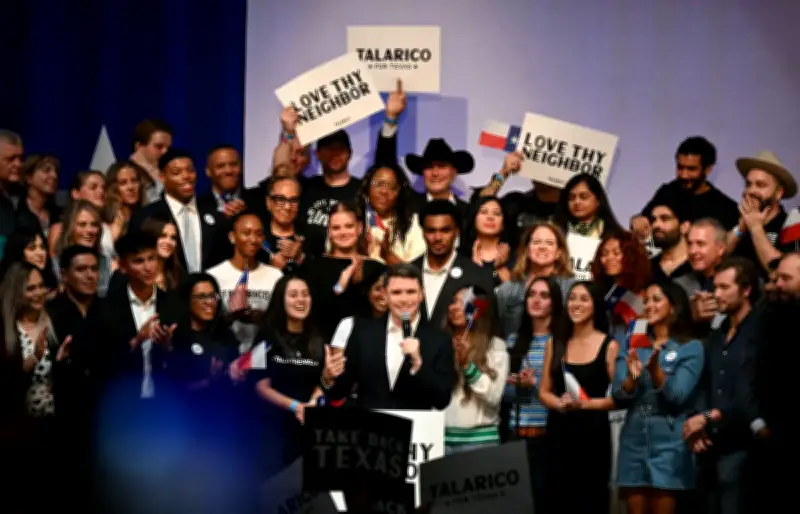
James Talarico beat Texas attorney general Ken Paxton to become the state’s first elected Democratic US senator in nearly 30 years.
Gina Hinojosa is poised to become Texas’s first-ever Latina governor and its first Democratic governor since 1995. Democrats also flipped 20 state House seats, three seats on the state Board of Education, all four Texas supreme court seats and all three Texas court of criminal appeals seats up for election.
For organizers who’ve spent over a decade trying and failing to mobilize voters against an increasingly hostile Republican-led government, “Blexas” felt firmly in pipe-dream territory.
“Who knew that winning was such hard work?” former state Sen. Wendy Davis said at the Austin watch party. Davis, who filibustered a 20-week abortion ban in 2013 and lost the 2014 governor’s race to Greg Abbott by more than 20 points, has spent the intervening years building Blueprint Texas to fund down-ballot races.
“A lot of us have not known a world where that was possible,” said Aimee Prudhomme, 39, executive director of Powered by People. “We kept trying to fight for it and then kept having our hearts broken, time and time again in this state.”
The revolt that rebuilt the party
The turnaround began with a mutiny. After Beto O’Rourke fell 215,000 votes short of Ted Cruz in 2018 and the Texas Democratic Party failed to lift down-ballot candidates in 2020, dozens of executive committee members demanded Chair Gilberto Hinojosa — father of the governor-elect — overhaul the operation.
Kendall Scudder, a former state Senate candidate from rural East Texas, led the push. When Democrats came up short again in 2024 — Beto O’Rourke lost to Cruz by over 8 points even with George Soros-backed Texas Majority PAC support — Hinojosa resigned. Scudder won the chair.
“We became this corporate party for defending institutions, and I’m sorry, defending institutions is not standing for something,” Scudder told the Guardian. “So if those institutions are gonna burn to the ground, let’s not try to rebuild them the way they were — let’s build them the way they should be built.”

Scudder moved the party headquarters from Austin to Dallas while keeping a capital office and opening satellites in Amarillo, Eagle Pass and Houston. He overhauled the approved vendor list — previously dominated by old-guard operatives — through a transparent RFP process that resulted in every vendor being owned by at least one person of color.
Texas Together: a $30 million coordinated campaign
The 2024 loss forced a reckoning between the state party and Texas Majority PAC. “It was sort of like a slap in the face,” said Katherine Fischer, TMP’s executive director and a veteran of both O’Rourke campaigns. The loss “pushed us in Texas to run a bunch of experiments, test new ways of talking to voters, that produced a lot of innovative techniques.”
Out of that friction came Texas Together, a $30 million coordinated effort linking the Texas Democratic Party, Texas Majority PAC and Powered by People. The state party focused on internal growth and candidate recruitment. TMP handled voter research, fundraising and paid virtual civics classes connecting policy to grocery bills. Powered by People mobilized voters aged 18–29 who resist partisan labels. Together they deployed more than 30,000 volunteers.
“We agreed as different entities, different bodies, that we all had the same goal,” Prudhomme said. “Working with these groups, it’s very apparent what’s possible when we can truly coordinate together.” Scudder added: “We knew we were going to be out-raised and out-spent, so how do we get as efficient as possible?”
Actually putting Democrats on the ballot
For the first time, Democrats contested every state and federal race. With Davis, O’Rourke and other surrogates, the coordinated campaign held 40 recruitment rallies, interviewed 1,385 candidates in target districts and recruited 104 candidates for 2026. Ninety percent were first-time office seekers. In 2024, Republicans had won five U.S. House seats and 22 state House seats unopposed. This year, at least 29 Democrats won state House seats, many toppling incumbents.
Stefanie Bord, a former science teacher and Moms Demand Action volunteer, ran for a Houston-area state House district no Democrat had contested since 2020. When the Abbott campaign sent AI-generated mailers claiming she “failed to support” his affordability plan, she fired back: “Just in case everybody doesn’t know it, I am not an elected official — I am a mom!” She won by 290 votes.
In Tarrant County, where Democrats flipped three state House seats, Powered by People voters comprised over a third of the winning margin. In Brazos County, Janet Dudding unseated a Republican incumbent by 309 votes; 1,438 voters in the network cast ballots. “I believe that James and Gina wouldn’t have won as resoundingly as they did [nor] flip Tarrant county as decisively as we did” without these down-ballot races, Davis said.
Broadening the message without abandoning principles
The strategy shift showed up in messaging. In a North Fort Worth district Taylor Rehmet flipped last year, Texas Majority PAC opened targeting to every primary voter regardless of past preference and surveyed them on what would move their vote — rather than trying to persuade them outright. Paid virtual civics classes proved 10 times more effective at turnout than phone banking or mail, Fischer said.
Hinojosa campaigned on ending state interference in local schools rather than framing it as a book-ban fight. Talarico ran on ending government corruption and state overreach in private health decisions. The populist economic message met voters’ exhaustion.
“I was helping [voters] connect the dots, and man, they were connecting the dots with us, or for us, too,” said David Villalobos, statewide political director of Texas Organizing Project.
The Texas Democratic Party, founded before statehood and dominant for more than a century, had not won a single statewide race since 1994 — a 32-year drought that was the longest in the nation. The party’s resurgence in 2026 swept every statewide office, flipped the Texas House and sent a Democrat to the U.S. Senate for the first time in 38 years.
Scudder, who entered politics defending his lesbian parents against Republican attacks, argued the lens must widen. “Sometimes in our efforts to be inclusive, we have put people in boxes. Yes, suicide rates are through the roof in trans and LGBT communities. And a lot of that ties into things like being unhoused; a lot of that ties into economics, right?”
Scudder said. “If we can focus on these things we all have in common, we can not allow communities to bear the brunt of a lot of these attacks, but face it together.”
Related reading
- DOJ Drops Alaska Senate Election Lawsuit, Cites Mixed Ballots
- Salt Lake City Arts Council Announces First Fleet Block Artwork: Kenseth Armstead’s 20-Foot “2 Gather” Sculpture
- Mass. Maritime Assistant Football Coach Charged With Child Sexual Exploitation, Posing as Teen to Target Minors (world-today-news.com)

DOJ Drops Alaska Senate Election Lawsuit, Cites Mixed Ballots
The Justice Department dropped its lawsuit challenging Alaska’s U.S. Senate election on Thursday, conceding the case is moot...

Salt Lake City Arts Council Announces First Fleet Block Artwork: Kenseth Armstead’s 20-Foot “2 Gather” Sculpture
Salt Lake City has commissioned the first permanent artwork for the Fleet Block redevelopment, a 20-foot sculpture titled...

Columbia Falls Residents Oppose Short-Term Rental Permit Fee Jump to $250
Columbia Falls residents pushed back hard Monday against a proposed short-term rental permit renewal fee that would jump...

CNBC: Apparel Prices Hit Record Highs as Shoppers Reject Synthetics
"If it's not a natural material, a retailer brand who passes it off as it is, they're really...