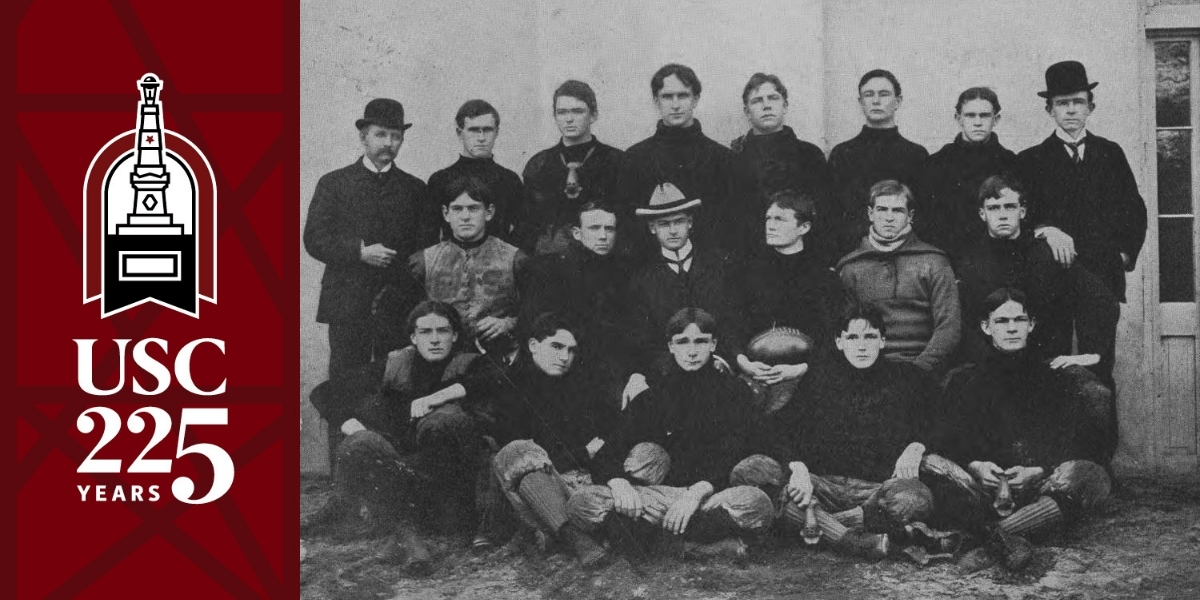
Long before the roar of “Sandstorm” filled the air at Williams-Brice Stadium, the University of South Carolina’s football origins were defined by anonymity, a lack of coaching, and a desperate scramble for players. In the late 19th century, the team—known then as the “College Boys”—operated without official university sanction, often paying their own way to games and playing under assumed names to avoid parental disapproval.
This early struggle, as detailed in a retrospective based on historian Daniel Walker Hollis’s 1956 work The University of South Carolina, Volume II: College to University, reveals a stark contrast between today’s multi-million dollar NIL era and a time when the university president viewed competitive athletics as a distraction from egalitarian education.
South Carolina loses first football game to Furman
The University of South Carolina’s first intercollegiate football game didn’t take place in a stadium, but at a baseball park in Charleston on Christmas Eve, 1892. The team was so disorganized they were dubbed the “College Boys” by the News and Courier, largely because they lacked both a formal name and a coach. To even field a full squad, the university had to recruit two nonstudents.
The game was a disaster. The College Boys paid their own train fare to reach the city, only to surrender 44 unanswered points to Furman, who were referred to as the “Mountain Boys.” While South Carolina struggled, Furman benefited from a level of leadership the Gamecocks lacked: a professor named H.P. Young, who served as both the coach and the quarterback, ensuring signals were never crossed.

The risk of playing was not just athletic, but social. One student-athlete, Singleton Green, played under an assumed name because his father was strictly opposed to the sport. It was a period where the university’s own magazine, Carolinian, lamented that few colleges in the state took as little interest in athletics as South Carolina.
President Woodrow and the war on “laurels”
The lack of success wasn’t just a matter of talent; it was a matter of policy. For years, the university trustees refused to sanction any sporting events played outside of Columbia, effectively banning official travel. This wasn’t an oversight—it was a philosophical stance.
President James Woodrow believed sports should be for all students through intramurals, rather than the “training of picked groups.” In the minutes of a November 16, 1892 meeting, Woodrow explicitly told trustees that athletics should not be about “crews” or “nines” who shall wander over the country seeking “laurels or gate money.”
“all of the students, and not the training of picked groups — ‘crews’ or ‘nines’ — who shall wander over the country seeking to gain laurels or gate money.”
In today’s landscape of Name, Image, and Likeness (NIL) deals, where athletes are essentially professional entities within a collegiate framework, Woodrow’s aversion to “gate money” represents a complete inversion of the modern collegiate model. The stakes then were about the purity of the student experience; today, they are about institutional competitiveness and economic viability.
The birth of the “gaudiest spectacle”
The tide began to turn in 1895 when vocal faculty members finally convinced the trustees to allow student-athletes to travel. Baseball led the way, with the “Carolina Nine” traveling to Greenville in 1896 to beat Furman. Even then, the cultural impact was visible; reports in the Carolinian noted that a group of girls from Converse College attended the game wearing garnet and black, signaling the start of a dedicated fan base.
Football finally found its footing in the fall of 1896 with the arrival of W.H. “Dixie” Whaley, a former star from the University of Virginia. Whaley provided the strategic leadership the program had lacked. Under his guidance, South Carolina faced a newly formed Clemson team at the Elmwood fairgrounds.
Two thousand fans paid 25 cents each to watch South Carolina win 12-6. Historian Daniel Walker Hollis described the event as “the gaudiest spectacle in South Carolina,” marking the official birth of a rivalry in college sports.
From municipal funding to modern monuments
The evolution of the program’s infrastructure mirrors its rise in status. Long before the modern era of luxury boxes, the earliest version of Williams-Brice Stadium was constructed in 1934. Funded by the federal Works Project Administration, it was originally known as Columbia Municipal Stadium, reflecting a time when stadium construction was a tool for civic employment and public works rather than a private revenue engine.
The journey from a nameless group of students paying their own train fare to a global brand illustrates the broader shift in American higher education. What began as a feared “distraction” by university leadership became the primary vehicle for institutional visibility and alumni engagement.
Keep reading

Wyoming weighs wildlife trust fund to boost conservation funding
Wyoming is weighing a proposal to create a wildlife trust fund that could inject roughly $20 million annually...

Madison Communities launches luxury senior housing platform
Madison Communities, a Charlotte-based multifamily developer, is launching a new platform dedicated to luxury senior housing and age-restricted...
Disney+ details bundle tiers and costs for Hulu and HBO Max access
Access to the game is integrated into the Disney+ interface for those utilizing the bundled service offerings with...

US Government Holds Equity Stakes in Approximately 40 Companies
The United States government has quietly evolved into a significant shareholder in dozens of private companies, creating a...