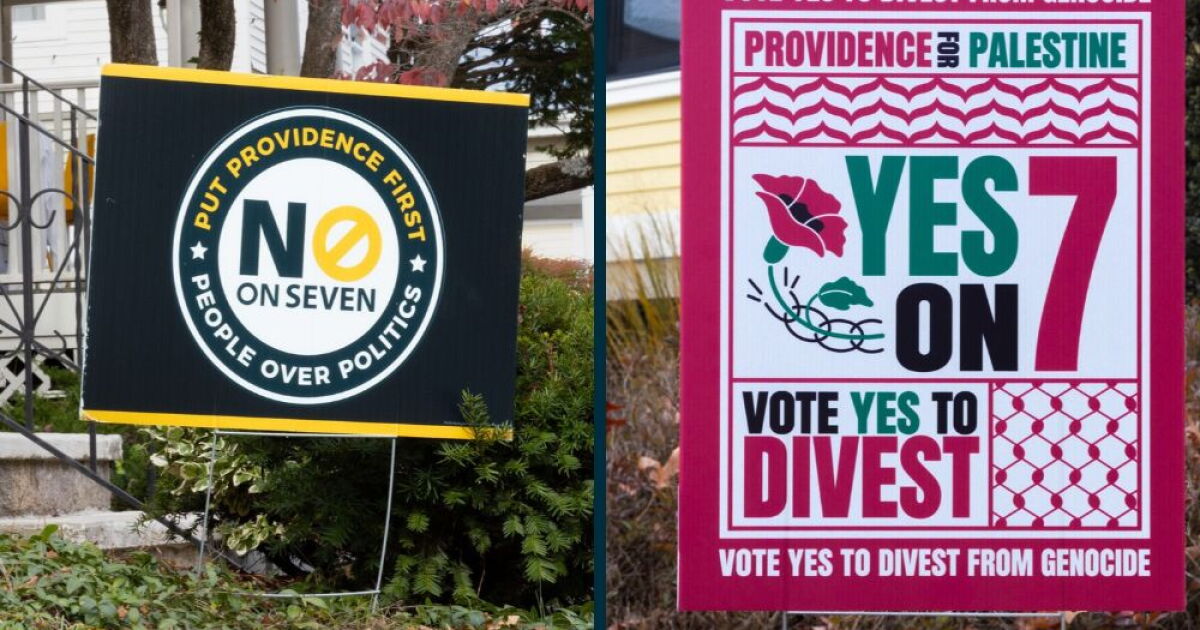
Providence voters will decide this Tuesday whether the city should pull its investments from companies and countries profiting from genocide, apartheid, ethnic cleansing, and prolonged military occupation. If the binding initiative, known as Question 7, passes, Providence would become the largest city in the country to divest and the first to do so directly by popular vote, according to Zack Kligler of Providence for Palestine.
The stakes extend far beyond a simple ballot box. This vote is a collision of municipal finance, international human rights law, and a deepening ideological rift within the city’s leadership. While the measure does not name Israel explicitly, its proponents and opponents agree that the Israeli government and companies doing business with it are the primary targets.
The battle over a $700 million pension fund
At the heart of the dispute is the city’s $700 million pension fund. Currently, the city rarely picks individual stocks, preferring index funds and diversified portfolios. Question 7 would require the city to divest from direct investments in “complicit” companies and officially pressure fund managers to adopt similar restrictions. The city treasurer would then be tasked with reviewing the portfolio annually to ensure compliance.
Mayor Brett Smiley, a convert to Judaism and a staunch supporter of Israel, argues the measure is a financial landmine. He contends that the broad language of the ordinance would force the city to dump shares in American blue-chip giants like Apple, Microsoft, Google, and Caterpillar simply because they do business with Israel.
Smiley warns that the move isn’t just a financial risk but a legal one. He believes the initiative violates the city charter and state law, predicting that the only tangible result for taxpayers will be a massive bill for legal services to defend a doomed policy.
A generational shift in civic values
On the other side of the divide is State Rep. David Morales, who defeated Smiley in the September Democratic primary. For Morales and a new wave of elected officials, the budget is a moral document. He argues that taxpayer dollars should reflect the city’s values, regardless of the legal hurdles that might follow.
Morales represents a growing political movement that seeks to decouple Jewish identity from the actions of the Israeli government. He maintains that opposing the regime of Benjamin Netanyahu is not the same as attacking the Jewish community.
“We have that responsibility as elected officials, across all levels of government, to have layers of moral clarity, but to also be absolutely clear that the atrocities and the genocide happening in Gaza in no way, shape, or form ever justify any form of antisemitism,” Morales said.
This distinction is rejected by critics like Maria Friedman, executive director of the Rhode Island Coalition for Israel. Friedman views the initiative as a transparent attempt to target Israel and, by extension, the Jewish people. She argues that Providence should focus its resources on essential services like snow removal and trash pickup rather than engaging in international political disputes.
Rhode Island law creates murky legal zone
The most pressing question for the city’s lawyers is whether Question 7 clashes with Rhode Island law. In 2016, state lawmakers passed H-7736, a law designed to counter the Boycott, Divestment, and Sanctions (BDS) movement. However, the application of this law to a city’s internal investment strategy is murky.
Jared Goldstein, a constitutional law professor at Roger Williams University School of Law, notes that while the law prevents the state from contracting with private parties that boycott Israel, it doesn’t explicitly mandate that a city must invest in companies doing business with Israel. Similarly, Steven Brown, executive director of the ACLU of Rhode Island, stated he sees no direct conflict between the proposed measure and the existing state law.
The tension here is a mirror of a global trend. The push for divestment in Providence follows a September 2025 finding by an independent United Nations commission that concluded Israel has committed genocide in Gaza—a charge Israel strongly rejects. Supporters of Question 7, including Zack Kligler of Providence for Palestine, see this as a local application of the strategy that eventually pressured South Africa to end Apartheid in the 1990s.
Providence vote could provide blueprint for other cities
If Question 7 passes, the impact will be felt well beyond the borders of Providence. For activists, it provides a blueprint for other American cities to bypass their political establishments and use the ballot box to dictate foreign policy through finance. For the Rhode Island Coalition for Israel, it is a dangerous precedent that could trigger a domino effect across the country.
The immediate future remains uncertain. Even if the voters say yes on November 3, the city faces a likely barrage of lawsuits from groups like the Rhode Island Coalition for Israel. The question then becomes whether a municipal government can legally prioritize moral boundaries over traditional fiduciary duties to its pension holders.
Polls close Tuesday, Nov. 3, at 8 p.m. The result will determine if Providence becomes a pioneer in civic divestment or a cautionary tale in municipal litigation.
Keep reading

Disney+ details bundle tiers and costs for Hulu and HBO Max access
Access to the game is integrated into the Disney+ interface for those utilizing the bundled service offerings with...

US Government Holds Equity Stakes in Approximately 40 Companies
The United States government has quietly evolved into a significant shareholder in dozens of private companies, creating a...
Henrico and Richmond police investigate vote poster vandalism
Small business owners in Central Virginia are facing unexpected cleanup costs after large, adhesive "vote" posters were glued...

VT Leaders Discuss How Election Results Could Shape State Agenda
Vermont's political trajectory depends on whether the state maintains a divided government or shifts toward a unified Democratic-Progressive...