
Voters approved the incorporation of Hartline by a margin of just three votes on February 2, 1907, according to HistoryLink.org.
The slim victory, consisting of 32 votes in favor and 29 opposed, set the stage for the town’s formal recognition. Articles of incorporation were subsequently filed with the Secretary of State in Olympia on March 6, 1907.
Though the town covers only a third of a square mile in Grant County, it drives much of the regional economy. Hartline functions as an agricultural hub, specifically serving as a site for wheat production, storage, and transport.
The community’s origins are tied to the expansion of the railroad during the late 1880s. As the Great Northern, Northern Pacific, and Chicago, Milwaukee and St. Paul railroads laid tracks across the region, small towns like Parnell—the community that would later become Hartline—emerged near planned railroad sidings.
Before the turn of the century, the landscape of Grant County was characterized by desert, cattle, and grass. Lieutenant Thomas Symons, a surveyor who traveled through the Big Bend Desert in 1879 and 1880, described the area as “a desert, pure and simple and can be dismissed in a few words,” according to HistoryLink.org.
Early Native American tribes, including the interior Salish, Wenatchi, and Okanogan, primarily lived along the Columbia River. “All of the early Indian trails and army wagon roads by-passed the desert section, for there were no watering places,” historian Faye Morris said.
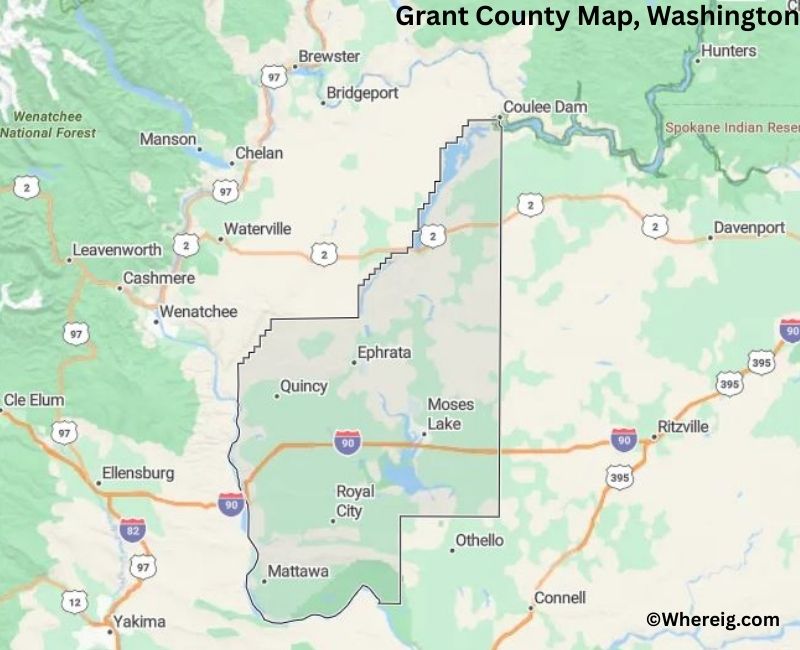
The transition toward a settled agricultural region began in the mid-1800s with livestock farming. By 1880, the first town, McEntee’s Crossing, was established to provide passage across the Grand Coulee.
The formal creation of Grant County was also a product of political maneuvering. A. I. Rogers, a resident of Douglas County with political influence, reportedly used a red pencil to draw a line that would split the county. This division ensured that high-quality farmland remained in the original Douglas County, while the lighter soil lands to the south were moved into the new jurisdiction.
This new jurisdiction, named after President Ulysses S. Grant, was officially established in 1909. Hartline had already begun establishing its footprint nearly two decades before this county division was finalized.
Agricultural growth in the region faced a major setback following World War I due to a combination of severe drought and economic depression. Many farmers were forced to abandon their livelihoods until the establishment of the Columbia Basin Commission in 1933.
The subsequent Columbia Basin Project, which began in 1935, transformed the semi-arid climate into a productive agricultural zone. The completion of the Grand Coulee Dam in 1942 and the arrival of irrigation water a decade later allowed the region to thrive.
By the time the third phase of the project concluded in 1975, 700,000 acres of land had been irrigated. This infrastructure enabled the rise of food processing plants and steady population growth in the county.
Today, the local economy relies heavily on the agricultural sector, including production, trucking, food warehousing, and processing. Hartline continues to support this cycle through its grain containers used for crop storage.
The town’s history is also marked by the legacy of specific families, such as the Schrocks, Harrises, and Poes, who maintained a presence through generations of farming. The area was also home to M. Dale Kinkade, a scholar who specialized in the Salishan languages of the Pacific Northwest.
The first post office in the area opened on July 28, 1890.
Keep reading
Pinedale Home Prices Rise as Mayor Tracks Loss of Public Workers
Pinedale home prices have climbed by roughly $200,000 in recent years as the Wyoming town struggles to balance...

Milwaukee Residents Weigh in on New Midtown Center Branch Library Design
Milwaukee Public Library officials and architects met with community members on Tuesday to discuss the future of the...
Richmond Marathon Will Cause Rolling Road Closures This Saturday
Sold-out crowds of runners will traverse Richmond on Saturday morning for the annual Richmond Marathon, its companion half-marathon,...
Utah Democrats See Shift in House as GOP Supermajority Ends
“Tuesday was a very clear message on where Americans are when it comes to the way people have...