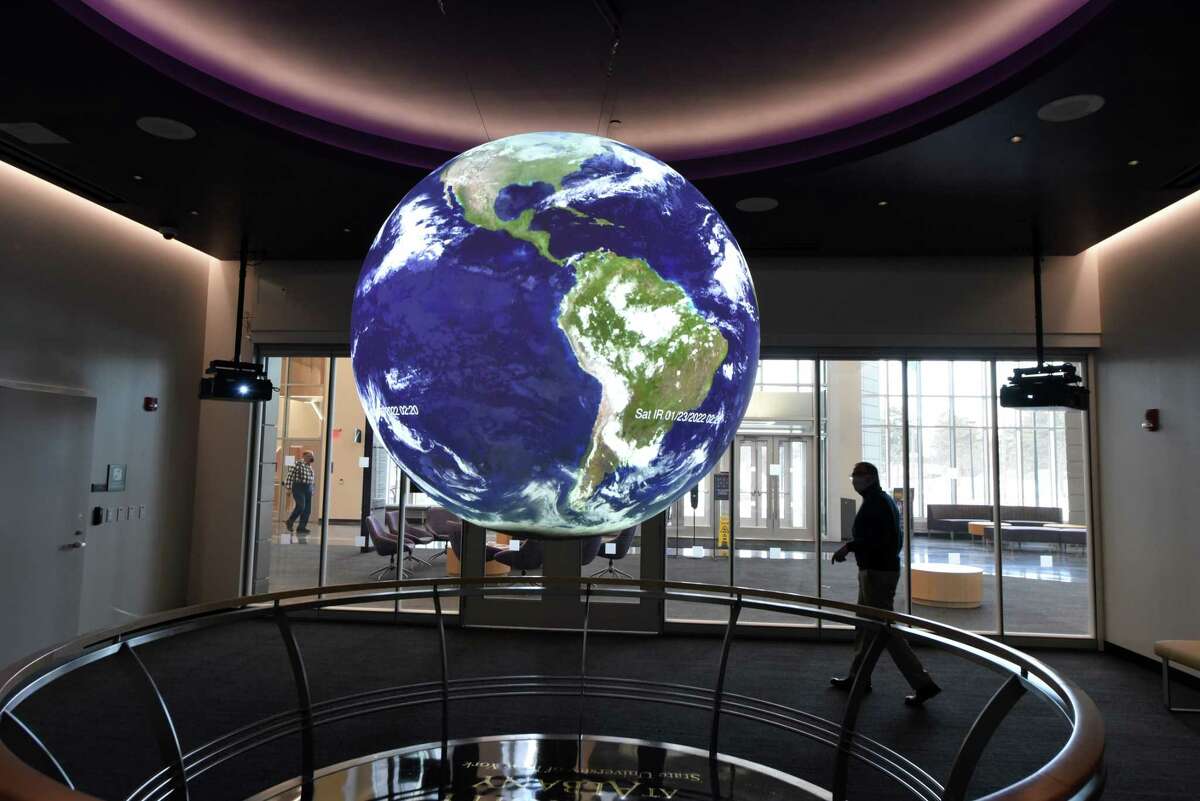
University at Albany senior Matt Case spent the past year converting a fourth-floor classroom in the ETEC research complex into a broadcast weather studio, the university reported.
The weather and climate media lab opened last month with a teleprompter, graphics computer, switcher, green screen and weather desk. Case delivered the first campus forecast from the space in October and plans to publish new forecasts every Monday, Wednesday and Friday through the spring semester.
“Having a digital presence is so important in this field, whether you want to be on TV or just help people better understand the weather,” Case said. “Now we have a space here at UAlbany where we can take the advanced science we learn in class, break it down and share it with the public. That’s a huge deal.”
The Department of Atmospheric and Environmental Sciences, based at ETEC, houses the New York State Mesonet, the State Weather Risk Communication Center and the National Weather Service’s Albany forecast office. Until now, it lacked a dedicated studio for students pursuing broadcast meteorology.
Ross Lazear, an academic instructor who directs undergraduate recruitment, said prospective students regularly asked whether the department had a media lab for building demo reels and social media content.
“Communication is such an important part of science,” Lazear said. “You can do great science, but if you’re not communicating it correctly and in a way that your audience can understand, you’re really going to lose a lot of the value of your work.”
Alumni Allison Lancia and Ethan Wilkinson, both spring 2026 graduates now working as broadcast meteorologists in the Capital Region, helped equip the studio after the first gear arrived.
“As I worked toward becoming a broadcast meteorologist, I realized how important it is to bridge the gap between science and the public,” Lancia said. “My internships showed me how valuable it would be for UAlbany students to have a space to practice communicating weather and build confidence. I didn’t get to use the lab myself, but I’m so excited future students will have that opportunity.”
“I’ve wanted to go into broadcast meteorology since I was five years old, so creating a space where other students could live out that same dream was the goal,” Wilkinson added. “Even though I didn’t get to use it during my time at UAlbany, knowing others can use it to build their weather communication skills and prepare for the future makes it all worth it.”
Case, who interned this summer at WNYT and the State Weather Risk Communication Center, returned to ETEC after shifts to finish the build-out. He credited Lazear and department chair Kristen Corbosiero for the creative freedom.
“Being a pioneer of this room is beyond my wildest dreams,” Case said. “I never came in as a freshman thinking I would get to work with the faculty here to create a space where students can practice their on-air skills and prepare for careers.”
The department launched a new minor in weather and climate communication this fall, combining atmospheric science with journalism, communication and emergency preparedness coursework. Lazear said he hopes to integrate the lab into the minor’s curriculum and make it available to State Weather Risk Communication Center interns and the student chapter of the American Meteorological Society.
“The weather and climate media lab is a fantastic space where students can hone their communication skills, while they’re also studying the theory and applications of atmospheric, climate and environmental sciences,” Lazear said. “We’re hoping it grows and we can continue the pipeline of alumni who are now working in the media, both in our region and across the country.”
Students interested in the lab or the minor can contact Lazear at [email protected].
Worth a look

Trump Administration Proposes Rescinding Roadless Rule in Blue Mountains
In northeastern Blue Mountains, the Trump administration is pursuing policy changes that would expand roadbuilding and motorized access...
Kings Hosts Debate Keeping Sabonis, LaVine, Hunter Amid Murray’s Growth
Sacramento Kings radio hosts Allen Stiles and Kevin Gleason debated how the franchise should weigh rookie point guard...

Springfield Vintage to Close Storefront After Nov. 27, Shift to Pop-Up Model in 2027
"I've already bought my vintage camper so when I go to my Rock-A-Billy events where people wear their...

Fountain Hills Becomes Second Arizona City to Ban Automated License Plate Readers
Fountain Hills banned automated license plate readers on Nov. 17 in a 5-2 Town Council vote, becoming the...