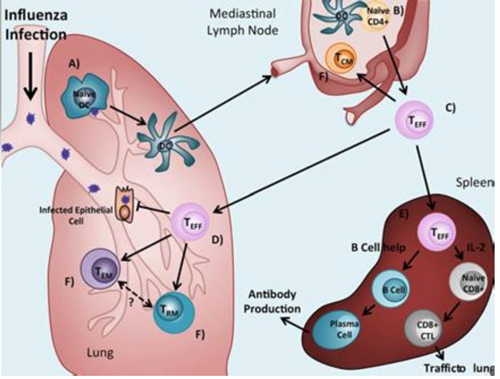
Researchers have identified long-lived monocyte-derived cells in the lungs that sustain tissue-resident memory T cells, providing durable local protection against influenza and pointing toward mucosal vaccine adjuvants such as galectin-1, according to recent findings from the University of Rochester Medicine. Influenza continues to cause major illness each year in the United States, leading to more than 35,000 deaths annually.
Rethinking Respiratory Immune Memory in the Lung
Traditional immunological models hold that long-term defense relies almost exclusively on T and B cells. However, new research appearing in Nature Immunology challenges that view by demonstrating that innate immune cells play a lasting role in the respiratory tract. Specialized tissue-resident memory T cells act as a vital first line of defense right where airborne pathogens enter the body.
“These cells are positioned right where infection begins, so they can react immediately and help limit viral spread,” said Minsoo Kim, PhD, a professor of Microbiology and Immunology at University of Rochester Medicine and lead author of the study.
“They are a central goal for next-generation vaccine design because they provide fast, local protection in the respiratory tract.”
How Monocytes Persist to Support T Cell Immunity
While standard intramuscular influenza shots prevent severe systemic illness, they often fail to generate robust, durable airway immunity. Investigators discovered that a subset of monocytes—immune cells typically classified as short-lived—can persist in the lungs for months after influenza infection. Rather than disappearing after clearing an acute threat, these persistent cells behave differently than expected, appearing to support the formation of immune memory by helping memory T cells survive and function in the lung.
“Our work identified a long-lived monocyte-derived population in the lung that provides essential support for durable T cell immunity,” Kim said, noting that this challenges the traditional view that immune memory is driven only by T and B cells, and shows that innate immune cells also play a lasting role.
Galectin-1 as a Promising Mucosal Vaccine Adjuvant
The investigation also pinpointed the specific molecular messenger driving this interaction. These long-lasting monocytes produce a protein called galectin-1, which helps activate and sustain tissue-resident memory T cells. When galectin-1 was added to an experimental nasal flu vaccine in mice, the immune response in the lungs became significantly stronger.
“We identified galectin-1 as a powerful immune signal that can be used as a vaccine adjuvant to enhance mucosal immunity. This is a completely new approach for improving how vaccines work in the respiratory tract,” Kim explained according to university statements detailing the adjuvant research.
Pediatric Vulnerability and Inflammatory Lung Injury
While enhancing mucosal memory offers a path toward superior vaccines, understanding pediatric vulnerability remains critical. Influenza A virus is a highly contagious RNA virus that can infect the respiratory tracts of both humans and animals. Each year, IAV infection affects up to 40% of children in the United States and is responsible for the hospitalization of approximately 1/1000 children less than 5 years of age. In the 2009 H1N1 pandemic, the pediatric population accounted for 33% of all severe respiratory tract infections.
Studies examining juvenile versus adult infection dynamics indicate that juvenile mice had increased mortality compared to adult mice at each infectious dose of IAV. This vulnerability is not driven by an inability to control viral replication, but rather by an exaggerated inflammatory response mediated by increased recruitment of monocytes to the lung. Juvenile mice had sustained elevation of type I interferons and persistent NLRP3 inflammasome activation in the lungs, both of which were independent of viral titer. Furthermore, juvenile mice, but not adult mice, had increased MCP-1 levels that remained high even after viral clearance, and continued production of MCP-1 was associated with persistent recruitment of monocytes to the lungs and prolonged elevation of inflammatory cytokines.
Implications for Next-Generation Respiratory Defenses
Uncontrolled monocyte recruitment can drive acute lung injury, as research on inflammatory monocytes in juvenile mice demonstrates. Depletion of monocytes with anti-CCR2 antibody decreased type I interferon secretion, NLRP3 inflammasome activation, and lung injury in juvenile mice. This study provides insight into severe IAV infection in juveniles and identifies key inflammatory monocytes that may be central to pediatric acute lung injury secondary to IAV.
Balancing these inflammatory pathways while harnessing innate cells to build lasting mucosal memory represents the core challenge for future immunization platforms. By combining targeted adjuvants like galectin-1 with strategies that prevent pathological inflammation, researchers aim to develop next-generation vaccines capable of stopping respiratory infections right at the mucosal threshold.
Worth a look

Sleeve gastrectomy improves cardiac and kidney MRI markers in youth-onset T2D
Vertical sleeve gastrectomy significantly improves cardiac and kidney MRI markers in youth-onset type 2 diabetes.

Treatment Action Group Launches Architects of Trust Program
As late-stage clinical trials advance toward potential approvals by 2029, the Treatment Action Group and Wellcome have launched...

Nearly 17 percent of eight-year-old autistic children in the United States meet the refined criteria for profound autism
Nearly 17 percent of eight-year-old autistic children in the United States meet the criteria for profound autism under...

Researchers launch Ebola vaccine trial in Uganda
Researchers in Uganda launched a Phase I clinical trial of the ChAdOx1 BDBV vaccine candidate in Masaka City...