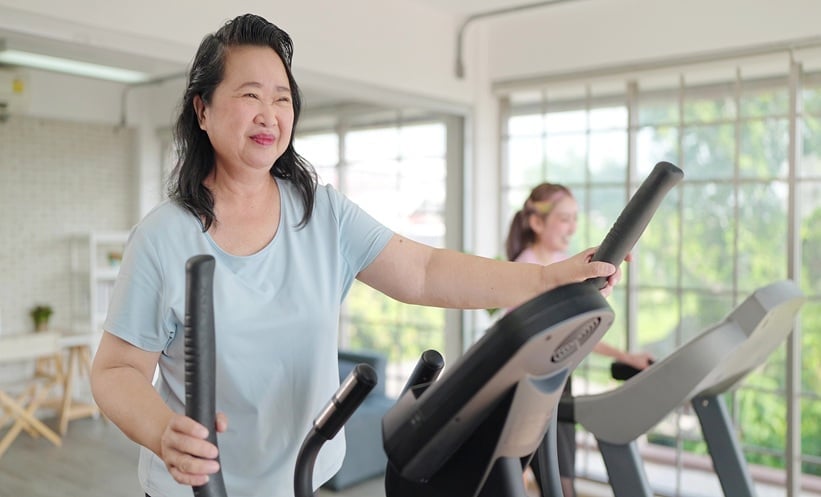
Post-menopausal women engaging in regular aerobic exercise experience greater improvements in executive function—such as task-switching and error management—than pre-menopausal participants or those doing stretching routines. Researchers analyzing trial data found these cognitive gains appear at three months and strengthen through a six-month program.
Investigating How Menopausal Status Alters Cognitive Response to Exercise
A recent secondary analysis of randomized controlled trial data suggests that a woman’s menopausal status significantly alters how her brain responds to physical training.
The underlying investigation evaluated 93 cognitively healthy women between the ages of 20 and 67 who presented with below-average cardiovascular fitness levels and did not regularly exercise prior to the trial. Approximately 37% to 43% of the participants were classified as post-menopausal across the analyzed cohorts. Throughout the study period, individuals underwent standardized neuropsychological testing alongside cardiorespiratory assessments at baseline, the three-month mark, and completion at six months.
Targeted Mental Gains in Executive Function
The cognitive improvements observed in the trial did not manifest uniformly across every category of mental performance. The benefits concentrated heavily on executive functions—the sophisticated mental processes responsible for planning, multitasking, inhibiting distracting stimuli, managing responses, and adapting to novel situations. As noted in coverage from medindia.net, the distinct advantage for post-menopausal women appeared specifically in these organizational and flexible thinking metrics.
Exploratory testing revealed that other cognitive domains did not share this specific boost. Menopausal status did not significantly moderate processing speed, episodic memory, working memory, language skills, or attention. The researchers emphasized that aerobic training does not universally enhance every facet of human cognition, but rather sharpens specific executive mechanisms that support independent daily living as individuals age.
Trial Structure and Training Intensity
Participants in the active intervention were assigned to structured routines conducted four days per week over a span of six months. Each session lasted approximately one hour, incorporating a dedicated warm-up, roughly 45 minutes of active training, and a cool-down phase. The aerobic regimen utilized treadmills, stationary bicycles, and elliptical machines, with intensity progressively scaled until participants reached 75% of their maximum heart rate.
Out of the initial group of 93 participants, 76 completed the three-month milestone, and 66 successfully finished the entire six-month intervention. A parallel control group spent the same schedule performing stretching and toning exercises. Because the trial tested one specific, intensive protocol, researchers caution that the data cannot establish whether four weekly hour-long sessions are an absolute requirement for every individual to reap cognitive rewards.
Separating Chronological Age from Hormonal Shifts
Because post-menopausal participants naturally presented with a higher average chronological age than pre-menopausal participants, investigators needed to rule out age as the sole driver of the cognitive changes. Statistical controls confirmed that the positive association between aerobic exercise, menopausal status, and executive function improvements remained statistically significant even after adjusting for age differences. This indicates that transitioning past menopause alters how the brain reacts to cardiovascular conditioning beyond the baseline effects of aging alone.

Investigators also explored whether shifts in the hormone estradiol could account for the cognitive divergence. However, neither the aerobic regimen nor the stretching program induced significant alterations in estradiol levels, and hormone fluctuations did not correlate with the observed mental gains. The study authors noted that limitations included its design as a secondary analysis of an existing trial, reliance on self-reported menopausal status, and an inability to track perimenopausal stages separately.
Broader Cardiovascular and Metabolic Context
Beyond immediate cognitive metrics, structured physical activity remains a foundational element for managing physiological transitions past middle age. Medical literature addressing post-menopausal health notes that declining estrogen levels frequently shift female cardiovascular risk profiles closer to male patterns, elevating concerns surrounding coronary heart disease, sarcopenia, and metabolic syndrome. Establishing consistent endurance routines helps counter the natural decline in basal metabolism driven by annual muscle mass loss, while simultaneously improving high-density lipoprotein profiles and reducing triglyceride counts.
While the clinical data highlights clear mental advantages, experts underscore that the findings do not prove exercise directly prevents neurodegenerative conditions like Alzheimer’s disease or dementia. Further prospective trials specifically designed around the menopausal transition are required to verify how hormonal shifts dictate cerebral plasticity and whether these targeted executive gains translate into long-term protection against cognitive decline.

Treatment Action Group Launches Architects of Trust Program
As late-stage clinical trials advance toward potential approvals by 2029, the Treatment Action Group and Wellcome have launched...

Nearly 17 percent of eight-year-old autistic children in the United States meet the refined criteria for profound autism
Nearly 17 percent of eight-year-old autistic children in the United States meet the criteria for profound autism under...

Researchers launch Ebola vaccine trial in Uganda
Researchers in Uganda launched a Phase I clinical trial of the ChAdOx1 BDBV vaccine candidate in Masaka City...

CDC Reports Third US Measles Death in 2026
The Centers for Disease Control and Prevention confirmed its third measles death of 2026 on October 20, as...