
Diverging Labor Markets Reveal Deep Structural Divide Between Canada and the U.S.
When Ottawa released its 2024 Fall Economic Statement, government officials pointed to a 7.4% employment growth rate since 2019, touting it as the strongest increase among Group of Seven nations. But beneath those headline figures lies a starkly different economic reality, as National Post reported. A new study from the Fraser Institute reveals that Canada added virtually no private sector jobs per capita between 2019 and 2024, while the United States expanded its private workforce by 7.6 jobs per 1,000 working-age residents during the exact same period.
The Bottom Line:
- Canada added zero private sector jobs per 1,000 working-age residents from 2019 to 2024, while the U.S. added 7.6 jobs over the same demographic baseline.
- Had Canada matched American private sector growth, the economy would have supported approximately 554,000 additional private-sector jobs by 2024.
- Small business hiring intentions have weakened significantly, with the Canadian Federation of Independent Business reporting that 22% of small firms planned layoffs against just 11% planning to hire.
Public Sector Expansion Masks Private Sector Stagnation
Ben Eisen, senior fellow at the Fraser Institute and co-author of the report alongside senior economist Nathaniel Li, emphasized that aggregate numbers obscure underlying vulnerabilities. “If you only look at the broad numbers, which includes robust government job growth, you can miss out on a very important story,” Eisen noted, pointing out that private sector job creation has failed to keep pace with the growing working-age population across most of the country.
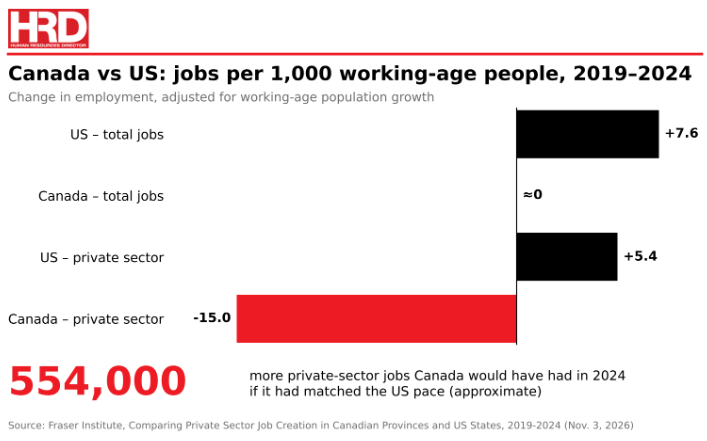
Provincial breakdowns illustrate the depth of the slowdown. According to data compiled from Statistics Canada, the U.S. Bureau of Labor Statistics, and the U.S. Census Bureau, government employment outpaced private sector growth in most provinces. British Columbia had an average of 35.7 private sector jobs lost. Alberta, typically an economic engine, lost 8.8 private sector jobs per 1,000 people, performing the worst compared to other energy-producing states. Meanwhile, Quebec shed an average of 5.5 private sector jobs over the studied timeframe.
Persistent Headwinds Stifle Small Business Recovery
The structural weakness documented in the Fraser Institute study continues to weigh heavily on employers. Data from the Canadian Federation of Independent Business highlights that small business staffing intentions hit their weakest point since the pandemic. With planned wage increases hovering around a modest 2.2%, business owners face margin compression driven by higher operating costs, restrictive monetary policy, and ongoing trade tensions with the United States.

These domestic pressures coincided with broader macroeconomic friction, including the Bank of Canada adjusting its policy rate and the national unemployment rate climbing to 6.7% in October. Even as monthly labor reports occasionally show sudden bursts of hiring—such as an addition of 75,000 jobs in July—economists observe that the underlying labor market remains fragile.
Future Policy Direction Remains Uncertain
Disclaimer: The information provided in this article is for educational and market analysis purposes only and does not constitute financial, investment, or legal advice. Always consult with a certified financial professional before making investment decisions.

Tropical Storm Pena Expected to Reach Hurricane Strength by Tuesday
Tropical Storm Pena is gathering energy in the Central Pacific and is on track to reach hurricane strength...

Georgia Injury Update: Chauncey Bowens Probable for Ole Miss Game
Georgia enters its crucial matchup against Ole Miss facing mounting roster adjustments as the Southeastern Conference released an...

Georgia Man Sentenced to 8 Years for Florida Hunting Lease Fraud
An elaborate fraud scheme that targeted Florida hunters across 15 counties has landed a Georgia man an eight-year...
BlackRock, Inc. Voting Rights and Subsidiary Holding Details
BlackRock Stakes Out Voting Rights in TAG Immobilien AG Disclosure The disclosure maps out an extensive corporate hierarchy...