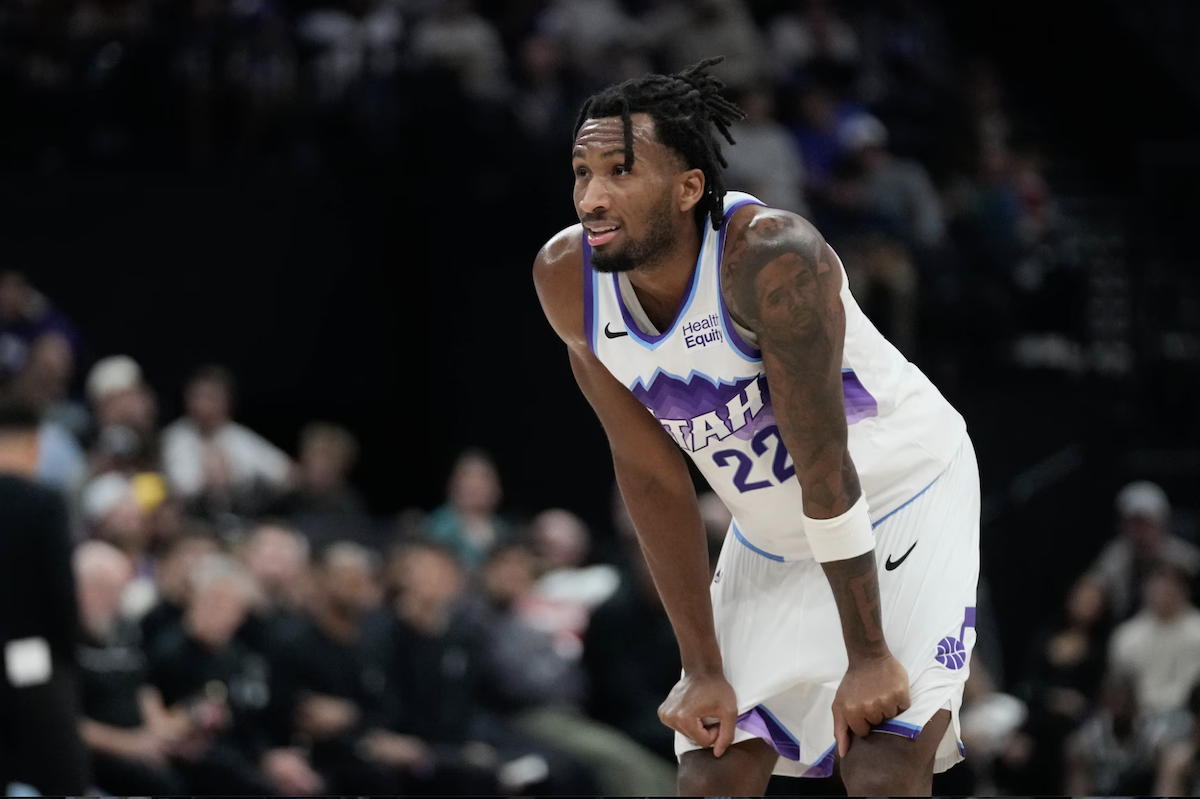
Overtime Bench Decision for Darryn Peterson Sparks Debate Following Utah Jazz Loss
When overtime began on Wednesday night in Salt Lake City, rookie guard Darryn Peterson was watching from the bench. The Utah Jazz were squaring off against the defending Western Conference champion San Antonio Spurs, and head coach Will Hardy had opted to leave his young talent out of the lineup as the extra period commenced. With Keyonte George temporarily sidelined due to a cramping issue, Hardy turned to Isaiah Collier and Brice Sensabaugh instead. The offense immediately lost its rhythm, and a promising upset bid dissolved into a 117-111 defeat.
Salt City Hoops reported the postgame fallout, highlighting Hardy’s blunt assessment of the team’s late-game execution. “We’ve got to clean up execution,” Hardy told reporters after the final buzzer. “In those moments of the game, you have to be able to execute the game plan. I think Darryn is making a lot of strides, but in that moment, I felt it was better to go with Brice.” That single rotation choice triggered an immediate wave of fan fury online, with critics arguing that benching Peterson robbed him of crucial development time in high-leverage, clutch-time scenarios.
The False Equivalence of Minutes and Development
There is a persistent belief among sports fans that dropping a rookie into high-pressure minutes acts as a direct shortcut to acquiring a clutch mindset. But coaching staffs across the NBA operate with a far more granular calculus. Throwing an unready player into a chaotic endgame situation does not magically accelerate his progression. In fact, if a player is struggling to execute fundamental schemes in real-time, forcing him to weather a storm against a disciplined championship contender can easily backfire.
This is Hardy-speak for DP screwing up on either an offensive play or a defensive scheme thing (or both) lateSo I guess my Q is: Do you believe benching DP is more likely to prevent those mistakes in future games than playing him? I don't know Darryn well enough to know. https://t.co/qt25kflyn1
Andy Larsen of Salt City Hoops raised a pointed question on social media following the matchup, asking whether benching a player is more effective at preventing mistakes than simply letting him play through them. The reality of a regular-season game for a franchise hunting for wins is straightforward. A coach’s rotation choices are engineered to secure the victory in front of them, not to run a laboratory experiment on future mistake prevention. Peterson had already committed a series of errors down the stretch—particularly on the defensive end, where championship-level teams punish lapses instantly.
Evaluating the Alternative Lineups in Overtime
While Hardy’s decision to sit Peterson for developmental reasons aligns with standard coaching pragmatism, the alternative lineup he deployed in overtime warrants a closer look. George’s temporary absence forced Hardy’s hand. He turned to Isaiah Collier, a player whose aggressive drives give a team plenty of offensive pressure while simultaneously taking away spacing due to his shooting limitations. The resulting five-man combination relied heavily on non-shooters, making life difficult for ballhandlers trying to navigate a collapsing San Antonio defense.

The defensive-minded unit did successfully lock down the rim for the first two minutes of the extra period, proving that Hardy’s strategy was built on cautious containment. Yet, putting a heavy offensive load on Brice Sensabaugh through isolation plays left the Jazz with a narrow margin for error. That dynamic naturally brings the conversation back to Peterson. With Keyonte George out of commission, would Peterson’s scoring skill set have provided the exact spark needed to steal the game, teaching moment be damned?
Reasonable minds will continue to debate the balance between chasing a single victory and nurturing a prized rookie’s long-term trajectory. For now, one difficult night in October will not define Peterson’s career arc. The rigorous demands of the NBA will offer plenty of other high-stakes moments very soon.
Keep reading

What Albany International (AIN) Said on Its Q3 Earnings Call – Yahoo Finance
Albany International reported record third-quarter revenue, lifted by a renegotiated helicopter contract and strong performance in its Engineered...

Through the boroughs: How the New York City Marathon became a citywide tradition … – amNY
The TCS New York City Marathon is celebrating its 50th year, marking a massive historical milestone for one...

How to Choose a Cosmetic Dentistry Provider in Albuquerque
Choosing a cosmetic dentistry provider in Albuquerque requires looking beyond promotional photographs to evaluate clinical experience, oral health...

The Advance Group has leased 93,728 square feet of industrial space at Port South in Carteret
The Advance Group has leased 93,728 square feet of industrial space at Port South in Carteret, consolidating its...