
A $1.2 Billion Stakes Behind Montana’s Cold-Water Economy
Sport fishing generates $1.2 billion a year in Montana—a economic pillar for a state operating on a general fund budget of $3.5 billion. For more than two decades, residents and stakeholders in the Blackfoot Valley have worked to forge a 430,000-acre package. Combining the Blackfoot Clearwater Stewardship and the Lincoln Prosperity Proposal, the legislation commands backing from roughly 80% of Montanans, according to a University of Montana survey. Families tied to the historic waterway are advocating to name the combined effort the A River Runs Through It Act. The title directly anchors contemporary conservation to the region’s literary and cinematic legacy, arriving fifty years after the publication of Norman Maclean’s celebrated novella.
Congressional Windows and Retiring Delegations
This legislative drive lands in Washington just as two prominent members of Montana’s all-Republican congressional delegation approach retirement. Steve Daines and Representative Ryan Zinke face the end of extended tenures, leaving them a closing window to secure a permanent framework for the roughly 430,000-acre area—a zone balancing the competing interests of wilderness advocates, ranchers, loggers, and snowmobilers.
Representative Zinke introduced the act this fall, quickly securing a co-sponsorship from Representative Troy Downing.
“This proposal was built by the people who live, work, hunt, and recreate in the Blackfoot, and after decades of work they found a way forward that keeps this landscape working for everybody,” Zinke said.
Meanwhile, Senator Daines addressed a June gathering in Washington, D.C., attended by the Daily Montanan. He noted how his own family cherishes the cultural resonance of the Maclean story during family gatherings. Facing his impending retirement after more than a decade in Congress, Daines pointed toward spending more time with his children and grandchildren.
Ecological Strains on a Prized Fishery
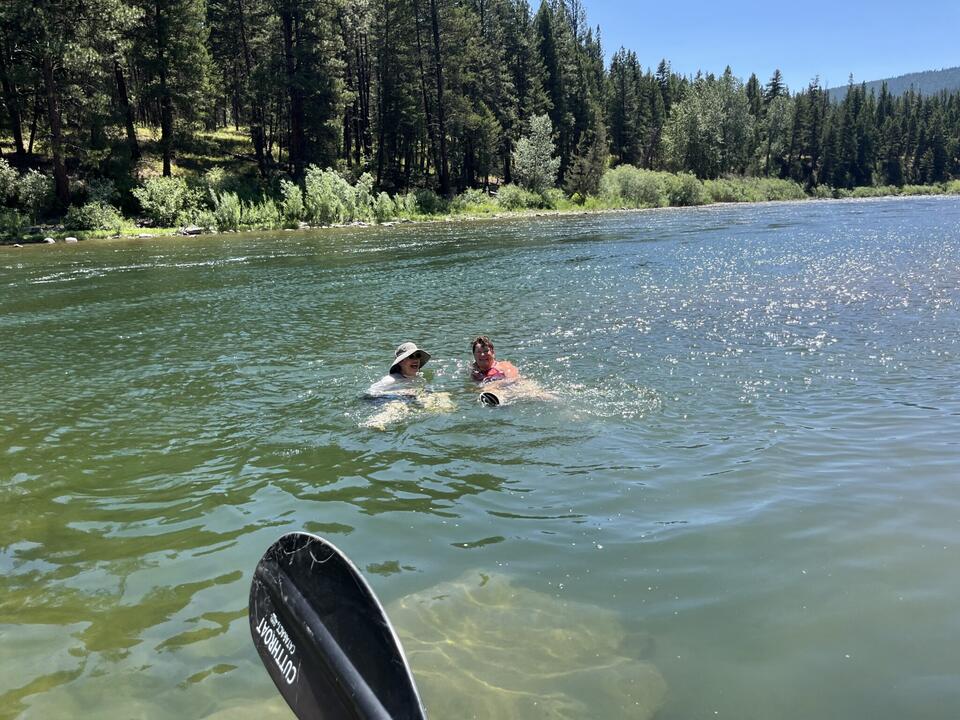
Political momentum tells only half the story. On the ground, the area faces acute ecological stress. The Blackfoot once functioned as a secondary or “tomahawk” fishery, visited primarily when larger waterways like the Missouri and Clark Fork ran poorly. Over time, it evolved into a prime destination for anglers investing in non-resident licenses and airline tickets.
That surge in popularity brings heavy daily boat traffic during the peak season. It arrives in tandem with rising water temperatures and shrinking flows that actively pressure local trout populations. Essential insect hatches—specifically October and early season caddis varieties—have remained virtually absent over the last two years. Low water levels have exposed gravel bars and spawning beds, leaving caddis larvae to dry out and perish inside their cocoons.
“We’re happy to see a mosquito anymore,” a fisherman remarked during a recent fall hot spell, capturing the starkly altered ecological reality across the valley.
More on River Runs Through It Act
@RepRyanZinke introduced the River Runs Through It Act today, and it's a big deal for the Blackfoot watershed. New wilderness for the Bob and the Scapegoat, a brand new area near Lincoln, forest restoration to guard against wildfire, and conservation and recreation areas for… pic.twitter.com/JFVl9Suf7N

Autism and Menopause: Study Finds More Severe Symptoms and Lower Quality of Life
Aging brings unwelcome disruptions for nearly everyone, but the routine-dependent adjustments required during midlife can trigger profound distress...

Alexander Brothers Sentenced to 30 Years Each for Sex Trafficking Scheme
Alon, Tal, and Oren Alexander were each sentenced to 30 years in federal prison on Tuesday, bringing a...

Detroit Pistons face New York Knicks at Madison Square Garden, seeking to maintain their perfect start against an 0-3 Knicks team
The Detroit Pistons travel to Madison Square Garden on Tuesday night to face the defending NBA champion New...
Detroit Pistons face New York Knicks at Madison Square Garden
The undefeated Detroit Pistons travel to Madison Square Garden on Tuesday night to face an 0-3 New York...