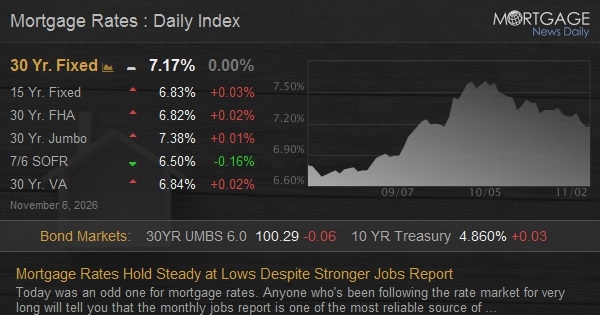
The mortgage market is currently navigating a paradoxical landscape where standard economic signals are failing to dictate price movement. Following a jobs report that significantly outperformed expectations—a scenario that typically triggers a sharp rise in bond yields and mortgage rates—the market has remained stubbornly flat. As Mortgage News Daily reported, this resilience defies the conventional wisdom that stronger labor data must immediately push borrowing costs upward, leaving analysts to reconcile the disconnect between robust hiring figures and the current interest rate environment.
The Bottom Line:
- The average 30-year fixed-rate mortgage currently sits at 6.99%, according to Zillow data, marking the first time rates have dropped below 7% since September 22, 2026.
- Despite the drop, total mortgage application volume fell 1.2% last week, and purchase applications are down 19% year over year, according to the Mortgage Bankers Association.
- Market sentiment remains heavily influenced by the recent U.S. midterm elections, which saw Democrats reclaim control of the House and Senate, triggering a shift in investor expectations regarding fiscal policy.
The Disconnect Between Employment Data and Bond Yields
The core of the current market mystery lies in the bond market’s refusal to sell off in response to the latest payroll counts. Traditionally, a surge in job growth provides the Federal Reserve with the necessary cover to maintain or increase its benchmark rates to combat inflation. However, the current yield environment is being dominated by factors outside of the immediate monthly jobs data. Investors are heavily focused on the unemployment rate component rather than the raw payroll numbers, and the broader bond market remains preoccupied with volatility in the technology sector.

The persistent weakness in tech stocks, which has seen heavy selling pressure recently, is acting as a gravitational pull on bond yields. When equity markets suffer—particularly in high-growth sectors like AI and tech—investors often pivot to the relative safety of government bonds. This flight to safety suppresses yields, which in turn prevents mortgage rates from spiking, even when the underlying economic data suggests they should. As noted by The New York Times and cited via Deseret News, the recent market turbulence has been exacerbated by concerns over potential regulatory tightening in the tech industry.
Election Results and the Shift in Fiscal Sentiment
The political transition in Washington, D.C., following the midterm elections is a primary driver of the current market narrative. Financial institutions are attempting to price in the implications of a new legislative balance, which has contributed to a drop in the yield on U.S. Treasury bonds. According to The Wall Street Journal, the electoral outcome triggered a broader market reaction, including a surge in equity markets and a notable easing in inflation expectations.

“Many newly elected representatives have voiced discontent with the ongoing conflict in the Middle East, which has contributed to rising inflation, so any progress toward resolution could mean lower inflation and softer mortgage rates ahead,” said Hannah Jones, senior economist at Realtor.com.
This political recalibration has created a unique window where investors are betting that future fiscal policy may mitigate some of the inflationary pressures that pushed borrowing costs toward 8% earlier this year. However, this optimism is tempered by the reality of the housing market’s current structural freeze.
Main Street Realities Amidst Institutional Rate Easing
While interest rates are technically trending downward, the “Main Street” impact remains muted. Potential homebuyers are facing a market defined by low inventory and declining purchasing power. Mortgage Bankers Association senior vice president Mike Fratantoni noted that the recent drift in rates has done little to thaw the deep freeze that descended on the housing market in September. Borrowers are increasingly turning to 5/1 Adjustable-Rate Mortgages (ARMs) to lower their initial monthly payments, with the ARM share hitting its highest level since September 2025.

For the average consumer, the current 7% threshold remains a psychological and financial barrier. Even with more than 40% of active listings seeing price reductions, the lack of competition and the high cost of financing continue to sideline a significant portion of the buyer pool. Sellers, meanwhile, are not necessarily distressed, but they are choosing to hold back rather than lower prices significantly, leading to a stalemate in transaction volume.
Looking Toward 2027
Institutional outlooks for the coming year suggest that the current volatility is unlikely to result in a rapid return to the sub-6% rates seen earlier this year. Both the Mortgage Bankers Association and Fannie Mae have forecasted that rates will likely hover near the 7% range through the end of 2026 and into 2027. The Federal Reserve continues to balance its dual mandate of price stability and maximum employment, and until there is a clear, sustained trend in inflation data, the current high-rate environment is expected to persist.
The market is currently in a state of digestion, waiting to see if the post-election momentum can sustain the current downward trend in rates or if a strong labor market will eventually force yields back up. For now, the “paradoxical resilience” of mortgage rates serves as a reminder that market mechanics are rarely driven by a single data point, but rather by the complex interplay of political, technological, and macroeconomic forces.
Disclaimer: The information provided in this article is for educational and market analysis purposes only and does not constitute financial, investment, or legal advice. Always consult with a certified financial professional before making investment decisions.
Keep reading

Josh Cuifici arrested after RV standoff in Salem, Oregon
A routine request to vacate a business parking lot in Salem, Oregon, escalated into a multi-hour standoff on...

Latter-day Saint Church Breaks Ground on New Cincinnati Temple
Construction crews are officially breaking ground this Saturday on a new landmark in Mason, Ohio, marking the start...

Bismarck mother publishes coloring book to help families with cancer
Bismarck mother creates resource for families navigating cancer treatment Two years after concluding her final round of breast...

Why I Refused to Move Back to New York for Love
The Boundary That Built a Relationship In a recent column for the Los Angeles Times, writer and journalist...