
The Wichita Falls Museum of Art at Midwestern State University has opened a survey drawn entirely from its permanent collection that traces how American and European artists shifted animals from scientific specimens into cultural symbols, a show the museum says runs through December 19.
The exhibition, Framing Nature: Animals Through Art, assembles roughly two dozen works on paper spanning the mid-1700s to 2009, Glasstire reported.
Co-curated by Dr. Kirsten Lodge, professor of humanities and English and coordinator of the Humanities Program at MSU Texas, the installation begins with 18th-century engravings by Johann Elias Ridinger and hand-colored lithographs by Frances Flora Palmer that functioned as visual encyclopedias for a frontier audience, then pivots toward abstraction through Roy Lichtenstein’s 1973 Bull Profile Series and into contemporary works such as Helen Altman’s torch-scorched Running Coyote (2013) and Billy Hassell’s fauvist Roadrunner (2009).
What distinguishes the show is how openly it reveals the mechanics of a regional collection. The Lichtenstein suite entered the museum as a direct purchase in 1975, just two years after it was printed, signaling an institution paying close attention to contemporary printmaking.
Will Barnet’s Atlanta arrived a year later as a gift from Mr. and Mrs. John D. Murchison. Altman’s coyote and Hassell’s roadrunner came through the Collectors Circle, a membership-driven acquisitions fund that has allowed the museum to keep buying living artists’ work.
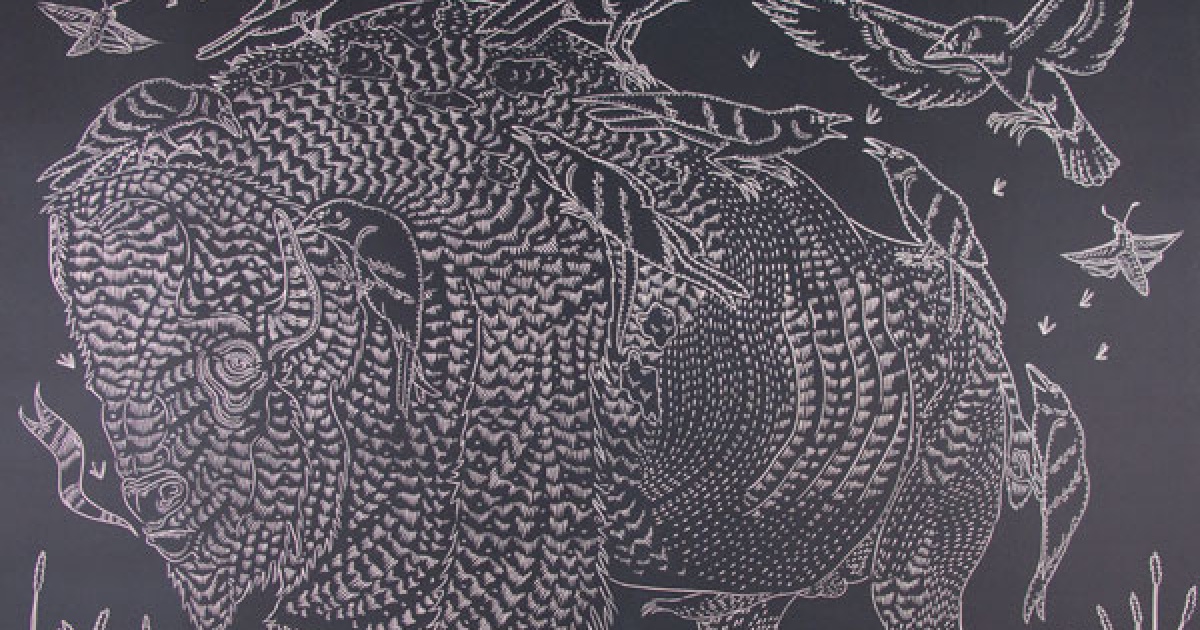
The exhibition frames the show as an invitation to consider “different ways animals have historically been portrayed in the visual arts, what these images say about attitudes towards the natural world, and how art helps shape our ways of thinking about the beasts and creatures we study, hunt, admire, fear, and adore.”
The show includes rarely exhibited pieces by Martin Johnson Heade and Albert Bierstadt alongside the Lichtenstein prints, which explicitly reference Picasso’s 1945–46 The Bull lithographs.
Guillaume Azoulay, Rickey Armendariz, and Richard Lindner extend the conversation into graphic simplification and psychological portraiture. Hassell’s Roadrunner sits somewhere in the middle: the bird is instantly recognizable, but the palette is anything but realistic.
The museum has scheduled three public events tied to the exhibition. Dr. Lodge will deliver a lecture on the cultural history of animals from antiquity to the modern day on February 11 at 5:30 p.m. The Great Backyard Bird Count at Sikes Lake follows on February 14 from 2 to 4 p.m., led by Taylor Majewski, director of STEM Excellence at the McCoy College of Science, Mathematics & Engineering, using a “Notice, Wonder, and Investigate” framework.
According to the museum’s exhibition page, Penny Miller, president of the Rolling Plains Chapter of the Texas Master Naturalists, was due to speak on birds in mythology and art on October 15 at 5:30 p.m.
For a Texoma audience, the show skips the expected horses and cowboys in favor of a hunted stag, a comic-strip bull, a torch-scorched coyote, and a fauvist roadrunner — an off-the-beaten-path suite that lays out the region’s inheritance plainly.
Midwestern State University, founded in 1922 as Wichita Falls Junior College and renamed Midwestern State University in 1975, is Texas’s only public institution focused on the liberal arts. It enrolled 5,287 students in fall 2025 and operates a 255-acre campus in Wichita Falls.
The university holds the distinction of being the only Texas member of the Council of Public Liberal Arts Colleges and was the first public university in the state to establish a core curriculum.
Framing Nature: Animals Through Art remains on view at the Wichita Falls Museum of Art through December 19.
Related reading

Metro Police Hunt Damaged Chevrolet Trax SUV in Deadly Murfreesboro Pike Hit-and-Run
Metro Nashville police are hunting the driver of a damaged Chevrolet Trax SUV who struck and killed a...
PCAC, NYPIRG, Straphangers Award Schleppie to B62, Pokey to M42 for Worst Bus Service
Transit advocates handed out their annual "awards" for the city's worst bus service on Thursday, giving the Schleppie...

Mariners Trade Bryce Miller, Acquire Maikel Garcia in Six-Player Deal With Royals
Seattle swapped a rotation staple for an infield anchor and a reliever who struck out nearly 45 percent...
West Virginia Fly Fishing 2026 Hatch Chart: Elk, Shavers Fork, Cranberry, Williams & Seneca Creek
FlyFishFinder has released its 2026 hatch chart for West Virginia trout streams, mapping the insect calendar across the...