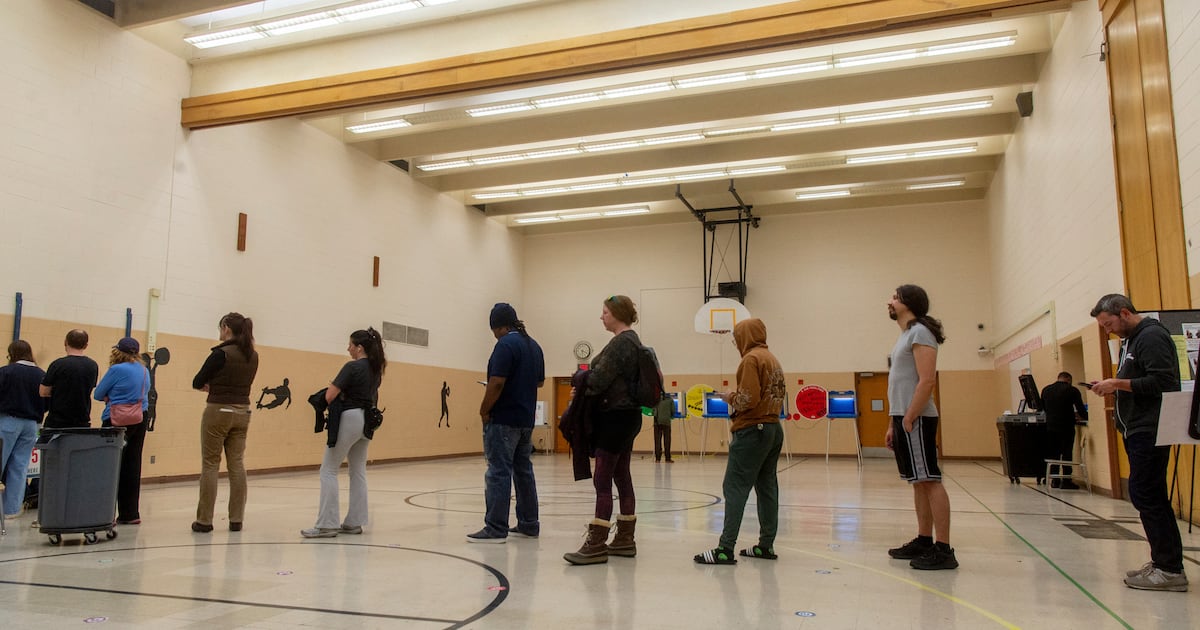
Wisconsin university voters again faced hours-long lines at polling places in November, with the worst bottlenecks reported near the University of Wisconsin campuses in Stevens Point and Whitewater, Votebeat reported.
The delays are not new, but they are persistent. Students often register on Election Day, a process that takes longer than a simple check-in, and municipalities with tight budgets struggle to staff and equip the sites that serve them.
In Stevens Point, the city consolidated its polling locations from 11 to six this year to save money. In Whitewater, the campus polling place for Ward 13 ran out of ballots because the clerk ordered supplies based on 2022 turnout, when 180 voters cast ballots, rather than the 355 recorded in state data. Ultimately, 421 voters showed up.
“The election operation there was a failure, but most importantly was avoidable,” said Ella Jordahl, voter access director at The Wisco Project, speaking at a Stevens Point city council meeting on Nov. 16. Four other speakers described frustration and chaos, noting that some people in line left and did not return.
Madison has spent a decade attacking the same problem. The city established early voting sites at the University of Wisconsin–Madison in 2016 and built a relationship with the university to encourage pre-registration. Even so, Election Day registrations remain high.
To manage the flow, Madison doubles staffing at campus sites — 18 workers or more versus eight at standard locations — and uses a wait-time calculator developed by MIT and Caltech to set staffing levels. In the November election, one campus polling place ran with 13 workers and three check-in stations; the longest wait was 12 minutes for those registering and four minutes for those already registered, Deputy Clerk Kaitlyn Bernarde told Votebeat.

Orange County, California, took a different tack. Beginning in 2025, poll workers at a University of California–Irvine site began sorting voters at the entrance. Registered voters go straight to the voting line; unregistered voters are routed to a registration tent. Registrar of Voters Bob Page said the change cut waits for registered students and reduced confusion for workers and voters alike.
“Anything that you can do to take some of those folks out of line on Election Day, that’s part of the solution,” said Jennifer Morrell, CEO of The Elections Group. She emphasized that fixes must be holistic — combining communication, adequate resourcing, and technology that works for everyone.
But smaller cities cannot easily duplicate those models. Stevens Point Clerk Susan Pagel said that when the city ran 11 locations, it relied on county clerk employees to troubleshoot problems. Consolidating to six sites concentrates limited staff, but it also means fewer places to vote.
Pagel plans to improve poll worker training on registration and coordinate with the university to urge early sign-ups. “What we need to do is have better line control,” she said. “Make sure the students have the required documents ready.”
A city ordinance caps the number of election officials at each polling place at 11, plus one greeter, blocking the kind of surge staffing Madison uses. Pagel said she will seek an ordinance change to allow more workers.
The finance committee approved $35,000 for additional electronic pollbooks on Nov. 9, a step Brittany Vulich of All Voting Is Local Action called “important and necessary” but not sufficient; she also urged more early in-person voting locations for students.
In Whitewater, Clerk Heather Boehm did not respond to requests for comment. Her post-election memo acknowledged the ballot shortage and the resulting lines at the ExpressVote machine. The city faced a similar crisis two years ago, when inadequate staffing led to hours-long waits and a court order to keep polls open late.
The University of Wisconsin–Madison, founded in 1848 when Wisconsin achieved statehood, is the flagship campus of the University of Wisconsin System and a public land-grant research university. It enrolled approximately 34,200 undergraduate and 14,300 graduate and professional students in 2024. The campus established early voting sites in 2016 and built a relationship with the university to encourage pre-registration, though Election Day registrations remain high.
The contrast is stark: jurisdictions with resources and planning keep waits under 15 minutes, while cash-strapped college towns watch students walk away. The solutions are known — early voting sites, entrance sorting, data-driven staffing, better training — but they require money and political will that remain uneven across Wisconsin.
Related reading

Santa Fe Balances Ancient Roots With Modern Economic Pressure at 7,199 Feet
Santa Fe sits at 7,199 feet in the Sangre de Cristo Mountains, the oldest state capital in the...
ADOT, Phoenix, MAG Plan $240M Elevated Intersection at 35th, Indian School, Grand
Arizona transportation agencies are planning a $240 million elevated intersection at 35th Avenue, Indian School Road and Grand...
Hendrix Mock Trial Opens Season With Awards in Houston and Record Finish in Atlanta
Hendrix College Mock Trial Association began its 2026–2027 campaign by sweeping individual honors and a team sportsmanship award...

Wyoming County commissioners approved technology and infrastructure upgrades Tuesday
Wyoming County commissioners approved technology and infrastructure upgrades Tuesday, targeting aging 911 systems and county networks that officials...