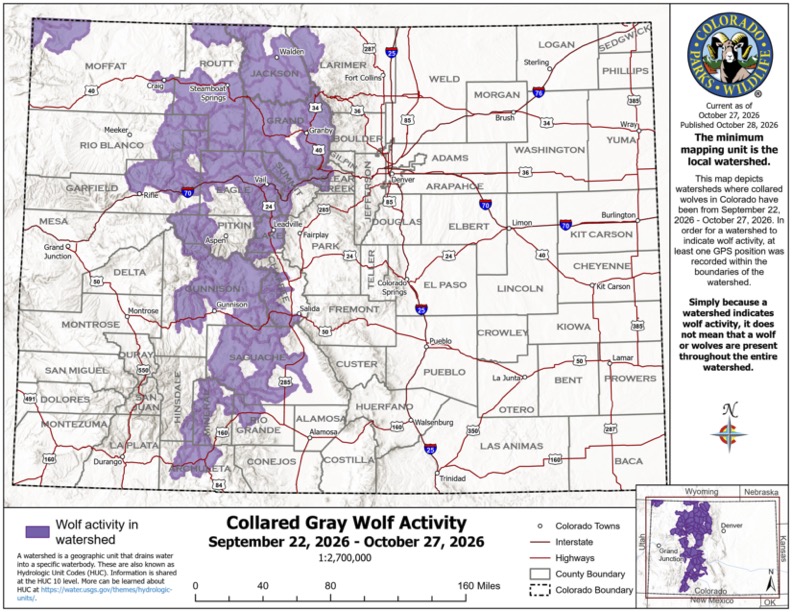
Colorado’s collared gray wolves expanded their footprint across the Western Slope through October, pressing into watersheds from Walden down toward Pagosa Springs in movements tracked by state wildlife officials.
The latest gray wolf activity map released by Colorado Parks and Wildlife covers the period from September 22 to October 27, documenting GPS data recorded roughly every four hours. The tracking data shows animals present in Moffat County’s far northwestern corner, sweeping across Routt, Jackson, Larimer, Grand, Summit, Clear Creek, Eagle, Rio Blanco, Garfield, and Pitkin counties, and pushing south into Gunnison, Lake, Chaffee, Saguache, Hinsdale, Mineral, Rio Grande, and Archuleta counties.
Because the monthly maps rely on GPS coordinates captured at regular intervals, they create visual gaps between highlighted watersheds as the animals cover vast distances in short spans of time. The October data shows slightly more expansive and concentrated activity through the central stretches of the Western Slope, largely mirroring the geographic footprint recorded the previous month.
Movement on the maps remains strictly confined to Colorado boundaries. Wolves crossing state lines encounter vastly different regulatory frameworks. Animals moving west into Utah, New Mexico, and Arizona face capture and return to Colorado under interstate agreements, while those heading north into Wyoming can be legally hunted across the majority of the state.

Colorado Wolf Population Reaches 45 Animals
State wildlife biologists estimated the total state population at 45 wolves as of September 24. That tally includes 20 pups born this spring in northwest Colorado across four distinct packs: the Piney Ridge Pack in Eagle County, the One Ear Pack in Jackson County, the Copper Creek Pack in Pitkin County, and the Three Creeks Pack in Rio Blanco County.
At six months old, these pups now travel broadly with adult pack members rather than remaining tied to seasonal homesites. Meanwhile, lone disperser wolves continue moving across long distances seeking food and mates, operating outside traditional pack territories.
Human-wildlife conflicts and mortality events have changed the living conditions for several monitored groups. Both breeding adults of Routt County’s King Mountain Pack died this year—one during a state collaring operation and another killed by a ranch hand defending livestock. State wildlife officials confirmed that four yearling wolves born to the pack in 2025 continue traveling together despite the loss of the breeding pair.
Low Survival Rates Threaten Long-Term Population Viability
Colorado Parks and Wildlife raised flags in September regarding long-term population viability under voter-mandated recovery goals. Nearly half of the estimated population consists of pups, a demographic vulnerable to winter mortality rates that typically claim 50-60% of young wolves in western states. Adult survival over the last full biological year sat at 61%, trailing the 75% benchmark common among established western populations, while potential disease concerns emerged in two separate packs.
Sourcing additional wolves from neighboring states remains a cornerstone of the state’s official wolf plan, but political friction has complicated acquisition efforts. These combined pressures prompted state wildlife officials to adjust their operational posture.
After euthanizing four wolves between August 4 and September 9 for livestock depredation, the agency announced a more conservative approach to conflict-related killings. State officials will still weigh lethal removals on a strict case-by-case basis moving forward, managing the friction between a growing apex predator population and Western Slope agricultural communities.

Austin City Council 2026 Race: Final Campaign Finance Reports
With the November 3 election just days away, more than 20 candidates fighting for five Austin City Council...

Sober Living Homes in Utah: Licensing, Costs, and How to Choose
Finding a safe place to live during recovery in Utah is fundamentally different than in most other states...

TN Governor Candidates Debate as Marsha Blackburn Skips Event
Seven days before Tennesseeans head to the polls, three candidates for governor faced off in a debate at...

Edgewater Villas in South Sioux Falls Offers apartments from $970
Edgewater Villas in south Sioux Falls is currently offering immediate and upcoming availability for one-, two-, and three-bedroom...