Iberia will operate flight IB1473 on August 12, 2026, using an Airbus A321XLR to observe a total solar eclipse from 33,000 feet over Palencia, Spain. Carrying Shelios project researchers to study the solar corona, the mission also features Starlink satellite internet to livestream the event globally.
Instead of scrambling for a clear horizon on the ground, a team of researchers and aviation specialists will intercept the path of totality from the upper atmosphere. The August 12, 2026, total solar eclipse marks the first time a total eclipse will be visible from the Iberian Peninsula since 1912, prompting a massive anticipated ground movement across Spain and Iceland.
While millions of travelers head to vantage points below, the Spanish flag carrier is taking a different route. By climbing above the cloud deck, the flight bypasses the atmospheric interference that typically complicates ground-based astronomy.
Flight IB1473 and the Copernicus Legacy
Operational planning for the journey carries deep symbolic and technical weight. Designated as flight code IB1473, the trip honors the birth year of astronomer Nicolaus Copernicus. The aircraft assigned to the mission is an Airbus A321XLR, representing one of the most advanced long-range narrowbody jets in the airline’s fleet.
The flight will depart from Adolfo Suárez Madrid-Barajas Airport at 18:45 local time. The aircraft’s trajectory is meticulously calculated to maximize the viewing window within the umbral shadow, positioning the jet directly over the Spanish province of Palencia as the eclipse reaches its peak in the late afternoon.
The cockpit operation involves specialized coordination.
Chasing the Shadow Above 33,000 Feet
Cruising at speeds exceeding 700 km/h, the aircraft will chase the shadow
, granting researchers an extended perspective to observe the phenomenon. Flying at an altitude of 33,000 feet places the cabin above most of the atmosphere, solving the perennial problem of cloud cover.
“Observing from cruise altitude will allow us to have a clear view of the solar corona, free from cloud cover and other atmospheric phenomena that can hamper observations from the ground.”
Miquel Serra-Ricart, scientific director of Light Bridges and researcher at the Instituto de Astrofísica de Canarias, via Aviación al Día
The scientific delegation on board represents the Shelios project, led by astronomer Miquel Serra-Ricart. Their primary objective is capturing critical measurements of the Sun’s outer atmosphere, studying the solar corona and the Sun’s morphology while the Moon completely blocks the solar disk.
Furthermore, the high-altitude vantage point will give researchers an unobstructed look at the immediate surroundings of the Sun. Observers expect to clearly track the apparent positions of inner planets like Venus and Mercury, alongside stellar structures that normally remain hidden in daylight.
Global Livestreaming via Starlink Connectivity
While regular ticket-holders will not fill the cabin—as the flight is reserved for the scientific mission—the public will not miss out. The operation doubles as a technological showcase for the airline’s rollout of high-speed Wi-Fi powered by Starlink satellite technology.
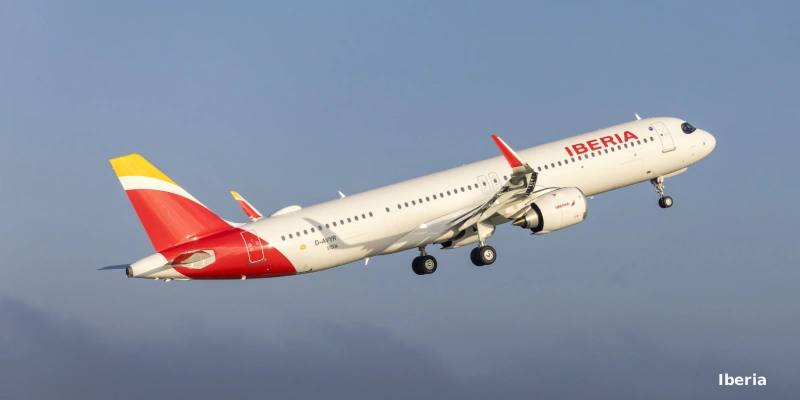
This connectivity infrastructure enables a real-time livestream across the airline’s social media channels. Viewers around the world can watch the celestial event from above the clouds, circumventing sunset visibility issues that might obscure the view from urban locations sitting just outside the path of totality.
A Broader European Movement Toward Airborne Astronomy
Iberia’s airborne expedition mirrors a wider trend across European commercial aviation, where airlines increasingly partner with scientific institutions to capitalize on rare astronomical alignments. In July 2026, Brussels Airlines announced its own specialized eclipse flight in cooperation with the Urania Public Observatory, the University of Antwerp, and Vrije Universiteit Brussel.

While the Belgian flight targets a deep partial eclipse reaching up to 96% obscuration to measure atmospheric light and temperature shifts, Iberia’s deployment aims straight for total darkness.
“We are very pleased to collaborate on an initiative that brings together aviation, science, and innovation. This flight will allow us to leverage the advantages of observing from cruising altitude to contribute to the study of an exceptional astronomical phenomenon.”
Diego Fernández, Director of Strategy, Transformation and Sustainability at Iberia, via Traveltomorrow
With commercial aviation carving out a new role as an active airborne laboratory, bridging the gap between aerospace technology and ground-based astronomical research.

Sand Hoppers Move Hundreds of Tons of Sand on California Beaches
Inch-long beach crustaceans known as sand hoppers dig fresh burrows nightly along Southern California shores, moving an estimated...

Scientists Discover 13 Fatty Acids in Cat Urine That Form Unique Scents
Researchers in Japan, Germany, and Spain have discovered 13 unusual branched-chain fatty acids in domestic cat urine that...

Google Patents Filing Details New Text Classification Method for Office Systems
While traditional office automation approaches historically relied on multi-label document categorization based solely on body text, newly surfaced...
Ancient rocks from Western Australia suggest Earth was already dragging surface water into its mantle and using it to generate volcanoes 3.1 billion years ago — through a primitive recycling process that may have preceded modern plate tectonics
Geologists examining ancient volcanic formations in Western Australia have discovered evidence that water was influencing Earth's interior and...