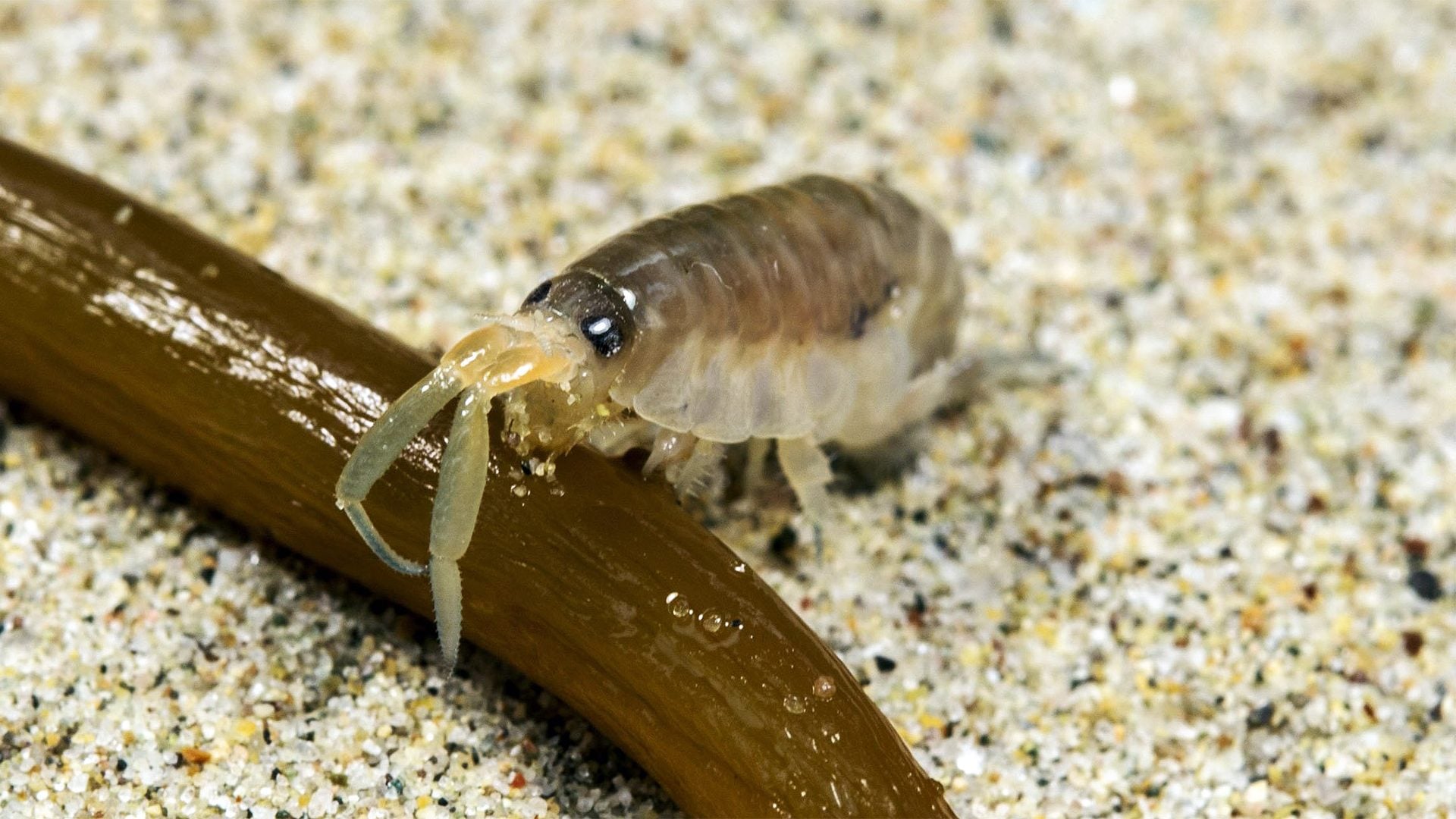
Inch-long beach crustaceans known as sand hoppers dig fresh burrows nightly along Southern California shores, moving an estimated 340 tons of dry sand daily across a 15.5-mile stretch. A environment coastal & offshore reveals their sediment-shifting power rivals regional rivers.
Waves, wind, and tides usually receive sole credit for shaping coastal landscapes. However, new research shows that shrimp-like crustaceans measuring about an inch, or 25 millimeters, long act as major earthmovers on sandy shores. Tim Baxter, a physical geographer at the University of Oxford’s Pitt Rivers Museum, led an investigation to examine these organisms beyond their traditional reputation.
“Sand hoppers are often overlooked or considered as a bit of a nuisance. We wanted to try and look at them in a different light.”
Tim Baxter, physical geographer at the University of Oxford’s Pitt Rivers Museum
Nightly Burrowing Habits on Isla Vista Beach
Unlike most burrowing animals that maintain the same home for months or years, sand hoppers abandon their resting spots daily. By day, the creatures shelter in shallow burrows within damp sand. After dark, they emerge to feed on washed-up kelp and seaweed deposited by the tide.
Two species, Megalorchestia corniculata and Megalorchestia benedicti, congregate densely on Southern California beaches. Researchers observed populations often exceeding 1,000 animals in a patch of sand a yard across. This nocturnal digging keeps the crustaceans fed, damp, and hidden from predators.
In July 2025, the research team staked out 21 plots on Isla Vista Beach near Santa Barbara. Investigators set metal frames flush with the sand after high tide and left them for 10 hours. Dave Hubbard, an ecologist at UC Santa Barbara’s Marine Science Institute and a co-author on the study, described the preferred zone for these activities.
“They don’t like saturated sand that’s like liquid – their burrows collapse immediately. They don’t like the powdery dry sand above the high tide line. They like the Goldilocks sweet spot in between where the burrow will stay intact because the moisture in the sand is just right.”
Dave Hubbard, ecologist at UC Santa Barbara’s Marine Science Institute
Quantifying the Sediment Churn
When researchers returned to the plots in the morning, they found some metal frames completely buried by overnight excavation. The team scraped off the overnight mounds, dried the material, and weighed it.

Cores pulled from the plots revealed an average population of 26 sand hoppers per core. Every three feet of shoreline held approximately 21,450 hoppers, which collectively piled up an average of 84 pounds of dry sand in a single night. Busiest stretches produced up to 110 pounds, or 50 kilograms, matching roughly 16 half-gallon sandcastle buckets.
Calculations showed that each individual digs up more than 10 times its own body weight for every burrow. Baxter admitted he reviewed the calculations multiple times because the figures appeared remarkably high for such small animals.
Extrapolating Annual Impact Across the Coastline
To establish broader context, the research team combined their single-night measurements with eight years of hopper counts from the Santa Barbara Coastal Long Term Ecological Research program, which has monitored beach populations since 2013.
Stretching the data across 15.5 miles of Southern California coastline near Isla Vista yields a daily movement of roughly 340 tons of dry sand. On an annual basis, Isla Vista Beach alone experiences roughly 2,100 tons of sand excavation a year. This calculation represents the highest annual excavation rate ever calculated for a land or coastal animal with accounted population swings.
Gemma Harvey, a physical geographer at Queen Mary University of London who was not involved in the research, noted that the project illustrates how individually small animals occurring in high numbers can exert substantial landscape-shaping impacts.
Ecosystem Functions and Modern Beach Management
Beyond moving sediment, sand hoppers perform vital ecological roles as detritivores. They break down washed-up kelp and recycle nutrients back into the marine food web, while their burrowing aerates the subsurface sand to supply oxygen to microbes.

The fluffed-up leavings created by their excavations can also be carried more easily by wind toward coastal dunes. Furthermore, the hoppers serve as a primary food source for foraging shorebirds.
However, routine beach maintenance often conflicts with this subterranean workforce. Tractors regularly drag rakes across Southern California beaches every morning to smooth the sand for visitors, hauling away accumulated seaweed and disrupting the habitat.
Because the current measurements do not account for sand moved entirely beneath the surface, the true sediment-shifting total may be even higher. Baxter plans to investigate whether wind and waves carry the excavated sand away to alter coastline geometry or if the hoppers merely rearrange it in place, with similar studies planned in the United Kingdom and Europe.
Keep reading

Scientists Discover 13 Fatty Acids in Cat Urine That Form Unique Scents
Researchers in Japan, Germany, and Spain have discovered 13 unusual branched-chain fatty acids in domestic cat urine that...

Google Patents Filing Details New Text Classification Method for Office Systems
While traditional office automation approaches historically relied on multi-label document categorization based solely on body text, newly surfaced...
Ancient rocks from Western Australia suggest Earth was already dragging surface water into its mantle and using it to generate volcanoes 3.1 billion years ago — through a primitive recycling process that may have preceded modern plate tectonics
Geologists examining ancient volcanic formations in Western Australia have discovered evidence that water was influencing Earth's interior and...

NASA’s Roman Space Telescope Captures First Starlight Test Image
NASA’s Nancy Grace Roman Space Telescope has activated its 300-megapixel Wide Field Instrument and captured its first starlight...