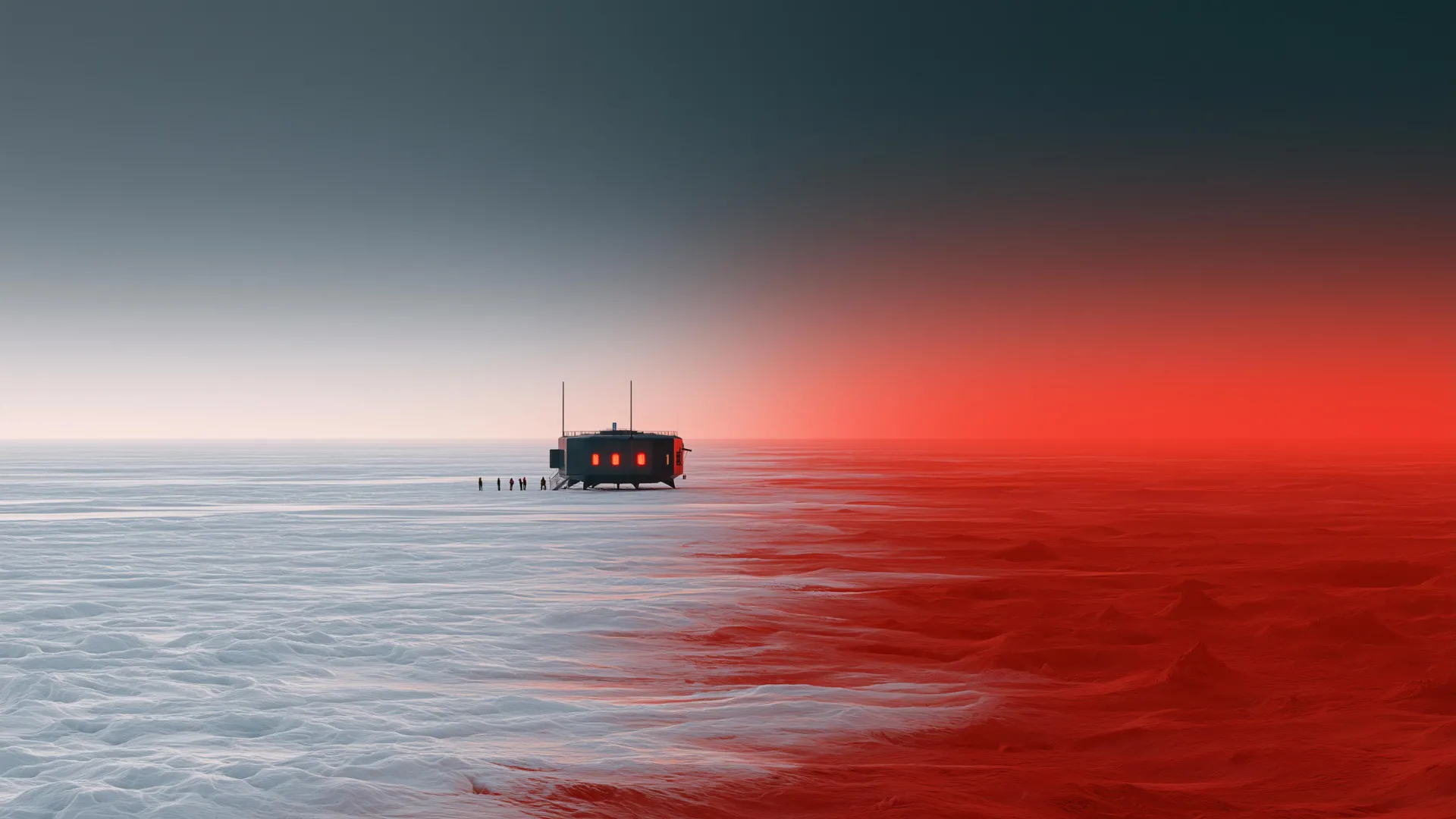
Researchers tracking 12 people during a 10-month overwintering mission at Concordia Station in Antarctica discovered that frequent physical contact increased interpersonal tension rather than social support. Published in the Proceedings of the National Academy of Sciences, the findings reveal critical social dynamics that could impact future crewed missions to Mars.
Long-duration space missions demand that small crews endure intense psychological pressure, strict confinement, and absolute isolation for months or years at a time. To simulate these conditions on Earth, an international research group observed a 10-month overwintering mission at Concordia Station in Antarctica, where winter temperatures plummet to minus 80 degrees Celsius, or minus 112 Fahrenheit.
The study, led by researchers including Jan Schmutz, a psychology professor at the University of Zurich, and Andrea Cantisani, a psychiatrist and research associate at the University of Bern, utilized a combination of surveys, interviews, and wearable electronics. The 12 crew members completed questionnaires at four distinct points during the 10-month deployment while wearing proximity sensors that automatically logged physical closeness and the duration of daily encounters.
Wearable Proximity Sensors Track Daily Social Friction
The wearable technology functioned reliably under harsh polar conditions, capturing everyday social patterns without disrupting crew routines. By matching sensor telemetry against periodic questionnaire responses, researchers monitored fluctuations in loneliness, trust, conflict, cohesion, and perceived performance across the mission lifecycle.
The tracking data uncovered a counterintuitive reality regarding how humans behave under persistent confinement. While space agencies often conceptualize the psychological toll of deep-space travel entirely around distance and isolation, the Antarctic data demonstrated that physical proximity itself can generate severe interpersonal friction.
Participants who spent more time near colleagues frequently reported heightened conflict, growing mistrust, and reduced individual performance. Although the study tracked correlations rather than establishing direct causation—noting that lonely individuals may have sought out interactions that ultimately failed to comfort them—the implications for confined habitats remain stark.
Subgroups, Cultural Fragmentation, and Crew Polarization
As the months progressed, the crew gradually separated into smaller, distinct social clusters. Wearable sensor logs showed that participants increasingly spent their time interacting with colleagues who shared their native language or nationality.
These micro-networks provided individual grounding and emotional support through stressful periods, but they simultaneously accelerated social fragmentation. The study noted that social interactions became increasingly clustered within national groups, highlighting the risk of social fragmentation and crew polarization.
In multinational exploratory missions, such cultural divides risk compounding the natural atomizing effects of long-term isolation.
Historical Context and Analogs for Deep Space Exploration
Antarctica has long served as a terrestrial proxy for space travel because it presents genuine physical hazards just outside habitat walls, alongside mechanical parallels like airlocks and bulky protective gear. Yet previous research efforts have often relied on retrospective debriefing rather than continuous real-time tracking.
The Mars500 project documented similar behavioral hurdles during a simulated 500-day journey, while Russia’s dedicated SIRIUS facility missions have tested extended social confinement under controlled conditions. Meanwhile, the infamous Biosphere 2 project exposed distinct interpersonal strains, and researchers have even applied spaceflight analog data to understand the societal impacts of COVID-19 lockdowns.
Science fiction authors have long sketched the complex social friction of deep space transit, most notably in Kim Stanley Robinson’s novel Red Mars
, which anticipated how international groups would fracture along cultural lines during prolonged transit periods.
Implications for Future Moon and Martian Expeditions
The Antarctic findings suggest that mission planners must look beyond mere physical separation to address the specific strains of close confinement. Researchers emphasized that monitoring psychosocial health and identifying emerging social divides early will be essential for maintaining mission safety across submarines, remote research stations, offshore platforms, and interplanetary spacecraft.
Such proactive strategies will be critical for ensuring the long-term psychological stability and operational success of crews operating in these isolated and high-pressure environments.
Worth a look

Sand Hoppers Move Hundreds of Tons of Sand on California Beaches
Inch-long beach crustaceans known as sand hoppers dig fresh burrows nightly along Southern California shores, moving an estimated...

Scientists Discover 13 Fatty Acids in Cat Urine That Form Unique Scents
Researchers in Japan, Germany, and Spain have discovered 13 unusual branched-chain fatty acids in domestic cat urine that...

Google Patents Filing Details New Text Classification Method for Office Systems
While traditional office automation approaches historically relied on multi-label document categorization based solely on body text, newly surfaced...
Ancient rocks from Western Australia suggest Earth was already dragging surface water into its mantle and using it to generate volcanoes 3.1 billion years ago — through a primitive recycling process that may have preceded modern plate tectonics
Geologists examining ancient volcanic formations in Western Australia have discovered evidence that water was influencing Earth's interior and...