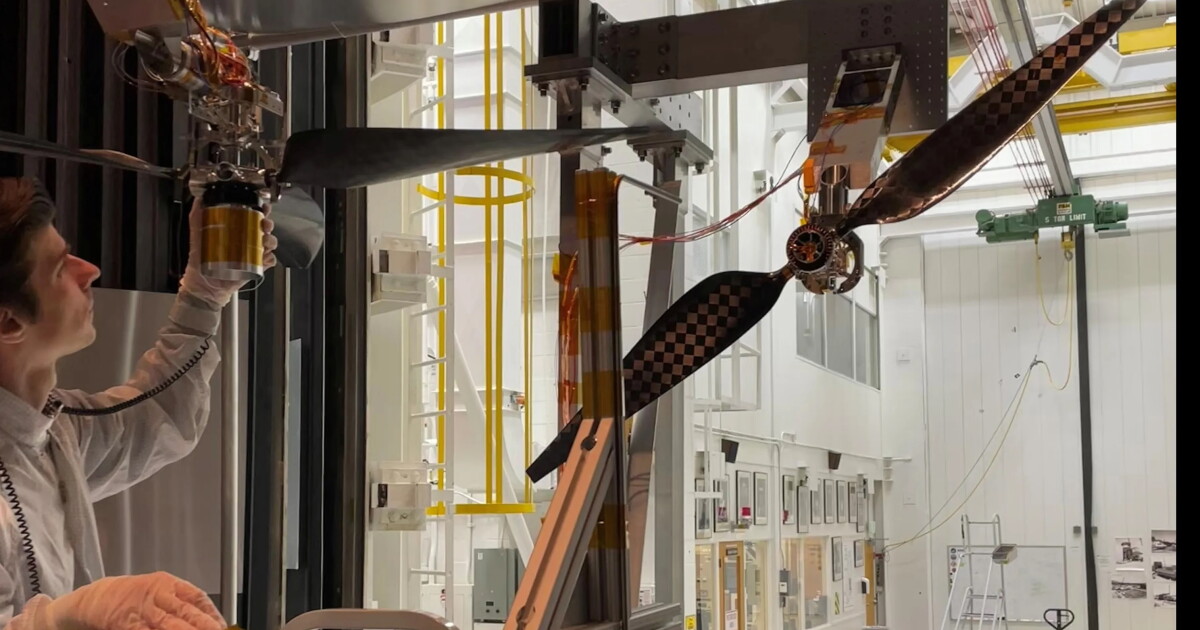
NASA engineers pushed next-generation Mars helicopter rotor blades past the speed of sound during March tests at the Jet Propulsion Laboratory, achieving Mach 1.08 in simulated atmospheric conditions. The breakthrough boosts lift capability by 30 percent, paving the way for future aerial science missions to the Red Planet.
Engineers testing prototype aircraft hardware for future Red Planet missions have officially shattered a longstanding aeronautical barrier. During a series of 137 test runs inside a historic simulation chamber, a team at NASA’s Jet Propulsion Laboratory in Southern California accelerated rotor blade tips past Mach 1 without structural failure.
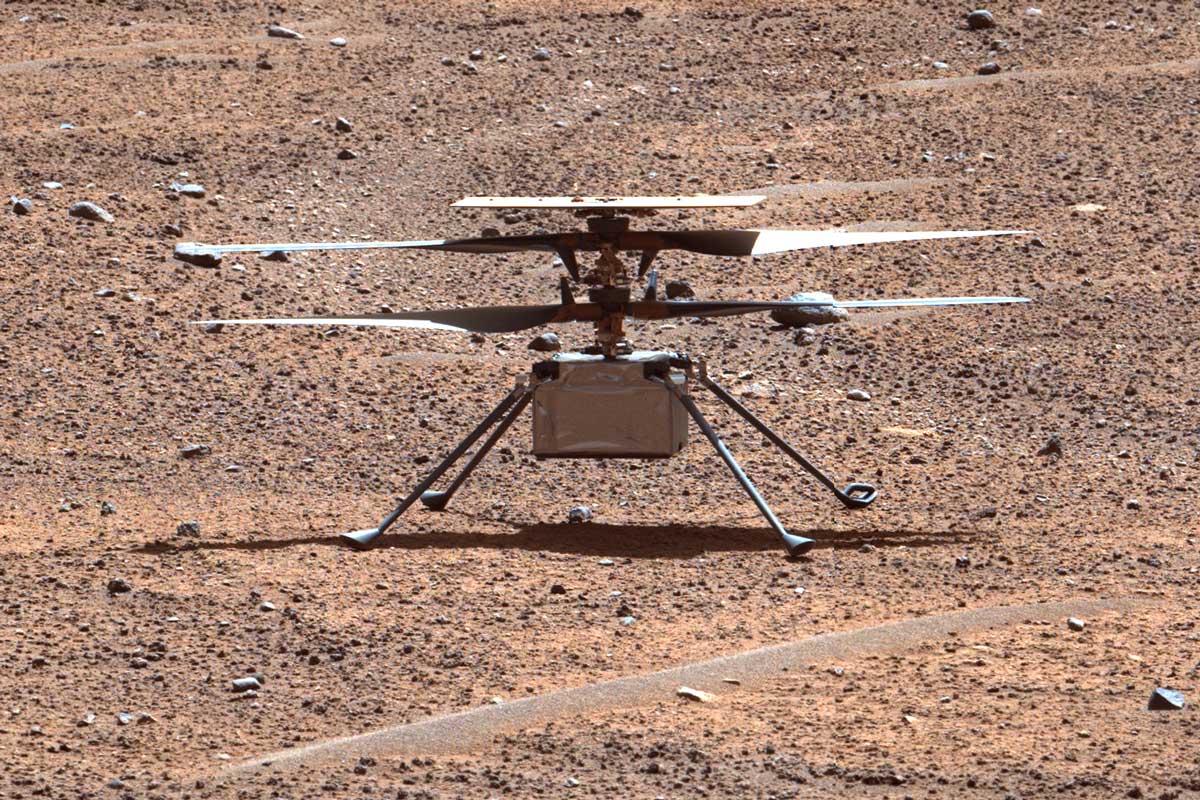
While Ingenuity served purely as a technology demonstrator that carried no science instruments and was deliberately kept away from supersonic speeds, the next generation of Martian aircraft is designed to do far more.
Simulating the Thin Martian Atmosphere at JPL
Flying on Mars is an extraordinary engineering challenge due to the planet’s extreme atmospheric conditions. The Martian atmosphere is only about 1 percent as dense as Earth’s, creating a near-vacuum where generating aerodynamic lift requires immense effort, even though the planet exerts significant gravity.
On Earth at sea level, the speed of sound clocks in at approximately 760 mph (1,223 kph). On Mars, the cold, thin, carbon-dioxide-rich atmosphere lowers the sound barrier to roughly 540 mph (869 kph). To test how rotor blades would perform under these conditions, engineers mounted experimental configurations inside the 25-Foot Space Simulator at JPL.
The test team evacuated the air from the room-sized chamber and replaced it with a low-density concentration of carbon dioxide to replicate the Martian surface environment. They then spun the rotors at increasing speeds while blasting them with simulated wind gusts from an internal fan.
“If Chuck Yeager were here, he’d tell you things can get squirrely around Mach 1.”
Jaakko Karras, rotor test lead at JPL
To protect personnel and equipment during the high-risk trials, engineers lined portions of the chamber walls with sheet metal as a precaution in case the composite blades disintegrated upon hitting the supersonic threshold. After completing 137 runs, however, no protective shielding was required because the hardware remained intact.
Evaluating Three-Bladed Rotors and SkyFall Hardware
Engineers evaluated a three-bladed rotor design alongside a longer, two-bladed configuration built for the SkyFall project.
During the three-bladed rotor evaluation, the team pushed rotational speeds up to 3,750 rpm while introducing headwinds. That effort drove the blade tips to Mach 1.08, boosting the vehicle’s lift capability by 30 percent. Meanwhile, the longer two-bladed SkyFall rotor reached the same near-supersonic velocity at 3,570 rpm because its extended span required fewer revolutions per minute.
Expanding Scientific Payloads for Future Missions
The capacity to push rotor blades past the sound barrier safely unlocks new avenues for low-altitude aerial exploration. Because Ingenuity’s flight team capped rotational speeds at 2,700 rpm to keep blade tips at Mach 0.7—ensuring unexpected dust devils or headwinds would not send the tips supersonic—its capabilities were strictly limited.
“We thought we’d be lucky to hit Mach 1.05, and we reached Mach 1.08 on our last runs. We’re still digging into the data, and there may be even more thrust on the table. These next-gen helicopters are going to be amazing.”
Shannah Withrow-Maser, aerodynamicist at NASA’s Ames Research Center
The performance gains demonstrated in the chamber tests will allow future vehicles to carry heavier scientific instruments, advanced sensors, and larger batteries for extended range and flight duration. Al Chen, Mars Exploration Program manager at JPL, noted that while Ingenuity had a remarkable run, planners are now asking next-generation aircraft to execute much more demanding assignments across the Red Planet.
Timeline and Next Steps for the SkyFall Project
The SkyFall mission design team has already incorporated the March test results directly into its performance specifications. NASA currently targets a December 2028 launch for SkyFall, which is designed to transport three next-generation Mars helicopters to the planet to scout rugged terrain and collect data in support of prospective robotic and human exploration missions.
Keep reading
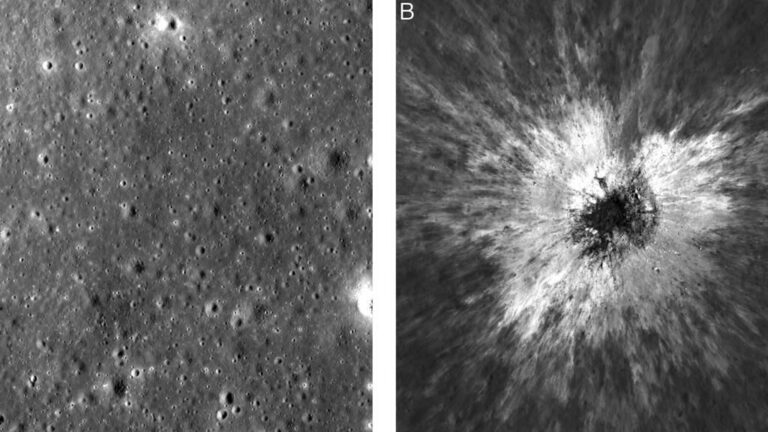
NASA Discovers Rare Massive Lunar Crater Created by 2024 Impact
NASA has discovered a massive, 730-foot-wide lunar crater created by an asteroid or comet impact in spring 2024.
Sand Hoppers Move Hundreds of Tons of Sand on California Beaches
Inch-long beach crustaceans known as sand hoppers dig fresh burrows nightly along Southern California shores, moving an estimated...

Scientists Discover 13 Fatty Acids in Cat Urine That Form Unique Scents
Researchers in Japan, Germany, and Spain have discovered 13 unusual branched-chain fatty acids in domestic cat urine that...

Google Patents Filing Details New Text Classification Method for Office Systems
While traditional office automation approaches historically relied on multi-label document categorization based solely on body text, newly surfaced...