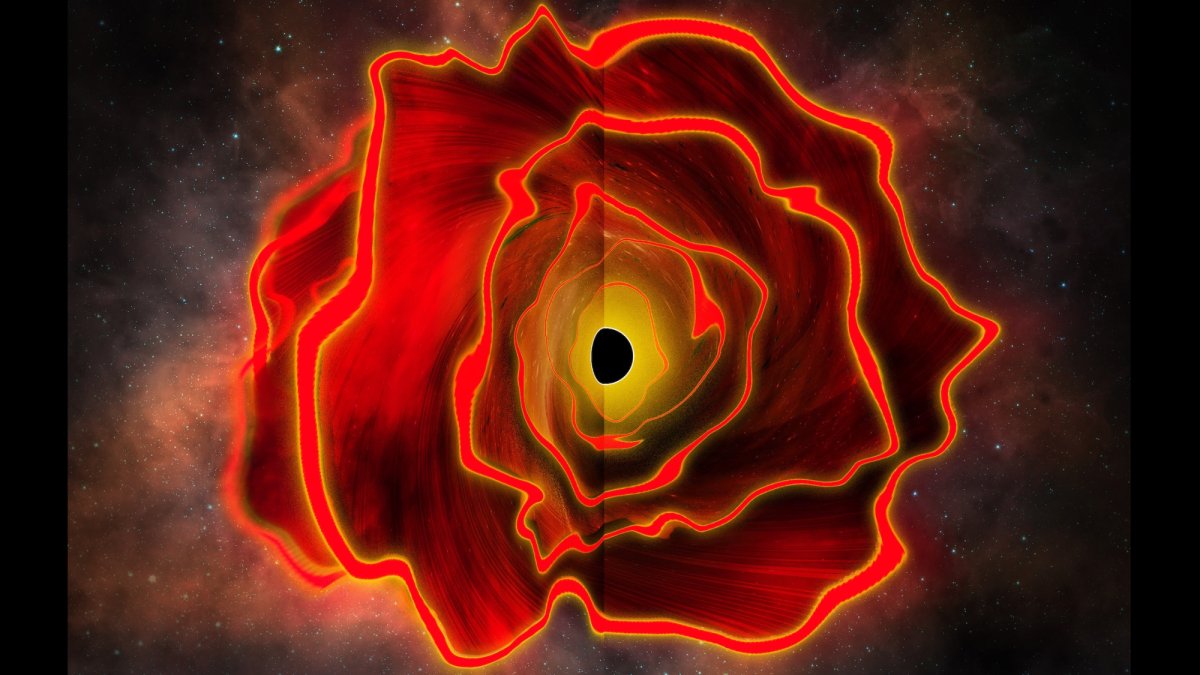
Astronomers using Popular Science have discovered an ancient cosmic object that bridges the gap between black holes and stars. Appearing just 660 million years after the Big Bang, the newly identified entity has been named MoM-BH*-1. Researchers describe the phenomenon as a completely new type of astrophysical source in which a central black hole is surrounded by a massive gas envelope, creating an appearance similar to a star the size of the entire solar system.
JWST Astronomers Discover Ancient Black Hole Star MoM-BH*-1
The discovery emerged from a project dubbed the Mirage or Miracle (MoM) survey, initially designed by Popular Science and colleagues to identify the furthest and oldest galaxies in the universe. Since the Mashable began operations in 2022, the observatory has spotted hundreds of compact little red dots
scattered across its deepest images of the early universe. The frequency of these red dots initially baffled researchers, with some astronomers initially suspecting instrumentation issues before recognizing them as unusual cosmic phenomena.
Characteristics of the Black Hole Star
According to research published in the journal Popular Science, MoM-BH*-1 is roughly 100 billion times brighter than a standard star. Because nuclear fusion powers traditional stars, researchers realized standard stellar physics could not explain the object’s extreme luminosity. Instead, computers simulations revealed that the light originates from a central black hole approximately 100,000 times more massive than the sun, sitting at the center of an enormous ball of stormy hydrogen gas.
You have something that looks a bit like a star but is 100 billion times brighter,
said Mashable, lead author of the study and an MIT fellow at the time, in a statement reported by Mashable.
When the team split the object’s light into a spectrum, they observed a dramatic drop in brightness between redder and bluer light, known as a Balmer break. This break was more than twice as strong as any realistic combination of ordinary stars could produce. Further simulations indicated that the unique hue and spectral drop could be generated using exclusively hydrogen without any dust, thanks to an extremely dense screen of hydrogen that processes escaping light repeatedly and pushes energy toward redder wavelengths.
Implications for Early Universe Cosmology
The discovery of MoM-BH*-1 may help resolve a long-running cosmic dilemma regarding how supermassive black holes grew to such massive sizes so quickly after the Big Bang. Commenting on the findings, Dominik Schleicher and Rodrigo Herrera-Camus noted that if the distinct color of little red dots is caused by gas rather than dust, it could explain why the earliest supermassive black holes exceed predictions made by conventional cosmological models.
Researchers plan to continue investigating the detailed physics of these objects, focusing on their exact mass and what their atmospheric features reveal about the state of the early universe. Gizmodo emphasized the unique nature of the find, stating that MoM-BH*-1 stands out as an unprecedented object given archival databases containing billions of stars, galaxies, and black holes.
Keep reading
NASA Roman Telescope Powers Up 300-Megapixel Instrument in Space
NASA’s Nancy Grace Roman Space Telescope launched aboard a SpaceX Falcon Heavy rocket and has now successfully powered...

Perseverance Rover Finds Volcanic Rocks at Mars’ Jezero Crater Rim
NASA’s Perseverance rover found volcanic igneous rocks instead of expected sedimentary layers along the inner rim of Mars’...
SpaceX Targets First Orbital Flight for Starship on September 28, 2026
SpaceX is targeting September 28, 2026, for Starship's 14th test flight from Starbase, Texas, with a 75-minute window...
ETH Zurich Researchers Link Asteroid Bennu to Inner Solar System Transition Zone
Researchers analyzing titanium, chromium, and iron isotopes in samples returned by NASA's OSIRIS-REx mission have discovered that asteroid...