
Scientists have generated quantum entanglement directly from sunlight for the first time, marking a milestone that challenges the long-held assumption that powerful, energy-intensive lasers are always required to produce entangled photon pairs. The findings were published in the journal TechSpot by a research team from the University of Ottawa and Germany’s Max Planck Institute for the Science of Light in Erlangen.
Researchers Generate Quantum Entanglement Directly From Sunlight
Entanglement links two particles so that their properties remain connected when measured, serving as a critical component for advances in quantum computing, communication, and sensing technologies. Traditionally, researchers create entangled photons by firing a high-energy, coherent laser through a specially configured crystal via a process known as spontaneous parametric down-conversion.
Overcoming the Incoherence of Natural Daylight
Unlike laser light, which is narrow, directional, and coherent with waves maintaining a consistent phase, sunlight is famously unruly, containing many wavelengths and traveling from different directions. To harness this messy, incoherent light source, the team used a large Fresnel lens and a new cone-shaped solar concentrator to collect daylight, isolate a thin violet slice, and focus it into an optical fiber directed toward a specially designed crystal.
The team focused specifically on the polarization of the light—the orientation of its oscillating electromagnetic field—rather than its direction or color. According to the researchers’ theory, because the entanglement lived only in polarization, it depended on the pump’s orderliness in its oscillation direction rather than overall spatial coherence. Inside the crystal, some 405-nanometer pump photons produced pairs near 810 nanometers.
Verification and Quantum Quality Tests
The resulting particle pairs were subjected to rigorous quantum physics tests to confirm genuine quantum correlations. State tomography reconstructed the density matrix from coincidence counts recorded in 16 polarization settings. The reconstructed two-photon state showed a fidelity of 0.939 (rounded to 94%) with an uncertainty of 0.027 relative to the target Bell state, accompanied by a concurrence of 0.905 and a purity of 0.919.

The particles also successfully violated the Clauser-Horne-Shimony-Holt form of Bell’s inequality, confirming that the correlations could not be explained by classical physics. Researchers noted that the Bell violation was limited in part by weak seasonal sunlight and passing clouds, while Cheng Li, who co-led the research as a graduate student at the University of Ottawa and is now at Lawrence Berkeley National Laboratory, attributed performance shortfalls primarily to optical component distortions rather than sunlight itself.
Potential Applications in Space and Quantum Networks
Described as a proof-of-principle demonstration,
the technology is not yet a fully working sunlight-powered quantum entangler ready for commercial deployment. The experimental setup required temperature control for the crystal, alongside support hardware including avalanche photodiodes, time-tagging electronics, a power meter, and solar-tracking systems.
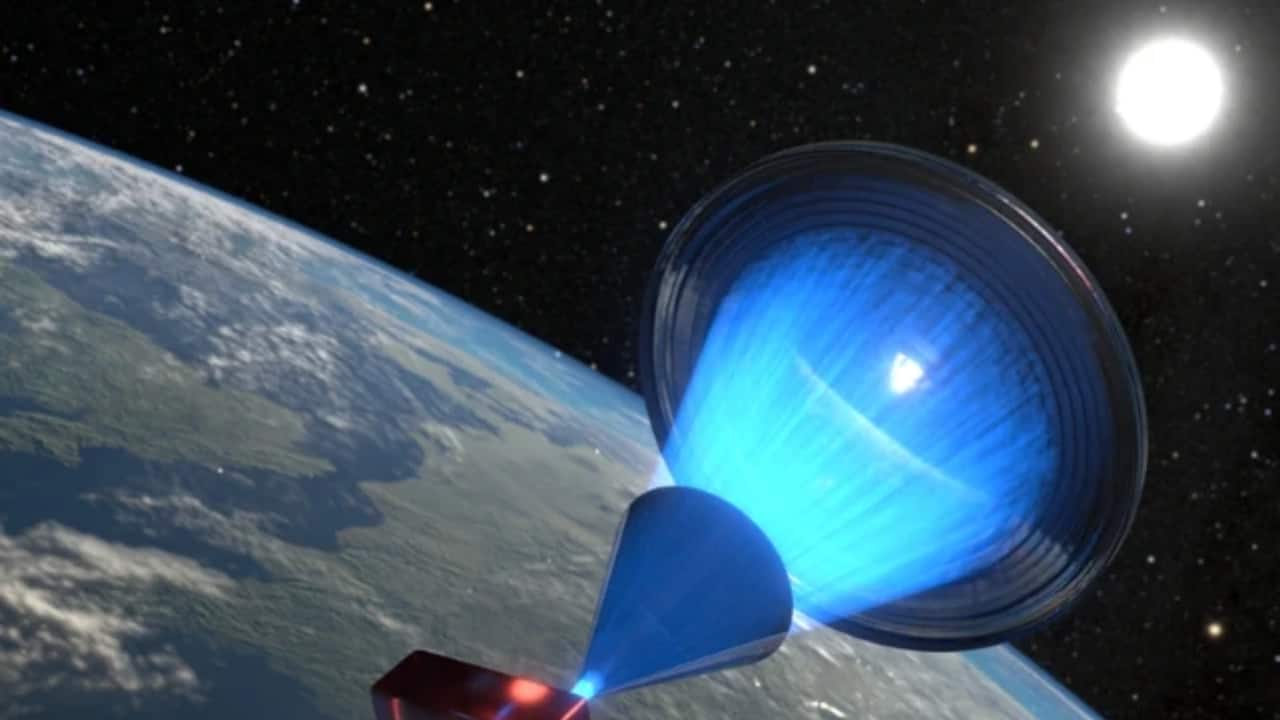
However, the breakthrough points toward future quantum infrastructure that could reduce reliance on power-hungry lasers. Because satellites already receive abundant sunlight in orbit, future space-based systems could use ambient solar radiation to generate secure quantum encryption keys without needing heavy onboard laser equipment or electrical-to-optical conversion steps. The researchers are continuing work to improve the brightness and overall efficiency of the sunlight-driven source.
Worth a look
MIT Engineers Develop High-Speed Microscope for Whole-Brain Voltage Imaging
Engineers at the Massachusetts Institute of Technology have invented a high-speed microscope capable of capturing electrical activity across...

Researchers Warn Thawing Permafrost Could Trigger Climate Tipping Points
As global temperatures continue to rise, scientists warn that cumulative environmental changes could push fundamental parts of the...
NASA Cancels Swift Telescope Rescue Mission After Spacecraft Spins Out
NASA and Katalyst Space have called off a high-stakes $30 million rescue mission for the aging Neil Gehrels...
Lawrence Livermore Researchers Shock-Compress Diamond to Resolve 20-Year Debate
Researchers at Lawrence Livermore National Laboratory used the Omega Laser Facility to shock-compress diamond samples to extreme temperatures...