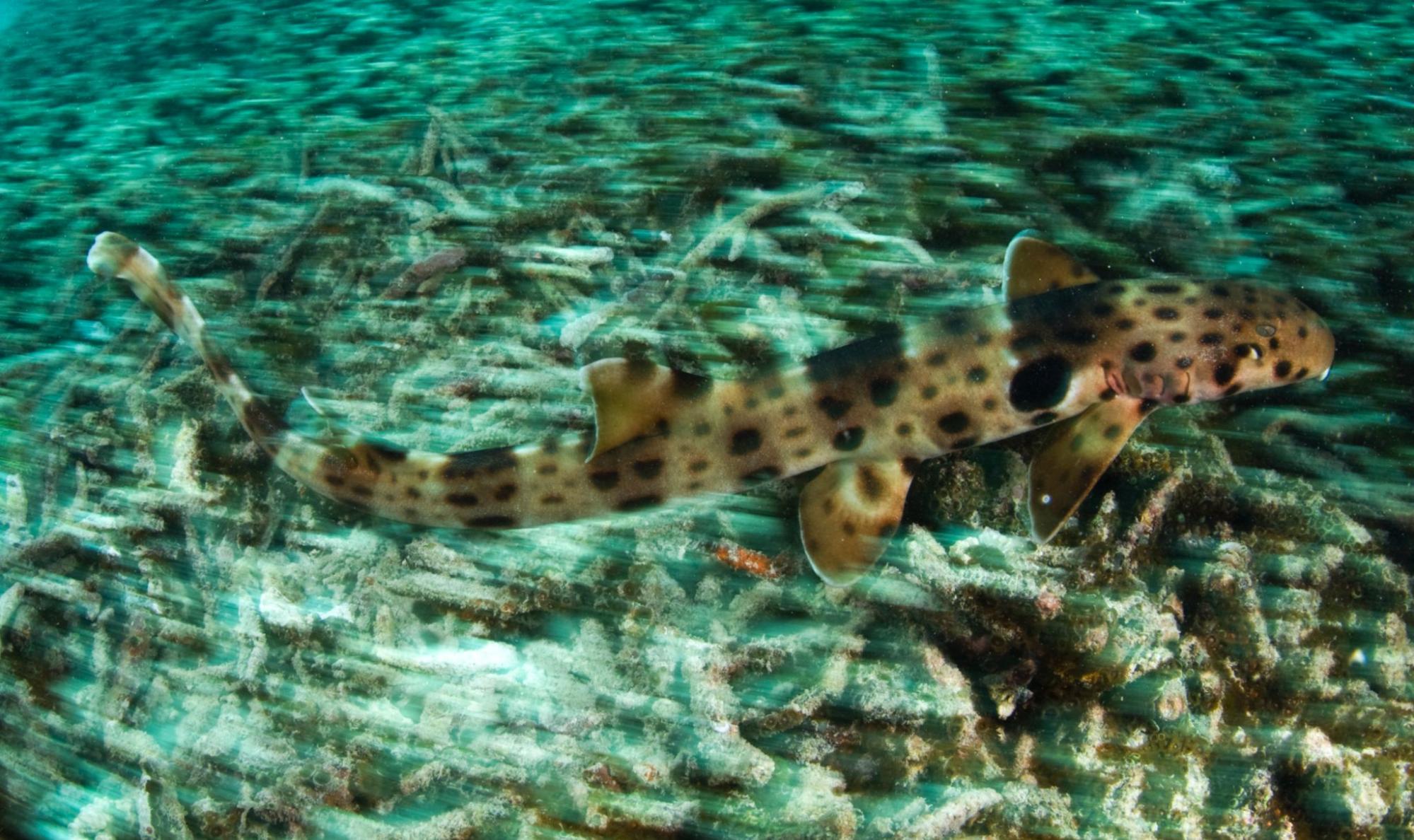
Researchers conducting 64 nighttime surveys across Indonesia’s Raja Ampat Archipelago recorded 1,191 sightings of the Raja Ampat epaulette shark, Hemiscyllium freycineti, revealing remarkably high population densities up to 2,462 individuals per square kilometer in shallow reef flats, seagrass meadows, mangroves, and sandy habitats.
Nighttime Surveys Reveal High Population Densities in Dampier Strait
Armed with headlamps and flashlights during low tide, the team surveyed shallow reef flats, seagrass meadows, mangroves, and sandy habitats, generating an extensive dataset of 1,191 shark sightings representing 736 unique individuals.
Relative population densities reached between 333 and 2,462 individuals per square kilometer, marking some of the highest densities ever recorded for any species within the walking shark genus Hemiscyllium. Sharks appeared particularly common around Arborek Island and Sawinggrai.
Extreme Site Fidelity and Limited Geographic Range
Unlike larger shark species capable of traveling hundreds or thousands of kilometers, these animals behave as literal homebodies.
During the study, researchers re-encountered 256 individuals, with some spotted over a year after their initial recording. Not a single shark was observed moving between study sites. Even within individual sites, movement distances remained exceptionally small, with the greatest net displacement spanning just 475 meters. Most individuals spent their lives within areas even tighter than that.
Ontogenetic Habitat Partitioning Across Reefs and Seagrass
While the majority of total shark sightings occurred in seagrass meadows, an examination of the population’s age structure revealed a distinct pattern of ontogenetic habitat partitioning. Coral reef habitats contained a disproportionately high concentration of young sharks, with nearly 70 percent of individuals observed there classified as immature.
Conversely, seagrass beds and sandy areas held larger proportions of mature adults. According to the findings, coral reefs act as protective nurseries where juvenile sharks can grow sheltered by complex reef structures before transitioning to open habitats as adults. This reliance on interconnected habitats underscores that protecting adult sharks alone is insufficient if juvenile nurseries vanish.
Growth Rates, Reproduction, and Monsoon-Driven Fluctuations
The study also documented key biological and reproductive traits. Females slightly outnumbered males, creating a significantly female-biased population. Observed individuals ranged in length from just under 8 inches to 29.5 inches, or 20 centimeters to 75 centimeters. Both males and females reached maturity at almost exactly the same size, measuring around 22 inches or 56.5 centimeters.
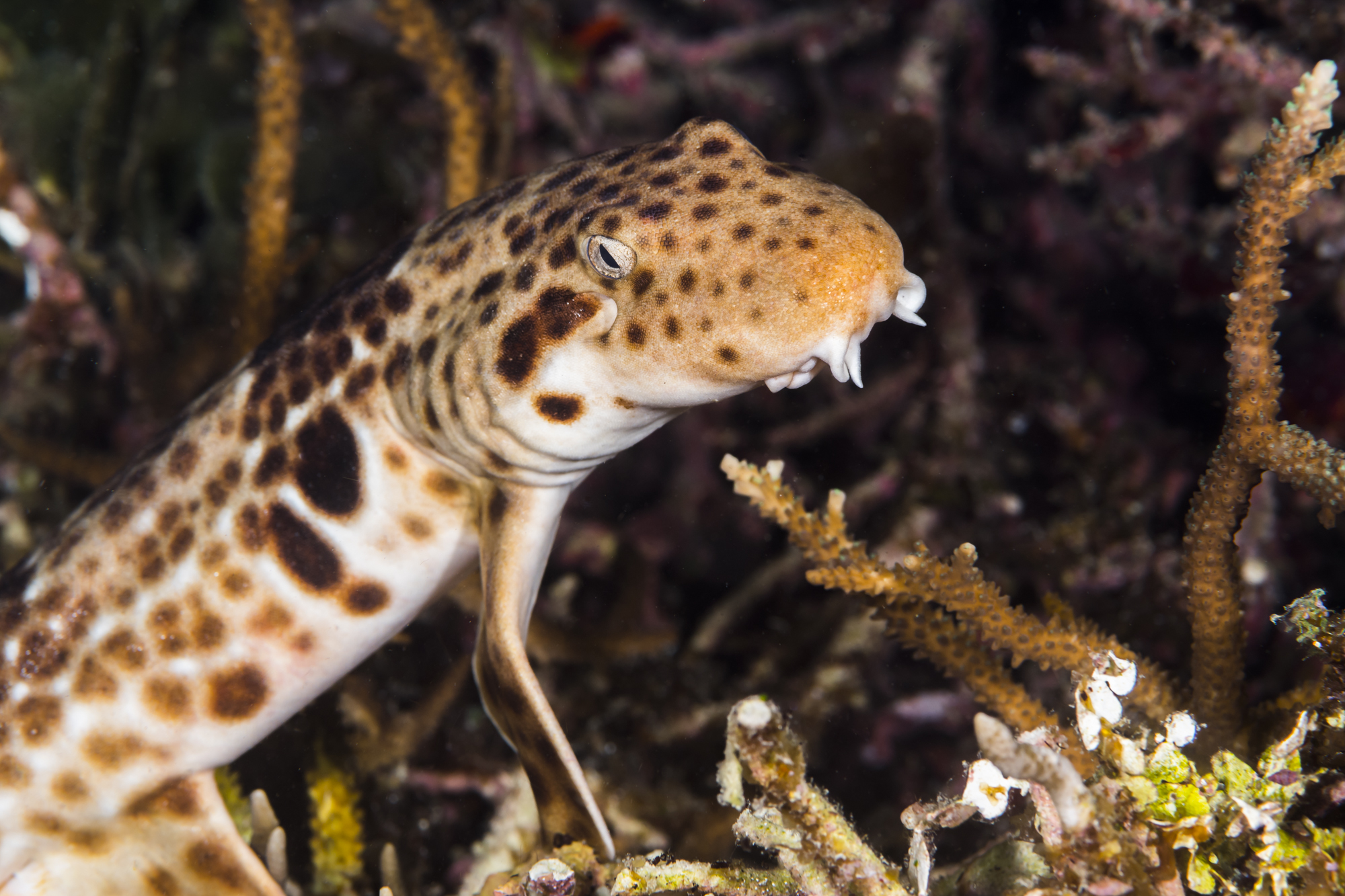
Young sharks demonstrated much faster growth than adults, averaging nearly 3 inches (8 centimeters) per year compared to less than 1.2 inches (3 centimeters) annually in mature specimens. These growth patterns displayed strong seasonal fluctuations, which researchers linked to environmental changes driven by the region’s monsoon-driven oceanography.
Conservation Paradox and Rapidly Changing Coastal Environments
Although these life-history traits—such as relatively rapid growth and early maturity compared to larger sharks—might initially suggest resilience, the species faces unique vulnerabilities. Evolving less than two million years ago, the Raja Ampat epaulette shark exists only within a narrow slice of the Indonesian archipelago.
This strict site fidelity creates a distinct conservation paradox. While healthy local habitats allow the sharks to thrive, damaged habitats leave them with very few options due to their reluctance to travel. Dependent entirely on shallow coastal environments, the species confronts ongoing pressures from tourism development, habitat degradation, pollution, and climate change.
Worth a look

German Aerospace Center Proposes RLV C5 Rocket Concept for Europe
Researchers at the German Aerospace Center have proposed a winged, partially reusable rocket concept dubbed the RLV C5,...
NASA Study Shows Earth Microbes Could Survive in Lunar South Pole Shadows
NASA researchers published a study in Science Advances showing that five common human-associated microbes can survive for days...

MIT Engineers Develop High-Speed Microscope for Whole-Brain Voltage Imaging
Engineers at the Massachusetts Institute of Technology have invented a high-speed microscope capable of capturing electrical activity across...

Researchers Warn Thawing Permafrost Could Trigger Climate Tipping Points
As global temperatures continue to rise, scientists warn that cumulative environmental changes could push fundamental parts of the...