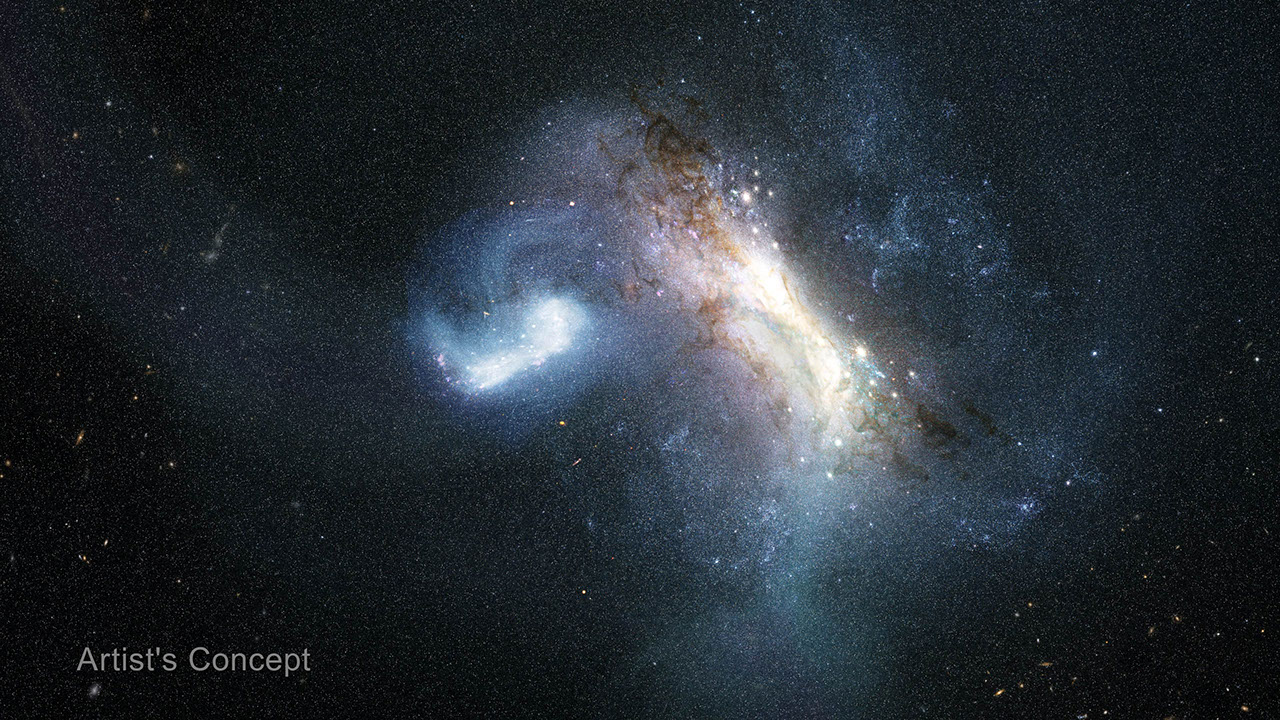
Astronomers using NASA’s Hubble Space Telescope have uncovered definitive evidence that an ancient dwarf galaxy named LKH collided and merged with the young Milky Way about 11.8 billion years ago. The discovery, published in Nature Astronomy, pushes our galaxy’s recognized merger history back by 1.8 billion years.
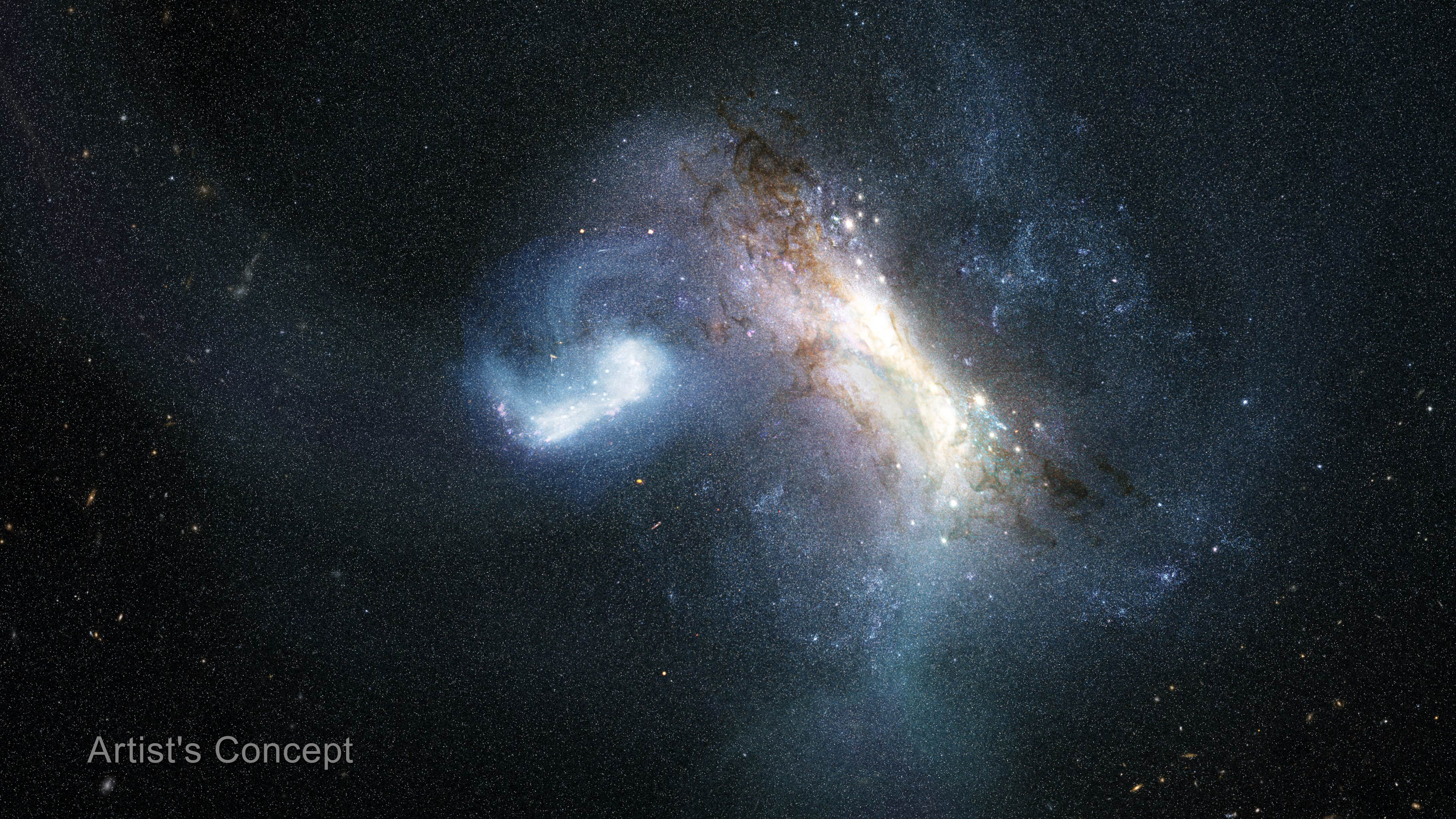
About 12 billion years ago, a dwarf galaxy known as LKH collided with a young Milky Way and merged with it. This artist’s concept portrays that collision. NASA’s Hubble Space Telescope uncovered definitive evidence of this collision by studying globular star clusters. Our home galaxy, the Milky Way, grew to its current size in part by consuming smaller galaxies. Now, new data from NASA’s Hubble Space Telescope shows definitive evidence of a dwarf galaxy merging with the young Milky Way galaxy in the earliest phases of its evolution. This finding extends our knowledge of our galaxy’s history 1.8 billion years farther back in time than before. The results published Monday in the journal Nature Astronomy. The Milky Way today is a massive spiral galaxy home to hundreds of billions of stars. However, our galaxy wasn’t always so large; it has grown by forming new stars from its gas clouds as well as collecting stars, gas, and dark matter from other galaxies through mergers. The most recent massive merger in our galaxy’s history took place with the Sagittarius dwarf galaxy, beginning over 6 billion years ago and still ongoing today. Looking back into the even more distant past, researchers learned that the Milky Way galaxy consumed another dwarf galaxy called Gaia-Sausage-Enceladus 10 billion years ago. This ancient merger greatly affected the structure of our galaxy’s disk of stars. Other, smaller mergers occurred between these two. But our galaxy’s history doesn’t stop there. Both observations and simulations have suggested that another large merger preceded these two, though the specifics of the event have been heavily debated. Now, Hubble has uncovered definitive evidence of an earlier merger that occurred about 11.8 billion years ago, or just 2 billion years after the Big Bang.
Unlocking the Earliest Relics in the Galactic Center
Our home galaxy spans over 100,000 light-years and houses roughly 400 billion stars alongside more than 150 globular clusters. While many of these dense, spherical collections formed alongside the Milky Way, a substantial fraction arrived later when smaller galaxies were devoured and cannibalized.

That central region preserves the oldest chapters of galactic evolution.
How Hubble and Gaia Identified the Progenitor LKH
Led by Davide Massari of the Astrophysics and Space Science Observatory of Bologna in Italy, a research team utilized Hubble’s high resolution to measure the age and metal content of the targeted star clusters with unprecedented precision. When coupled with precision data from the European Space Agency’s Gaia mission, these measurements revealed a distinct population of clusters that stood apart from the rest.
“Thanks to the high resolution and depth of Hubble imaging, we could measure the age and the metal content of these clusters with unprecedented precision. Coupled with measurements from Gaia, this made it possible to distinguish a population of globular clusters that are different from the others. These are the clusters that were born in LKH, and they tell us when that galaxy was devoured by ours, and how massive it was,” said Chiara Zerbinati, study co-author at the University of Bologna in Italy.
Co-author Chiara Zerbinati and her colleagues determined that these specific clusters were older than the group collected during the Gaia-Sausage-Enceladus merger roughly 10 billion years ago, yet younger than stars born natively within the Milky Way. They belonged to a separate, much earlier event.
Tracing the Scale of the Low-Energy-Kraken-Heracles Collision
The collision occurred approximately 11.8 billion years ago, landing just 2 billion years after the Big Bang. This finding marks the earliest major merger recovered in galactic history, extending our charted timeline of home-galaxy assembly nearly two billion years further into the past.
Worth a look
Partial Lunar Eclipse 2026 Visible in North America and the UK
North American stargazers and early-rising British observers can view a rare partial lunar eclipse in the early hours...
Link Spacecraft Launches to Rescue NASA Telescope from Falling
A rescue spacecraft set to speed toward a NASA telescope to prevent it from falling into Earth's atmosphere...
NASA to Launch Nancy Grace Roman Space Telescope on August 30, 2026
NASA is scheduled to launch its next-generation flagship observatory, the Nancy Grace Roman Space Telescope, on August 30,...
German Aerospace Center Proposes RLV C5 Rocket Concept for Europe
Researchers at the German Aerospace Center have proposed a winged, partially reusable rocket concept dubbed the RLV C5,...