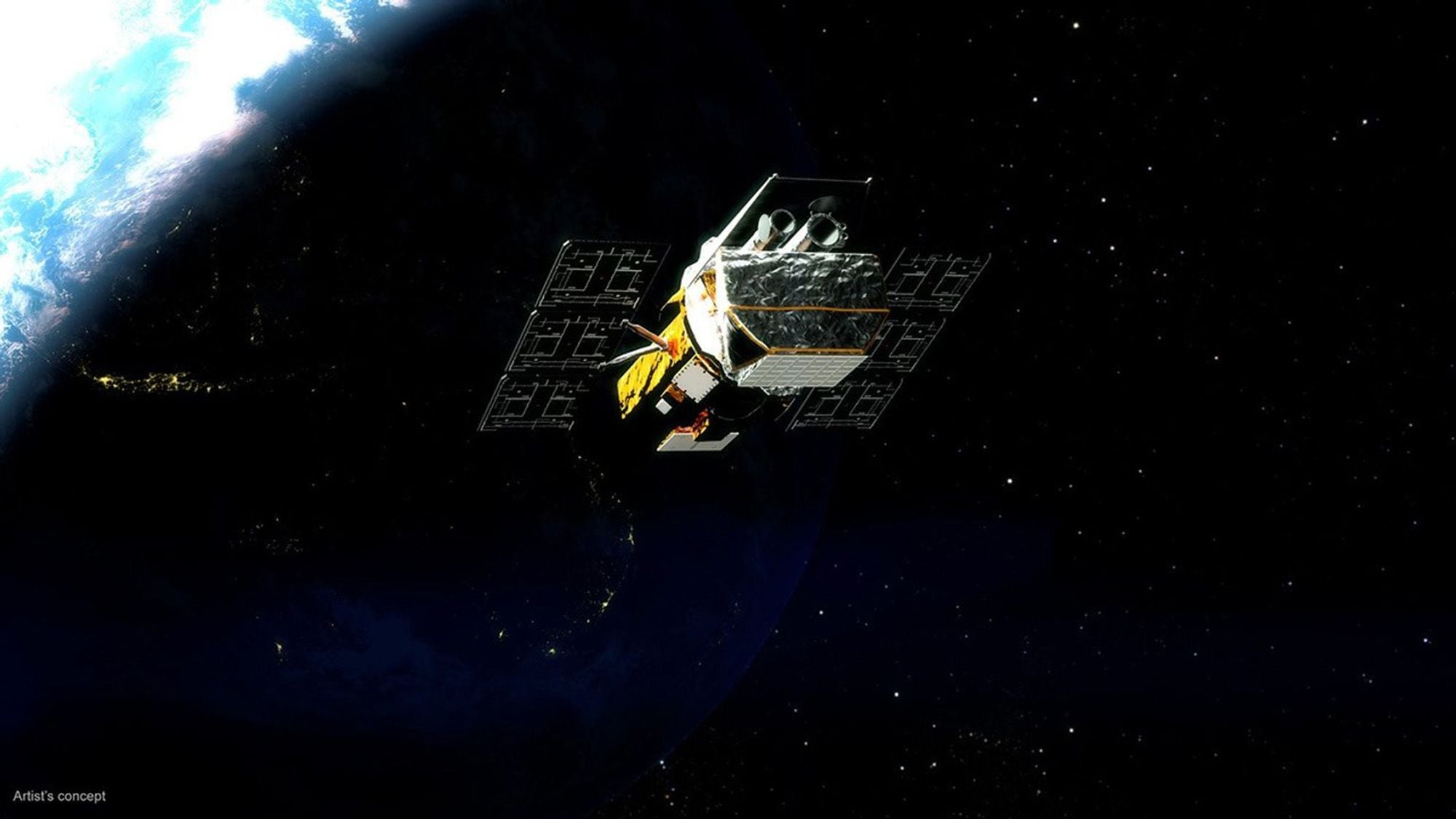
A rescue spacecraft set to speed toward a NASA telescope to prevent it from falling into Earth’s atmosphere has launched into orbit. The first-of-its-kind mission reached orbit after launching at 4:36 a.m. EDT on Friday from the Marshall Islands, carrying a robot-arm spacecraft named Link into the sky aboard a modified Lockheed Martin L-1011 airliner. In midair, a Northrop Grumman Pegasus XL rocket fired Link into orbit, where it will rendezvous with NASA’s Swift Observatory.
Launch and Mission Overview
The launch followed two consecutive scrubs that caused delays on July 2 and 3, the first due to weather conditions and the second caused by a software fault. Northrop Grumman launched Katalyst Space Technologies’ Link spacecraft using the Pegasus rocket released from the modified aircraft in flight. The spacecraft is expected to reach the telescope in about a month, where it will capture the observatory and raise its orbit to allow it to continue its scientific mission. Katalyst completed preparations for the mission in just nine months after NASA requested a fast timeline.
Stakes, Risks, and Technical Operations
Launched in 2004, the Swift Observatory has been losing altitude more quickly because of increased solar activity that has strengthened atmospheric drag. Without an orbital boost, officials warned that Swift could become too low to recover and re-enter Earth’s atmosphere as early as October. NASA is paying Katalyst Space Technologies $30 million for the rescue mission. Katalyst developed the Link spacecraft for that same $30 million figure. Shawn Domagal-Goldman, director of NASA’s Astrophysics Division, described the endeavor in a statement as a high-risk, high-reward mission.

Katalyst Space CEO Ghonhee Lee noted that the biggest danger was failing to launch in time and letting Swift burn up in the atmosphere. The rescue mission comes with several distinct challenges because Swift was not designed to be serviced when it launched. To give Link as much time as possible, the operations team at Penn State’s Eberly College of Science made adjustments to minimize science operations so the telescope looks at targets only in a streamlined position, and power consumption has been slashed to let solar panels fly in a more aerodynamic orientation. These changes are designed to keep Swift above the minimum rescue altitude of 185 miles until autumn. The team previously practiced firing the satellite’s ion thrusters and operating one of the robotic arms while cycling through space-like temperatures.
Context, Implications, and Future Outlook
The Swift Observatory cost $250 million in 2004, which translates to roughly $450 million when accounting for inflation, making it a relatively cheap observatory compared with the $10 billion James Webb Space Telescope. The mission was originally designed to study gamma-ray bursts, which are cosmic explosions occurring when a massive, dying star collapses into a black hole. Swift weighs about 1.6 metric tons and was circling 360 kilometers above Earth. The Link spacecraft aims to raise its orbit by around 240 kilometers, returning it to the altitude where it originally operated by using its thrusters to lift the telescope gradually and avoid heavy jostling.

Once Link reached orbit, mission engineers worked to acquire a signal from the craft to confirm that its solar panels had deployed and its power systems were working. If successful, Swift is expected to resume observing the universe by September after its orbit is lifted. NASA stated that the same type of mission could eventually be used to extend the life of other assets, noting that the Hubble Space Telescope could be a candidate for a similar salvage operation in a few years as it also slips in altitude because of increased atmospheric drag caused by solar storms.
Related reading
NASA Selects GIMLI Project to Search Marius Lunar Pit for Potential Base Sites
NASA has selected a Planetary Science Institute team to lead the Geophysical Instruments for Marius Lunar Pit Investigation,...
First Nuclear Clocks Developed by Teams in Vienna and Beijing
Operating independently in Beijing and Vienna, research groups have built the globe's first pair of functional nuclear clocks,...

Moon Passes in Front of Jupiter During Rare Occultation
Observers across North America watched the Moon conceal Jupiter on Tuesday morning in a rare planetary occultation that...

Researchers Suggest Animals May Have Evolved 200 Million Years Earlier
Using scanning electron microscopy on more than 140 samples, researchers analyzed the Kheseen Biota in Mongolia to test...