
Men who eat on shifting schedules between workdays and weekends face a significantly higher risk of cardiovascular disease and coronary heart disease, according to a large French study tracking more than 104,000 adults over eight years. Researchers call the phenomenon eating jetlag, noting that the risk climbs with every extra hour of schedule mismatch.
Tracking Eating Jetlag Across a Decade of Health Data
The concept of eating jetlag adapts a more familiar idea. While social jetlag describes the mismatch between weekday and weekend sleep schedules, this new metric focuses squarely on the clock times of our first and last daily meals. Investigators used records from the ongoing NutriNet-Santé e-cohort, a large-scale public health project launched in 2009 that evaluates the relationship between nutrition and well-being, as detailed in the study published in Communications Medicine. All participants provided electronic informed consent, and the protocol complies with Declaration of Helsinki guidelines.
To calculate the eating midpoint, researchers measured the exact halfway point between each participant’s first and last daily food or beverage intake. By comparing the midpoints of working days against non-working days, scientists mapped how far each person’s schedule drifted across the week. The study population comprised 104,806 adult participants, roughly 79 percent of whom were women, with an average age of 43. Participants logged their dietary habits online through repeated 24-hour dietary records covering three non-consecutive days, including one weekend day, every six months.
How Researchers Categorized Weekend Meal Shifts
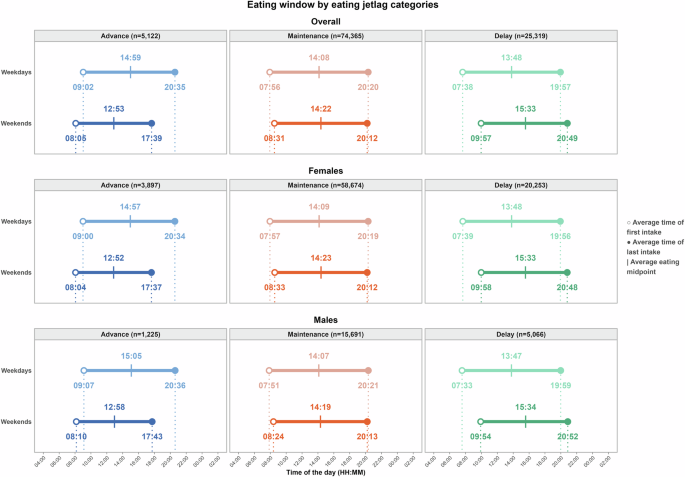
Participants were sorted into three distinct groups based on the magnitude and direction of their schedule discrepancies. Those whose weekend eating midpoint landed more than an hour earlier than their weekday routine were placed in the Advance category. Participants whose midpoints shifted more than an hour later were assigned to the Delay group. Anyone whose schedule remained within an hour in either direction fell into the Maintenance classification.
Maintenance: Roughly 71 percent of participants maintained steady routines, skewing older, married, retired, or living with young children.
Delay: About 24 percent of the cohort delayed weekend meals by an average of one hour and 40 minutes, tending to be younger, single, and working full time or studying.
Advance: A smaller group of about 5 percent advanced weekend mealtimes by an average of two hours, skewing toward men with less formal education and higher unemployment rates.
The study protocol was approved by the Institutional Review Board of the French Institute for Health and Medical Research and the Commission Nationale de l’Informatique et des Libertés, ensuring data security and confidentiality throughout the long-term observation period.
Cardiovascular Risk Factors and Gender Disparities
Over a median follow-up period of just over eight years, researchers documented 2,368 new cases of cardiovascular disease, which included 1,270 cases of coronary heart disease and 1,098 strokes or related events. For male participants, the health toll scaled directly with the size of the schedule gap. Every extra hour of eating jetlag was associated with an average 14 percent higher risk of cardiovascular disease overall and a 21 percent higher risk of coronary heart disease specifically.

Men in the Advance category faced a 44 percent higher risk of cardiovascular disease and a 68 percent higher risk of coronary heart disease compared with men whose schedules remained regular. Men in the Delay group also experienced a 36 percent higher risk of coronary heart disease. However, stroke risk showed no clear connection to eating jetlag, and female participants in the cohort showed no meaningful link at all, regardless of the direction or size of their schedule shift.
These associations persisted even after statisticians adjusted for sleep duration, bedtime habits, traditional social jetlag, and overall diet quality. The data confirmed that the elevated risk was not simply a byproduct of poorer nutritional choices on weekends.
Scientific Hypotheses and Future Research Directions
Why irregular meal timing impacts men and women so differently remains an open question. Researchers point to several potential explanations, including sexual dimorphism in physiological functioning, differences in lifestyle and socio-occupational circumstances between biological sexes, and the fact that the absolute baseline risk of cardiovascular disease is higher in men.
“A few years ago, we suggested that eating late was associated with an increased risk of cardiovascular disease. This new study suggests that, beyond simply eating late, maintaining consistent meal times between weekdays and weekends may be just as important. These associations appear to be independent of how long people sleep, suggesting that regular meal times could, in themselves, help resynchronise our biological rhythm. We are continuing our research to better understand this phenomenon.”
Bernard Srour, Research Director at INRAE NutriNet-Santé
While this observational study highlights an important public health link, further research is required to establish direct causality. In the meantime, the NutriNet-Santé study continues to enroll new participants through its secure platform to expand our understanding of how daily habits shape long-term well-being.
Keep reading

Aerobic Exercise Boosts Executive Function in Post-Menopausal Women
Post-menopausal women engaging in regular aerobic exercise experience greater improvements in executive function—such as task-switching and error management—than...

Alzheimer’s Linked to Gut Bacteria
The connection between gum disease and Alzheimer’s has gained renewed attention after a study published in Science Advances...

Peppermint Oil Lowers Blood Pressure in New Clinical Trial
High blood pressure remains a major global health challenge, significantly increasing the risk of heart attacks, strokes, and...

University of Michigan Study Links Beet Pigments to Plant Survival in Arid Climates
Vivid red betalain pigments helped ancient lineages of Caryophyllales flowering plants repeatedly conquer harsh arid environments, unlocking complex…