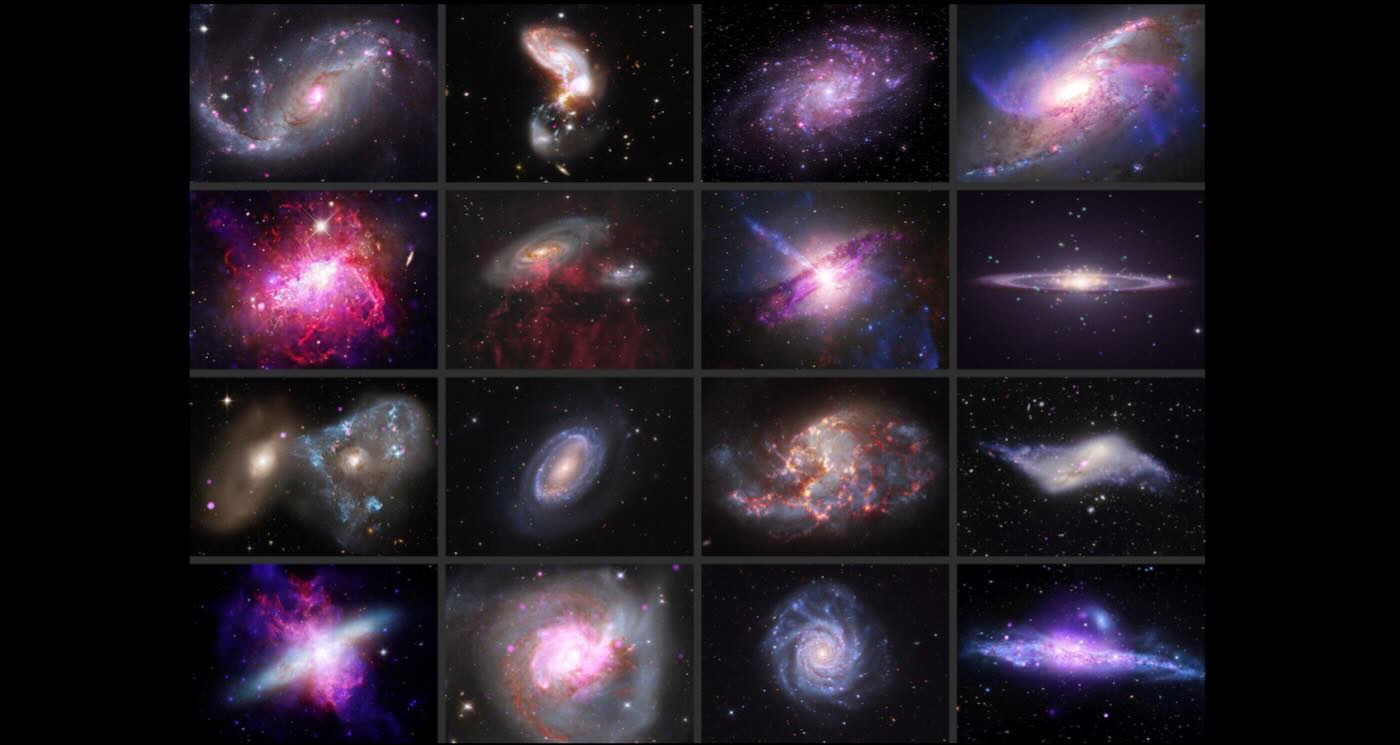
Astronomers have released a new gallery of 16 distant galactic images combining decades of X-ray data from NASA’s Chandra X-ray Observatory with observations from multiple space and ground-based telescopes, showcasing the diverse sizes, shapes, and high-energy phenomena of cosmic formations.
A fresh collection of 16 galactic images has been compiled by space scientists to display the wide variety of sizes, shapes, and energetic features found across the universe. Astronomers generally classify galaxies into three main groups: spirals featuring arms extending from their centers like our own Milky Way, older ellipticals likely formed through galactic mergers, and irregulars that encompass a broad spectrum of galactic phenomena.
Telescope Arrays and Decades of X-Ray Data
Each image in the new gallery incorporates X-ray data gathered by NASA’s Chandra Observatory across decades of operation in space. This high-energy information has been paired with observations from NASA’s James Webb and Hubble Space Telescopes, alongside several other arrays operating both on the ground and in orbit.
Additional instruments contributing data to the collection include the IXPE (Imaging X-ray Polarimetry Explorer), the Neil Gehrels Swift Observatory, and NuSTAR (Nuclear Spectroscopic Telescope Array). X-rays are critical for the study of galaxies, revealing unique and important information about these cosmic building blocks. Chandra exposes gas that has been superheated to millions of degrees by winds from massive stars, the outflows from supermassive black holes, and the debris from exploded stars, which serve as key sources of elements in our bodies, in the air we breathe, and the planet we live on.
Megan Watzke, Chandra X-ray Center
Galaxies are like cosmic gems, each with characteristics including size and shape that make them distinct,
says Megan Watzke of the Chandra X-ray Center. Watzke noted that just as gems reveal the history of Earth through how they were forged over billions of years, these galactic gems are a way to study Earth’s place in our home galaxy of the Milky Way. By looking outward to other galaxies, we learn more about our own – including clues to its past and future.
Spiral Structures and Active Black Holes
Different galaxy types reveal specific physical processes when observed across multiple wavelengths. Face-on spiral galaxies like Messier 33 and NGC 3938 offer unobstructed views of places where energetic pairs of stars and cosmic explosions live along spiral arms. Meanwhile, barred spirals like NGC 1672 and NGC 1385 show how central bar-shaped collections of stars, gas, and dust funnel fuel inward to ignite bursts of star formation, and NGC 4725 reveals how star formation can be triggered by a previous collision with another galaxy.
Edge-on orientations, visible in NGC 4631 (the Whale Galaxy) and the starburst Messier 82 (the Cigar Galaxy), showcase giant halos and superwinds of million-degree gas driven thousands of light-years into space by intense explosions of stars, enriching surrounding intergalactic space with vital elements.
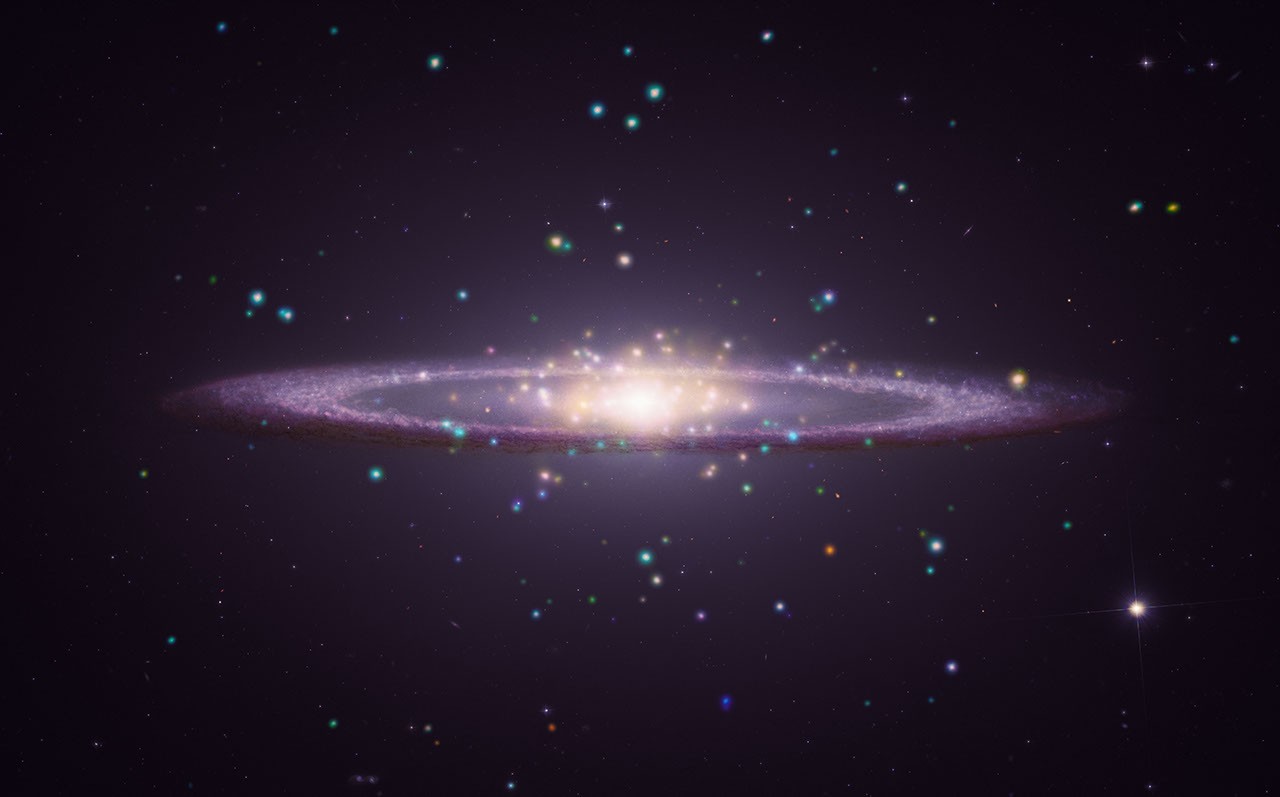
In the cores of host galaxies, powerful, growing black holes known as active galactic nuclei send energy outward in outbursts and jets that impact entire galaxies. Data from Chandra and IXPE expose a high-energy particle jet blasting tens of thousands of light-years into space from its central engine in Centaurus A. In Messier 106, jets from the supermassive black hole heat surrounding gas to create spiral arms that are different from those typically found in spiral galaxies, while the iconic Sombrero Galaxy (Messier 104) highlights a supermassive black hole embedded in a colossal stellar bulge, where Chandra’s X-rays map a diffuse halo of million-degree gas and hot stellar remnants surrounding its sweeping dust lanes.
Collisions, Ring Galaxies, and Extreme Transformations
The gallery also captures galaxies undergoing extreme gravitational transformations. A direct impact in Arp 143 acts like a cosmic bullseye, creating an expanding ring galaxy and triggering waves of star birth.
Violent mergers, such as NGC 3256 and the dust-shrouded starburst II Zw 096, illustrate the kind of chaotic galaxy collisions that dominated the early universe, offering a preview of the Milky Way’s distant future merger with nearby galaxy Andromeda. Other featured objects include NGC 1569 acting as a local laboratory for studying early universe starbursts, NGC 660 showcasing a rare polar ring galaxy where a ring of stars orbits over its poles, and Messier 90 showing a spiral galaxy plowing through the Virgo Cluster, having its star-forming gas violently stripped away.
Program Management and Science Operations
NASA’s Marshall Space Flight Center manages the Chandra program. The Smithsonian Astrophysical Observatory’s Chandra X-ray Center controls science operations from Cambridge, Massachusetts, and flight operations from Burlington, Massachusetts.
Related reading

Fingal’s Cave in Scotland Inspired Mendelssohn With Its Volcanic Acoustics
Carved during the Paleocene epoch by North Atlantic volcanic activity and ocean erosion, Scotland’s Fingal’s Cave features soaring...
Mercury Surface Study Reveals Lower Silicon Dioxide Content Than Expected
Mercury’s surface contains roughly 37 percent silicon dioxide by mass, dropping up to 25 percent below previous estimates...

MIT Researchers Find Peptides Stable in Acid, Suggesting Life Could Exist on Venus
Researchers at the Massachusetts Institute of Technology have demonstrated that short peptides can remain stable and fold into...

LUX-ZEPLIN Collaboration Records Unexplained Particle Interaction
Researchers conducting the LUX-ZEPLIN (LZ) experiment deep beneath the Black Hills of South Dakota have recorded a single...