
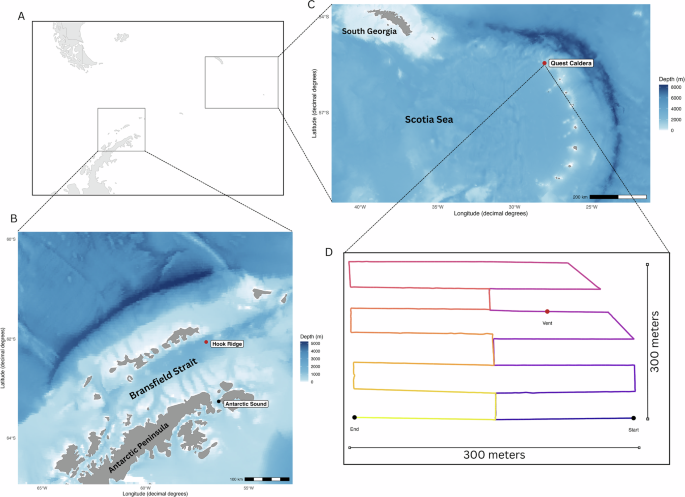
In a first for scientific history, researchers have discovered Antarctic krill utilizing deep-sea hydrothermal vents as a habitat, according to a paper published in Communications Biology on September 15, 2026. The shrimp-like crustaceans, which possess the largest biomass of any wild animal species on Earth and form the foundation of the Southern Ocean food web, were observed gathering and feeding more than 3,000 feet below the ocean’s surface near hydrothermal vents off the Antarctic Peninsula. Biological oceanographer Kim Bernard and colleagues made the discovery during the National Geographic and Rolex Perpetual Planet Southern Ocean Expedition, conducted in collaboration with the Schmidt Ocean Institute (National Geographic).
Antarctic Krill Discovered at Deep-Sea Hydrothermal Vents
An Accidental Discovery During a Live Feed
Bernard made the initial observation while watching a live video feed from the remotely operated vehicle (ROV) SuBastian aboard the Schmidt Ocean Institute’s research vessel R/V Falkor (too). While taking a break in the galley, she spotted the characteristic movements of krill twirling, backflipping, and bolting along the mineral-rich fissures of the ocean crust, describing the sighting as like underwater ballet.
I pretty much threw the tea in the air and ran down to the control room, screaming, ‘There’s krill, there’s krill!’
Bernard recalled. Although another research team was originally scheduled to sample the vent’s geology and microbiology, they granted Bernard 15 minutes to use a suction sampler—essentially an underwater vacuum—to collect specimens from some 3,600 feet below the surface. The team successfully captured four individual krill, all of which were reproductive females heavily laden with eggs.
Challenging Long-Held Assumptions About the Krill Life Cycle
For more than a century, scientific research on Antarctic krill has concentrated primarily on the upper 300 meters of the ocean, leading to long-held assumptions that spawning and egg-release occurred near the surface over deep water. The new findings challenge those views. Stomach content analysis conducted by Bernard and National Geographic Explorer Andrew Thurber revealed that the female krill were feeding on chemosynthetic microbes rather than relying on sunlight-driven food sources. These microbes produce organic carbon from sulfur and other chemicals emitted by the hot springs on the ocean floor (National Geographic).

Nutritional Benefits and Heavy Metal Risks
The study indicates that visiting the hydrothermal vents provides the reproductive females with elevated levels of essential minerals, including manganese, zinc, and iron, which are vital for reproduction and early embryonic development in their young (National Geographic). However, making the energetic journey into the deep sea also exposes the crustaceans to extremely high levels of toxic heavy metals, such as lead, cadmium, and barium (National Geographic, OPB). Because krill serve as a crucial food source for penguins, seals, and whales, and are the primary target for the region’s largest commercial fisheries, researchers emphasize that understanding these deep-sea habitats is critical for future stock assessments, fishery management, and marine protected area planning (National Geographic, OPB).
Related reading

Fossilized Dinosaur Poop Provides Clues on Why Some Birds Survived Asteroid
Unearthed in Montana's Hell Creek Formation, a fossilized dinosaur dropping preserved an exquisite feather belonging to a prehistoric...
International Observe the Moon Night 2026 Returns on September 19
International Observe the Moon Night returns on Saturday, September 19, 2026, bringing together astronomy enthusiasts, local communities, and...

Venus May Have Destroyed and Swallowed Its Own Moon, Study Suggests
Venus may have once possessed a natural satellite capable of surviving for up to 1.7 billion years before...
Rocket Lab Protests NASA’s $700 Million Mars Contract Award to Blue Origin
Rocket Lab filed a formal protest with the Government Accountability Office on September 11, 2026, challenging NASA’s decision...