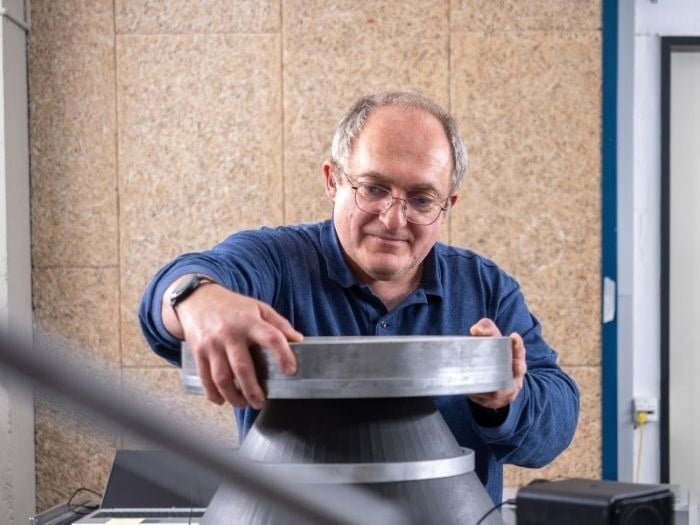
Researchers at Empa and space company Beyond Gravity have developed a novel payload adapter system for rockets that transforms the entire carbon-fiber structure into a phononic crystal, absorbing dangerous low-frequency vibrations caused by component separations during launch to protect sensitive satellite instruments.
When an Ariane 6 rocket lifts off from the Kourou Space Center in French Guiana carrying a European Space Agency weather observation satellite, the payload endures extreme mechanical forces. While acceleration poses some challenge, the sudden shocks and vibrations generated during stage separations present a far greater threat to on-board electronics. As the rocket ascends, it gradually jettisons large solid boosters, fuel tanks, and the protective payload fairing using small explosive charges. These separations release sharp vibrations that travel directly through the vehicle’s structure toward the delicate sensors and communication instruments housed at the top.
How Phononic Crystals Absorb Rocket Vibrations
To combat these damaging forces without adding prohibitive weight, researchers turned away from conventional spring-based dampening elements used on Earth. Because a payload adapter system must remain both lightweight and rigid, the team looked to acoustics and the physics of phononic crystals.
While optical crystals manipulate nanometer light waves, phononic crystals target sound waves with wavelengths ranging from centimeters to meters. The researchers modeled their adapter concept on a crystal structure previously developed in their lab. That design utilizes a framework of rotatable plates connected along a longitudinal axis, converting linear incoming shock waves into rotational movements within heavy disk elements. This rotational conversion effectively dampens the incoming energy before it reaches the payload.
Transforming the Adapter into a Crystal Structure
Integrating a complex crystal architecture into a truncated cone without adding excess weight or sacrificing stiffness required an innovative manufacturing approach. Rather than embedding separate crystal components inside the adapter, the Empa research team turned the entire structure into a functional phononic crystal. Aluminum rings act as the rotating disk elements, while carbon-fiber-reinforced plastic forms the connecting framework. Strategic alignment of the carbon fibers allows for slight rotational movement in the aluminum rings while preserving overall rigidity.
This configuration bypasses the need for complex 3D printing of intricate geometries, establishing an industrially viable manufacturing method. Both laboratory experiments with a prototype and computer simulations demonstrated that the redesigned adapter successfully swallows particularly dangerous low-frequency vibrations.
Patent Filings and Next Steps for Flight Readiness
Following successful prototype testing, the Swiss space company Beyond Gravity has filed a patent application for the invention, as noted by Keystone-SDA on 22.09.2026 at 10:38. The design successfully adds vibration-damping functionality to the adapter in a single manufacturing step while resolving longstanding production challenges associated with phononic crystals. Before the system can fly on an operational rocket launch, the hardware requires further refinement and optimization.

A PAS must be lightweight and rigid.
Andrea Bergamini, Empa Acoustics / Noise Reduction laboratory
With Beyond Gravity manufacturing the payload adapter for rockets including the Ariane 6, the refined system aims to expand operational capabilities for upcoming weather observation and scientific missions. As optimization continues, engineers must balance further structural tuning with strict mass limits before final flight qualification.
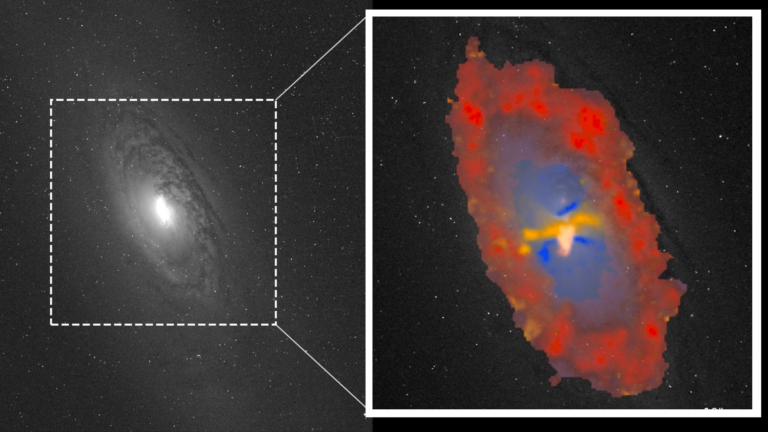
Black Hole Shock Waves Spark Star Formation in Nearby Galaxies
Astronomers studying nine local galaxies have discovered that shock waves from active supermassive black holes consistently travel perpendicular...
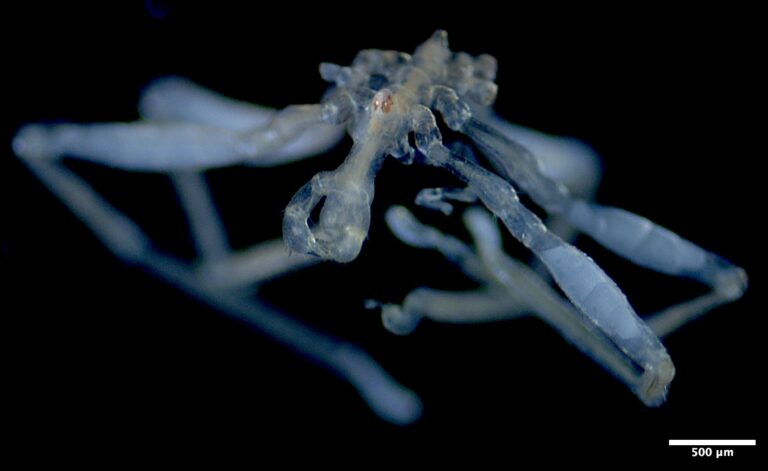
UBC Researchers Discover Two New Sea Spider Species in the Salish Sea
Researchers at the University of British Columbia have discovered two new species of sea spiders, Callipallene pilosuspedes and...

Climate Impact Lab Projects 450,000 Heat Deaths From Super El Niño
A newly released Climate Impact Lab report projects that more than 450,000 people worldwide could die from excessive...

Harvest Moon Rises September 26 to Mark the 2026 Autumn Equinox
Skywatchers are preparing to view the full moon this weekend as the Harvest Moon rises on September 26,...