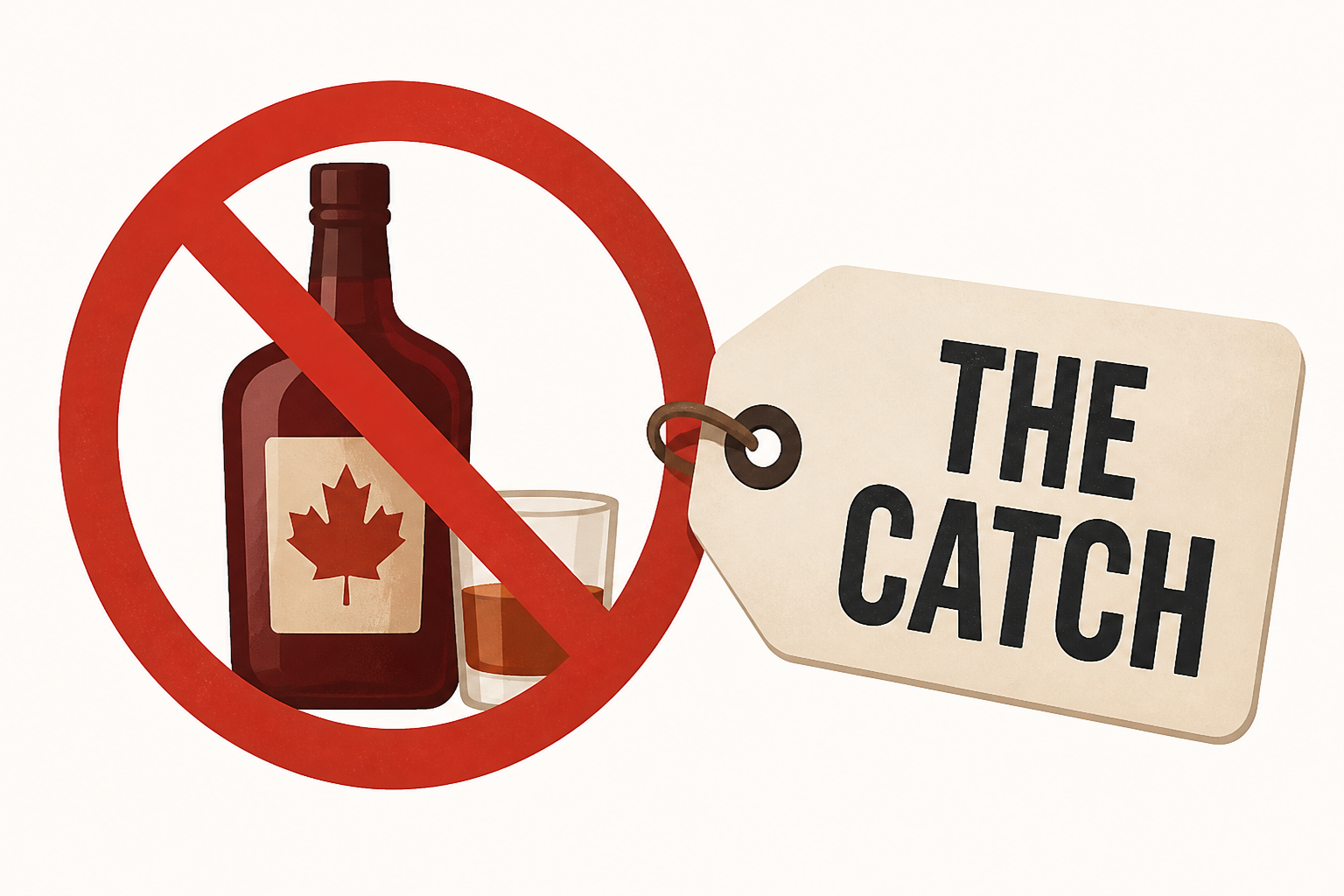
President Donald Trump implemented a trade ban on $800 million worth of Canadian alcoholic beverages on September 29, 2026, invoking a Great Depression-era tariff law as retaliatory trade measures between Washington and Ottawa deepen.
Smoot-Hawley Section 338 and the Ban on Canadian Alcohol
The trade restriction relies on Section 338 of the Smoot-Hawley Tariff Act of 1930, a statute that permits the U.S. president to impose tariffs of up to 50% or enact outright import bans when a foreign country discriminates against American commerce. Administration officials defended the step as a necessary reaction to provincial policies north of the border, noting that certain Canadian provinces previously restricted the sale of American alcohol in provincially run outlets.
A senior Trump administration official explained the rationale behind Washington’s approach during a briefing with reporters on background, stating that these are things that we are doing in order to level the playing field, defend American production and take action against one of the only countries on the planet to retaliate against the United States,
while asserting that Canada set this precedent of banning things.
Trade Minister Dominic LeBlanc issued a statement labeling the American measures unjustified
and emphasizing that Ottawa remains focused on supporting affected workers and businesses.
When the U.S. ready to engage, our government will work in good faith and constructively towards a more secure mutually beneficial trading relationship that fully respects Canadian sovereignty.
Dominic LeBlanc, Canada-U.S. Trade Minister
Exemptions, Bulk Containers, and Market Workarounds
While the ban targets roughly $800 million in imported Canadian spirits, industry analysts point out significant structural exemptions in the federal proclamations. Whisky and liqueurs escape the restriction entirely when shipped in containers larger than four liters, shielding specific commercial operations that rely on bulk transport.
Crown Royal occupies an advantageous position under these rules because the brand routinely ships bulk whisky to domestic U.S. facilities for local bottling. For smaller distillers and standard retail distributors, however, shifting to bulk transport requires sourcing alternative containers and establishing new rebottling pipelines, steps that threaten to drive up operational expenses and filter down to retail shoppers.
Despite the high-stakes policy shift, retail experts suggest that U.S. consumers will not see immediate empty shelves. Distributors spent weeks building up inventory reserves before the September 29 deadline, mitigating short-term supply shocks.
Even so, the friction is real for businesses operating along the international boundary. A Niagara Falls, New York, liquor store manager situated less than five miles from the Canadian border expressed frustration over the sudden policy shift, noting that we have a lot of Canadian customers and a lot of Canadian liquor. This is not good for business.
Broader Economic Fallout and Industry Frustration
The alcohol ban forms one component of a broader escalation signed into law on September 29, 2026. Alongside spirits, the proclamations place strict import bans on Canadian motorcycles, whey products, and molasses, while imposing 50% tariffs on dairy, paper, wood, aluminum, furniture, and mattresses. Simultaneously, the Trump administration directed the General Services Administration to strip Canadian-origin products from federal procurement schedules.
Inu Manak, a senior fellow at the Peterson Institute for International Economics, observed that using import bans against an ally is unprecedented and a major deviation from US trade policy.
Manak added that the alcohol restriction functions primarily as a high-visibility signal intended to drive Canadian negotiators back to talks, though she noted that Prime Minister Carney faces little pressure to settle before upcoming U.S. midterms.
Industry groups representing American distillers voiced deep concern over becoming collateral damage in the cross-border dispute. Chris Swonger, president and CEO of the Distilled Spirits Council of the United States, described the situation as an unforced error on both sides of the border that harms globally competitive producers.
Chris Swonger, president and CEO of the Distilled Spirits Council of the United States, said it’s unfortunate the industry has been pulled into the dispute. He noted that American distillers export globally and oppose tariffs on their products and imports, preferring to compete based on quality rather than tariffs.
Hours before the restrictions took effect, President Trump expressed optimism to reporters regarding a swift resolution, predicting that Canadian officials would initiate trade talks to eliminate tariffs within weeks. Prime Minister Carney has made no public statements indicating an imminent deal, maintaining instead that Canada will absorb the costs of pivoting trade relationships toward alternative international partners.
Keep reading

Pope Leo XIV Challenges Nvidia CEO Jensen Huang Over AI Safety Risks
Pope Leo XIV publicly challenged Nvidia Chief Executive Jensen Huang on September 28, 2026, rejecting claims that artificial...

South Africa Mass Shootings in Wedela and Lwandle Kill 27 People
Two separate mass shootings in South African townships over the weekend killed 27 people within hours of each...

Malaysia to End Search for 55 Missing Citizens in Nepal
Thirty-three days after glacial flash floods struck Nepal, families of 55 missing Malaysians pressed government officials in Putrajaya...