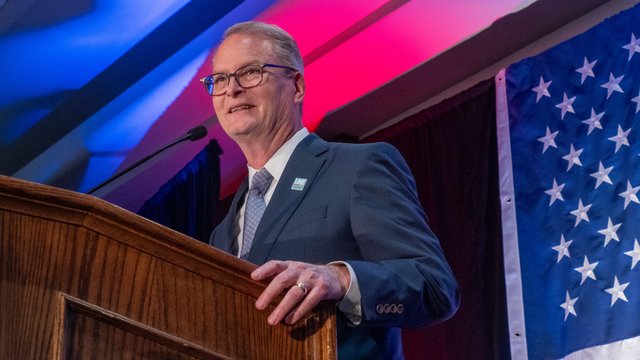
Kansas Senate Shift Marks First Democratic Victory in 94 Years
“I’ve always said, make disappointment an appointment with God, and that’s how the Marshall family will be doing.” In a result that has rippled across the political landscape, Democrat Adam Hamilton has defeated incumbent Republican U.S. Senator Roger Marshall, securing a seat that has remained out of Democratic hands since 1932. According to Yahoo News, Hamilton garnered 556,414 votes—roughly 50.9 percent—while Marshall trailed with 503,230 votes, or 46.1 percent. Libertarian David Graham received 32,934 votes, or 3.0 percent.
Marshall’s vote total dropped by 224,732 compared to his 2020 performance, a decline of nearly 31 percent. He confirmed his concession in a phone call to Hamilton, adding, “I called Adam Hamilton. I’ve congratulated him. We’re conceding. I don’t have any answers.”
Too Close to Call: The Executive and Legal Races
While the Senate seat has been decided, other high-profile contests remain in a state of flux. Both the gubernatorial race and the contest for Attorney General are currently too tight to declare a winner. Similarly, the Attorney General’s race between Democrat Chris Mann and Republican Kris Kobach shows a difference of only 11,288 votes.
These contests now hinge on outstanding ballots that have yet to be fully processed and canvassed. The uncertainty highlights a trend of competitiveness in Kansas politics this year, where Democrats managed to secure between 44.2 and 50.9 percent of the vote in every statewide race. In the Kansas House, Democrats held leads in 38 of the 87 races listed by the Secretary of State, signaling a potentially significant shift in the balance of legislative power. Elsewhere in the executive branch, Republican Pat Proctor led Democrat Jennifer Day by 10,756 votes, while Scott E. Morgan had 4.2 percent. Republican Daniel Hawkins led Democrat Dinah Sykes by 19,115 votes, and Republican Steven Johnson led Democrat Juan C. Luengo by 75,948 votes.
Counties Maintain Republican Leads
Despite the statewide volatility, rural Kansas remained a stronghold for the Republican ticket. In Barton County, where nearly 50 percent of registered voters participated, Republicans maintained leads in every partisan contest. Marshall himself continued to perform well in these areas, capturing 67.3 percent in Barton, 66.1 percent in Pawnee, and 69.5 percent in Stafford County.
In Barton County, the constitutional amendment passed with 80.2 percent support, while municipal sales tax questions in Great Bend and Hoisington also saw approval. Statewide, voters backed the constitutional amendment 63.7 percent to 36.3 percent, and Supreme Court Justices Eric Rosen and Larkin Walsh each received about 65 percent yes votes. In Pawnee County, Ad Astra Radio reported that local voters finalized seats for the county commission and Larned City Council, with Michael P. Burdett securing 645 votes for the 1st District and Sharon McGinness winning the Ward 4 council seat with 92 votes. Brett Fairchild won House District 113, representing portions of Pawnee, Rice, Stafford, and Rush counties.
The Human and Economic Stakes
With a Democrat capturing a Senate seat and races for governor and attorney general remaining too close to call, the state’s ability to pass unified policy will be tested. Federal congressional races saw incumbents retain their seats, including Republicans Tracey Mann, Derek Schmidt, and Ron Estes, as well as Democrat Sharice Davids. The volatility is further evidenced by the narrow margins in the Kansas House, where three districts—the 27th, 40th, and 123rd—are currently separated by fewer than 100 votes. As the state moves toward official canvassing, officials maintain that “all results are unofficial until counties canvass the vote.”
Earlier coverage: Adam Hamilton wins Kansas Senate race in historic upset
More on Roger Marshall
Related reading

Alabama voters overcome suppression laws with record turnout
Alabama Election: Voters Overcome Suppression Laws with Record Turnout In a column for aclualabama.org, a coalition of voting...

Trump’s Triumphal Arch Faces Federal Vote and Legal Challenges
President Trump’s proposed 250-foot triumphal arch is moving toward federal approval, with the National Capital Planning Commission scheduled...

Wendy’s rejects takeover proposal from Nelson Peltz’s Trian Fund
Wendy's has officially rejected a $1.4 billion takeover proposal from a group of investors led by Nelson Peltz's...
Brewers’ win Ignites Debate Over Bringing baseball back to UW-Madison
Brewers' Title Ignites Debate Over Bringing Baseball Back to Badgers The question is hanging in the Wisconsin air,...