Astronomers have watched a giant exoplanet vanish from view for the first time.
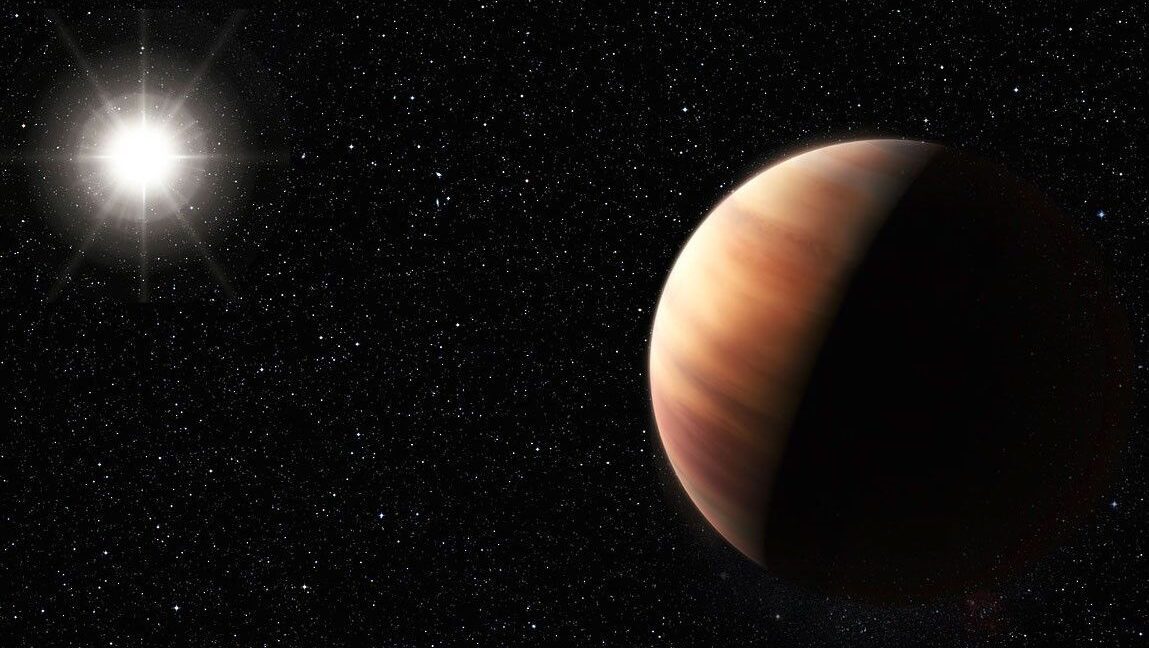
The planet, a hot Jupiter known as TOI-2535 b, sits about 1,000 light-years from Earth and orbits an early K-type dwarf star in the constellation of Corvus (Sci. News: Breaking Science News).
While studying the system using space telescopes and ground-based instruments, researchers discovered that the world has not been destroyed or evaporated into space. Instead, a massive hidden neighbor is pulling on its orbit so violently that the planet has tilted out of alignment with Earth.
Seven Years of Tracking TOI-2535 b with TESS
NASA’s Transiting Exoplanet Survey Satellite first picked up the system in April 2019. The telescope monitors stellar brightness, flagging the tiny dip in light that occurs when a planet crosses in front of its star. TOI-2535 b circles its parent star in just 8.25 days, which is ten times faster than Mercury’s journey around the sun.
Between April 2019 and March 2026, researchers routinely observed the gas giant. Over time, the transits stopped following a reliable schedule, arriving up to six hours early or late. The crossings also grew progressively shorter and shallower before failing to appear entirely in early 2026. To test the blank result, the research team planted fake transits into the data, confirming that a grazing planet would have been recovered about half the time.
An Unseen Neighbor and a Top-Like Wobble
The changing geometry indicates that a second, undetected planet is exerting a powerful gravitational pull on TOI-2535 b. The two worlds tug on each other, causing their orbits to precess and wobble like a spinning top (Sci.
News: Breaking Science News). This rapid tilting shifted the hot Jupiter’s path from across the middle of the star toward the edge and eventually out of Earth’s line of sight (Sci. News: Breaking Science News).
“This is the most extreme example we've seen because the two planets are interacting so strongly. The planet's orbit is tilting so quickly that its transit disappeared while we were watching,” Samuel Yee, a 51 Pegasi b Postdoctoral Fellow at UCLA and the paper's corresponding author, said.
Photo: The Brighter Side of News
We think of the universe as resembling clockwork, where everything is regular, but that’s not true. If there are multiple planets in a system, they can affect each other’s orbits. We know of a few systems that are like this.
Samuel Yee, 51 Pegasi b Postdoctoral Fellow at UCLA and corresponding author
The mechanics mirror the physics governing eclipses on Earth. Because the moon’s orbit is tilted relative to Earth’s path around the sun, eclipses occur only during precise alignments rather than every month. UCLA researchers note that the tilt of the moon’s orbit itself stems from a violent collision with the early Earth.
If the moon’s orbit around the Earth was perfectly aligned with the Earth’s orbit around the sun, we would see an eclipse every month. But because the moon’s orbit is tilted, eclipses are less common. The tilt of the moon’s orbit is a relic of its violent formation history, which resulted from a collision with the early Earth.
Erik Petigura, UCLA astrophysicist and co-author
Modeling the System and Tracing Planetary Migration
To understand what forces could drive such rapid changes, scientists modeled 300,000 starting configurations and ran the leading solutions forward for a million years. The analysis, combined with radial-velocity measurements from the NEID spectrograph on the WIYN 3.5-meter telescope at Kitt Peak National Observatory, points to a companion of roughly Saturn mass or greater locked in an orbital resonance (Ars Technica, Sci. News: Breaking Science News).
Photo: Ars Technica
Because TOI-2535 b has a close neighbour, it probably migrated by slowly spiraling in instead of getting flung in. We may be seeing a formation channel that doesn’t happen very often but is very interesting.
Photo: Space
Samuel Yee, UCLA
Most hot Jupiters are thought to form far from their host stars before moving inward. While violent gravitational encounters can fling planets into close orbits, the presence of a stable companion suggests this system followed a gentler path by spiraling through a protoplanetary disk (BigGo Finance, Sci. News: Breaking Science News). The study’s findings were published on November 9, 2026, in The Astrophysical Journal Letters.
Researchers estimate that TOI-2535 b will cross in front of its star again in 30 to 50 years, though its hidden neighbor may come into view sooner if its tilting orbit aligns with Earth first.