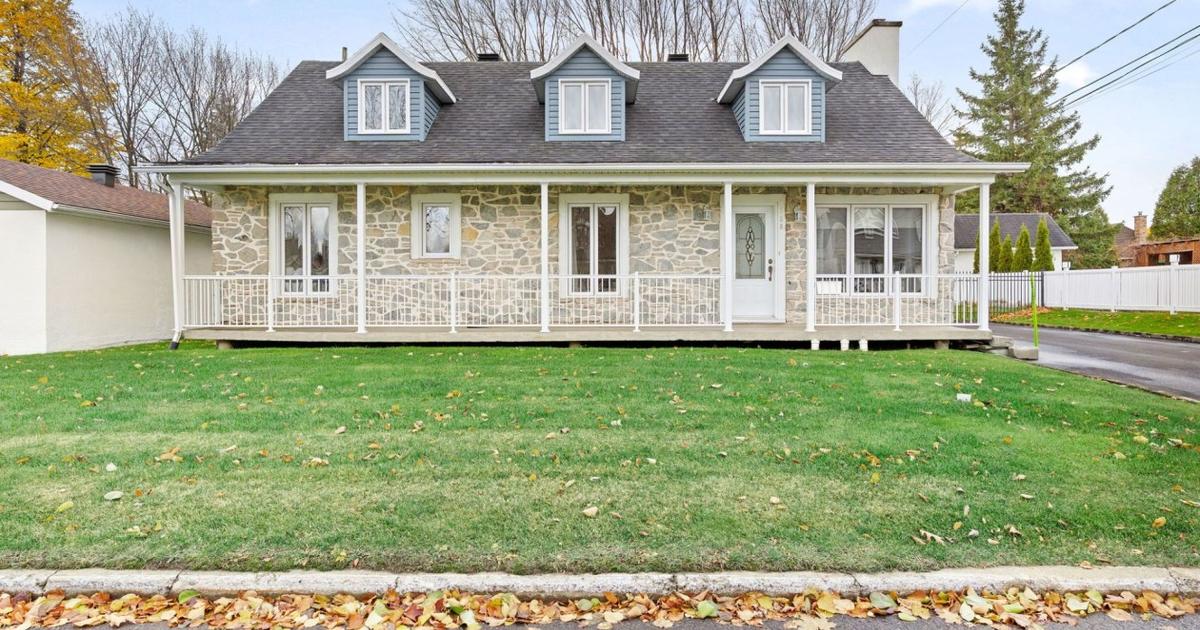
Beauport home stands, a 1975 stone and wood house, listed at 439,900 $ on Saturday.
This solidly built Canadian-style home in Beauport, just minutes from downtown Quebec, presents a rare chance to update without erasing its enduring character, Les Maisons reported.
The property, featuring natural stone on its facade and visible wooden beams, speaks to an era of building intended to last, offering substantial living space on a 7,714 square foot lot.
The immediate appeal isn’t just the structure; it’s the palpable sense of permanence in a modern housing market where new builds often lack this deep, established presence.
Stone Facade Commands Quiet Presence
From the street, the natural stone detailing gives the house a quiet, almost country-like dignity even within the city setting.
The balanced proportions and pitched roof assert a strong, unpretentious silhouette on its lot.
Parking for four vehicles is accommodated, a practical necessity when families grow or friends gather for a Sunday dinner.
Warmth Within Visible Structure
The living room opens with massive, dark, exposed beams crossing the ceiling, providing a reassuring architectural skeleton.
A wood-burning fireplace anchors the domestic life, imagining crisp January days in Beauport filled with the scent of resin from burning logs.
Light filters through the windows, caressing the original woodwork, proving the period charm is intact.
Designing Life Across Spaces
Fluid movement connects the living room to the adjacent dining area, suitable for hurried mornings or festive holiday receptions.
The U-shaped kitchen maximizes accessibility, offering ample storage designed for home-centric living, ready for a November Saturday morning.
Upstairs, the four bedrooms spread out with a generosity often missing in newer construction, including a spacious primary bedroom.
Sublevel Offers Flexible Living
The basement adds utility with a family room perfect for movie nights or board games.
It includes a bedroom, a bath, and an attached workshop, catering to artisans or those needing a dedicated workspace without disturbing the main level.
Outdoors, a vast, welcoming wooden terrace opens onto a fully fenced, 7,714 square foot yard, an authentic family oasis complete with a storage shed.
Beauport’s Place Near Quebec
Beauport acts as a welcoming gateway to Quebec City, an established, peaceful borough supporting daily needs like schools and local commerce.
Proximity matters; Montmorency is close, and Sainte-Anne mountain and Beaupré coast are within a short drive, while Old Quebec remains easily accessible, according to Les Maisons.
The reality check here is that while the house offers immense character, it isn’t perfect, and that’s precisely what makes it attractive to someone ready to invest in its inherent quality.

“Someone who wants to roll up their sleeves, a little, for a lot of happiness in return,” said the property listing.
This isn’t about buying pristine; it’s about recognizing the quality of the beams and the nobility of the stone beneath the surface.
The demographic drawn to this residence isn’t the flit-and-flurry city dweller, but the family or individual seeking deep roots in an accessible, established regional setting.
The counterpoint, often raised in housing discourse, is the investment required to modernize the two functional bathrooms, demanding thoughtful capital allocation.
For those balancing location against modernization needs, the 439,900 $ asking price offers a tangible entry point into established Quebec living compared to newer, more sterile developments.
You can learn more about municipal planning in the region by reviewing the official Quebec government site.
Civic planners often point to the value of existing, resilient housing stock over constant new development in national housing reports.
The accessibility to major routes means Montreal sits about 240 km west, connecting this quiet life to larger economic centers via provincial route data.
Quebec, Canada’s largest province by area, takes its name from an Algonquin word meaning ‘narrow passage’ where the Saint Lawrence River constricts near Quebec City. Samuel de Champlain chose the name in 1608 for the colonial outpost that became the administrative seat of New France.
After the Seven Years’ War, the French colony became British, eventually joining Confederation in 1867. Today the province is the country’s only Francophone-majority jurisdiction, with a population of 8,501,833 in 2021.
The enduring appeal lies not just in the square footage, but in the historical narrative held by the stone and wood, a tangible counterpoint to modern disposable living.
Worth a look
University Reactor Scram Triggered by Firemain Pipe Rupture Not Core Failure
Reactor pipe burst in Columbia, Missouri, early on Friday. A low power research unit at a university facility...

Woman Quits Boston Consulting Job for Farm Work in Hawaii, PEOPLE Reports
Sarah Bonello left her Boston environmental consulting job in November 2025. She spent years working for federal, state...

Hoosiers Respond to Weaponized Wording of Indiana Bail Amendment
Indiana voters approved a constitutional amendment on Nov. 3 that gives judges new power to deny bail for...
Montana State Hosts Montana Sat at 2 P.m. for Big Sky Title
No. 2 Montana State hosts No. 9 Montana on Saturday at 2 p.m. Eastern at Bobcat Stadium in...