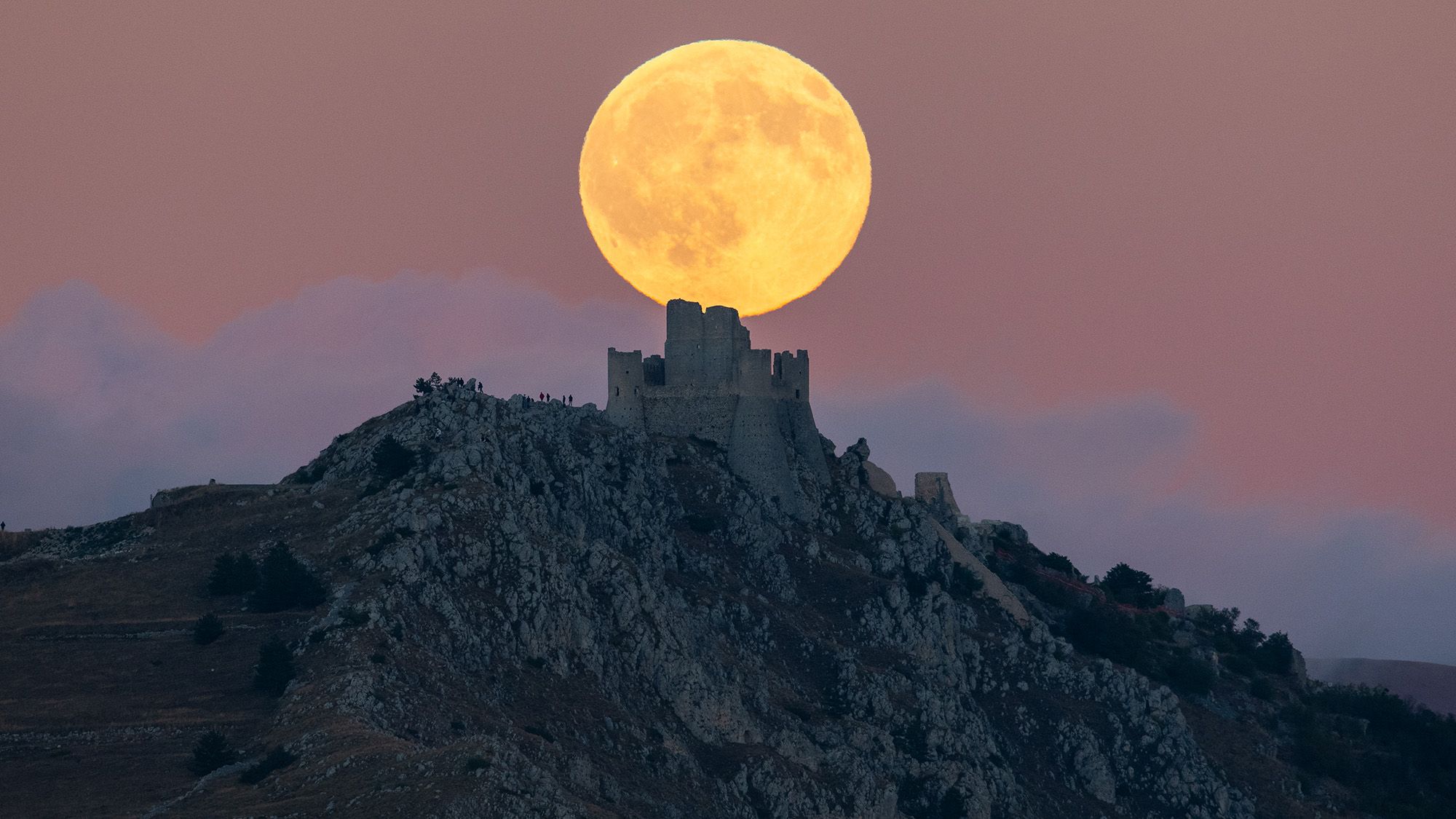
November’s full moon reaches peak illumination at 9:53 a.m.
Best viewing comes at moonrise — around 4 and 5 p.m. across western Europe — when the horizon amplifies its size through the moon illusion. “Folks who pay regular attention to full moons will notice the difference,” said Kevin Lewis, vice chair of Earth and planetary sciences at Johns Hopkins University.
NASA’s Noah Petro, chief of the Planetary Geology, Geophysics and Geochemistry Lab at Goddard Space Flight Center, puts the difference at about 17 percent larger and 30 percent brighter than the year’s smallest full moon. The moon’s average distance is 238,900 miles; tonight it sits roughly 224,170 miles away.
Three supermoons, one rising closer
The Beaver Moon kicks off a trio. December’s Cold Moon on the 24th will be the closest, biggest and brightest full moon of 2026 — 221,667 miles from Earth, the nearest since January 2, 2018. January’s Wolf Moon follows on the 22nd at 222,229 miles. November’s is the smallest of the three.
🌕 If the skies are clear where you are, look up tonight for November’s Full Moon! Known as the Beaver Moon, its name comes from the time of year when beavers prepare for the winter ahead. Tonight’s Full Moon is also the first of three consecutive supermoons. With the Moon near… pic.twitter.com/DbTBesMhKI
Supermoons cluster because the anomalistic month (perigee to perigee, 27.5 days) nearly matches the synodic month (new moon to new moon, 29.5 days). When a full moon lands near perigee once, it tends to repeat the next month. “These similar time frames allow the full moon to coincide with its closest approach to Earth several months in a row,” Lewis said.
Names, lore and a livestream lost to clouds
The Beaver Moon name traces to beavers securing lodges and storing food for winter. Indigenous names vary: the Dakota and Lakota call it the Deer Rutting Moon, the Cree the Frost Moon, the Tlingit the Digging or Scratching Moon, Cherokee the Trading Moon, Algonquin the Whitefish Moon. The Anishinaabeg know it as Baashkaakodin Giizis — the Freezing Moon.
At Kennedy Space Center, we're always looking up! 🌕 Keep your eyes on the sky for tonight's supermoon, shining bigger and brighter than usual, as the full Moon nears its closest point to Earth. pic.twitter.com/h3RsXkQYTm
The Virtual Telescope Project planned a live YouTube stream from Manciano, Italy, at 10:30 a.m. EST. Clouds cancelled it. Photos from Salzburg to Srinagar are already circulating.
Supermoon series extends through February with precise distances
The series continues beyond January with a fourth supermoon on February 20, 2027, called the Snow Moon. The three upcoming full moons sit at 224,170 miles on November 24, 221,667 miles on December 24 and 222,229 miles on January 22, 2027, according to sources.
Who ordered the extra large? 🌕 👀 Watch for tonight’s full Moon rising in the east around sunset (your local time). This one may look a little bigger than usual…and here’s why. pic.twitter.com/5eOLDtescz
The pattern is typical; we get three to four a year and always back to back, according to sources.
Supermoon tides may break records
The Beaver Supermoon is set to have potentially damaging effects along the west coast of the U.S., according to sources. Pacific Coast high tides may shatter four-decade records and inundate low-lying seaside towns, snarling travel during Thanksgiving week. In the San Francisco Bay Area, water levels could climb nearly a metre above normal on Tuesday before cresting Wednesday, says Dial Hoang, a National Weather Service forecaster, according to sources.
The supermoon’s gravitational pull also influences Earth’s ocean tides, with full moons contributing to larger high tides, according to sources. Sources noted the supermoon could cause “monster king tides” on U.S. coasts.
Moon passes near Pleiades cluster
For Northern Hemisphere observers, the Beaver Supermoon ascends in the east around sunset, arcs across the southern sky, and descends in the west near dawn the next day, according to sources. For Southern Hemisphere observers, the Beaver Supermoon ascends in the east around sunset, arcs across the northern sky, and descends in the west near dawn the next day, according to sources.
Will you be on the lookout for tonight's Beaver Supermoon? 🌕 It's shining about 13.5% brighter than an average full moon, so catch it rising in the east after sunset and share your best shot with us! pic.twitter.com/EtNAcVPcNa
The full moon will pass just 0.9 degrees north of the famous Pleiades star cluster, according to sources. The full Moon will also be close to two beautiful star clusters, the Pleiades and the Hyades, according to sources. During evening hours, Orion towers in the southeast with Taurus above it and Gemini climbing to the left, according to sources.
Why it looks bigger at the horizon
Scientists attribute the moon illusion to how the brain compares the lunar disk with trees and rooftops near the horizon. “When you have a supermoon, that effect is just slightly more striking,” said astronomer William Alston of the University of Hertfordshire.
@EarthDotCom 👉 https://t.co/u5Sf8FOqzv
The moon itself does not swell; the orbit is simply elliptical, not a perfect circle. “So sometimes the moon is slightly closer to the Earth, and when that happens, it’ll appear larger in the sky as a result,” Lewis said.
“We’re still exploring our closest neighbor in the universe, and so it’s now especially exciting to look up at the moon,” Lewis added.
LOOK UP! Skywatchers can look forward to November’s full moon, known as the Beaver Moon, which will reach peak illumination at 10:53 p.m. on Tuesday, 24 November, Philippine time. This year’s Beaver Moon will also be a supermoon, appearing slightly larger and brighter than an… pic.twitter.com/5vsgGDuqbx
More on Beaver Moon
In pictures: Wednesday's Beaver supermoon captured around the world https://t.co/XBEWG4ua6r
Tonight's Full Beaver Moon will be the last supermoon for a year. Remember to look up! 🌕🦫 #FullMoon #FullBeaverMoon More details here: https://t.co/7tiJT3LHXn pic.twitter.com/WBaS78xpzT
Worth a look

ICMR Trial: Menu Labels Cut Calories at One Chennai Chain But Not the Other
Nutrition labels on menus cut calories at one Chennai restaurant chain but not another, an Indian Council of...

Jakarta Government Intervenes to Return Celebrity Mall Cat Parhan
The Jakarta government intervened this month to return Parhan, a celebrity cat living at the Senayan City mall,...

OpenAI’s GPT‑6.2 Designed 322 Minibinder Backbones That Were Synthesized and Tested
OpenAI's GPT‑6.2 designed 322 minibinder backbones that were synthesized and tested; 35 bound their targets, a hit rate...

Gothic House Where Frankie Dunne Was Murdered Set to Be Demolished
A derelict 19th century Gothic-style house on the grounds where Frankie Dunne was murdered in 2019 is to...