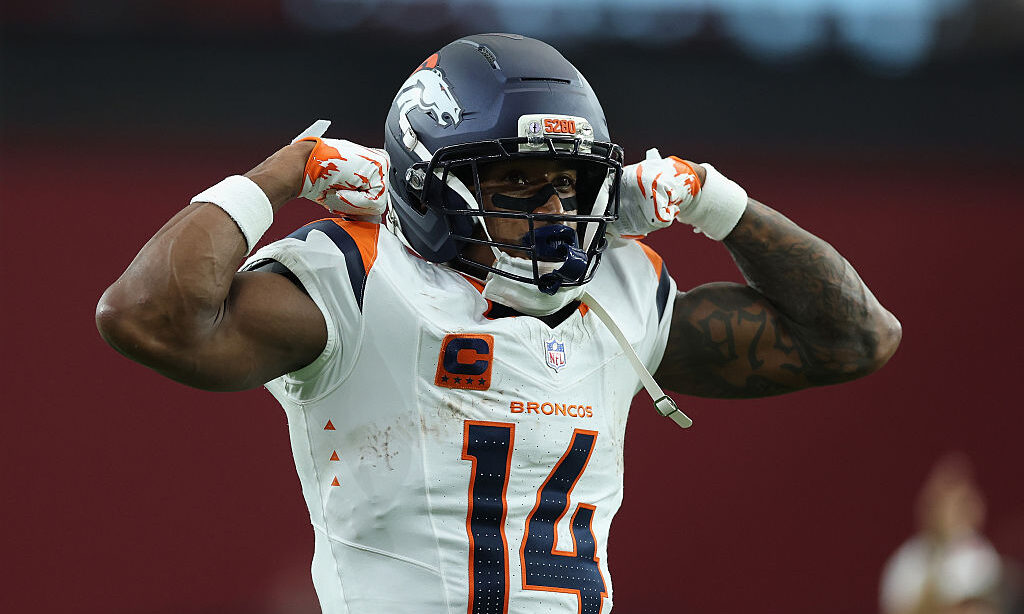
Broncos Red Zone Offense Faces Fresh Scrutiny Over Courtland Sutton Usage
The Denver Broncos are 6-2 and in first place in the AFC, yet questions remain regarding how the offense operates near the goal line.
Denver ranks 10th in the NFL with a 65.22% touchdown rate inside the 20-yard line this season, a mark better than most of the offense’s overall statistical output. Despite that efficiency, the team lacks a clear, dependable first choice when plays must be decided quickly in tight spaces.
That disconnect took center stage during a recent broadcast of “Dover and Cecil” on 104.3 The Fan. Host Josh Dover posed a direct question to co-host Cecil Lammey on November 6th regarding who should be trusted most in those high-stakes moments.
“Who would you consider right now, today on November 6th, the Broncos’ best red zone weapon?” Dover asked.

Lammey’s reply carried an immediate caveat. “It should be Courtland Sutton right?”
Why the Production Shifted Away From Sutton
For years, Sutton served as the primary perimeter target Denver looked for when drives stalled near the end zone. Through the first eight games of the current campaign, however, that production has slowed, leaving the veteran receiver with 20 catches for 221 yards and a single touchdown.
A broader shift in personnel and play-calling accounts for part of the drop. The arrival of Jaylen Waddle altered the target distribution across the offense. At the same time, Bo Nix has occasionally looked less comfortable pushing the ball downfield, while Jonah Coleman has emerged as a frequent target out of the backfield.
Earlier in the year, Lammey pointed out that the Broncos relied too heavily on Sutton on third downs during the previous season and needed to spread the ball around. Joel Klatt projected that Waddle’s speed would pull defensive attention away and pave the way for a stronger year for Sutton, though that dynamic has taken time to materialize.
Still, Lammey argued that the red zone offers an ideal setting to reset that rhythm.
“I mean it should be Courtland Sutton, it just hasn’t been enough Courtland Sutton. We just got a taste last week. I want more Sutton,” Lammey said.
The Case for Size and Chemistry Near the Goal Line
As the field compresses near the end zone, defensive coverages tighten and safeties cover less ground, making traditional separation harder to generate. In those crowded windows, raw speed loses value while contested-catch ability takes priority.
Sutton stands 6-foot-4 and has built his career on hauling in jump balls with defenders draped tightly over his frame. Beyond physical stature, he shares the most history with Nix of any receiver on the roster. That two-plus seasons together have built trust on the back-shoulder throws and fades that work best near the goal line.

Signs of that connection surfaced during last week’s matchup against the Kansas City Chiefs, where Sutton recorded four receptions for 53 yards—marking his first 50-yard performance of the season—and helped spark Denver’s most productive fourth quarter of the year.
Leaning on Sutton near the goal line would provide Nix with a straightforward, high-percentage read during moments that require quick execution. It could also alleviate pressure for a quarterback who has struggled with timing and pocket patience.
“It should be Courtland Sutton because of his connection with Bo, because of his size. Because you can throw it up, a jump ball, and let the big man go get it,” Lammey said.
Keep reading

Midwestern State beats LCU volleyball to win Lone Star Conference match
Thirty-one ties across four fiercely contested sets can wear down even the most resilient volleyball squad, and for...

Frankfort beats Keyser 41-19 in Mineral Bowl
Falcons Roll Past Keyser 41-19 in Mineral Bowl to Claim Sixth Straight Victory Short Gap, W.Va. knew it...

Finding Joy in Simple Traditions: A Halloween Memory
Halloween Evening in Des Moines Brings a Simple Tradition In a column published by The Waterland Blog, life-long...

Boise Mayor Proposes Moratorium on Mega Data Center Development
Boise Mayor Lauren McLean Proposes Immediate City Limits Moratorium on Mega Data Centers Boise Mayor Lauren McLean has...