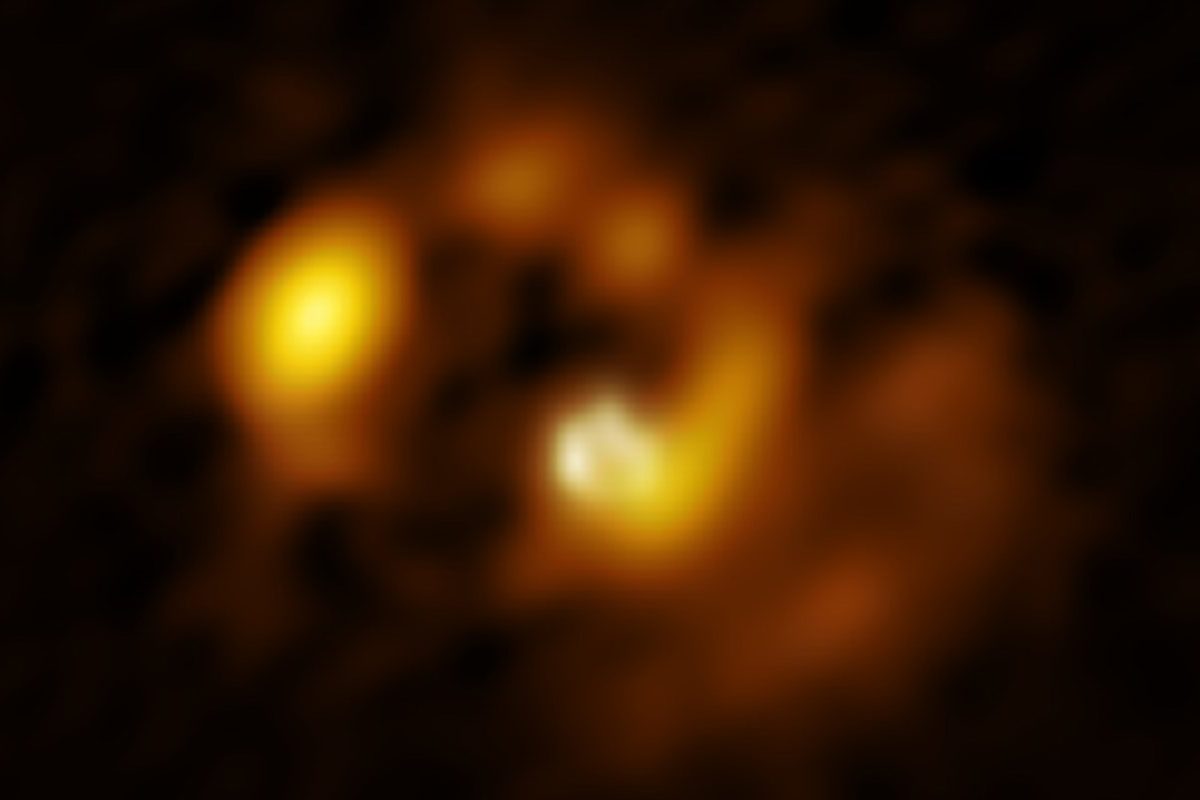
“That changes a fundamental part of the origin story of the atoms we ourselves are made of,” said Wouter Vlemmings, professor at Chalmers University of Technology, after his team captured a giant magnetic loop erupting from the red giant Mira A.
The Atacama Large Millimeter/submillimeter Array in Chile imaged the loop stretching 10 astronomical units — roughly the distance from the Sun to Saturn — from the star’s surface, 330 light-years away in Cetus.
For decades, astronomers assumed radiation pressure on dust grains pushed stellar winds from ageing giants outward. ALMA observations show something else: intense magnetic fields on Mira A’s surface fling material into space.
Wouter Vlemmings, professor at the department of Physics and Astronomy at Chalmers University of Technology in Sweden and part of the study, said radiation pushes dust grains in the outer atmosphere, but Mira A demonstrates that powerful magnetic fields also shape and drive stellar winds.
That showed us a connection between the flare and the loop and reminded us also of phenomena we can see on our Sun.
Wouter Vlemmings, Chalmers University of Technology
The team found magnetic storms on Mira A are not one-offs. Each flare lifts parts of the star’s outer layers and launches them into interstellar space, seeding the galaxy with carbon, oxygen and nitrogen — elements essential for life.
Behzad Bojnordi Arbab, doctoral student at Chalmers and part of the research team, said a flare appeared on the star’s surface in 2023. Over the following two years that eruption produced a vast, expanding loop of gas around the star, imaged in 2025.
Chalmers University of Technology anchors this research through its Department of Physics and Astronomy, where Wouter Vlemmings serves as professor, and its Onsala Space Observatory, Sweden’s national facility for radio astronomy. These assets position Chalmers at the forefront of millimetre and submillimetre astronomy, enabling the high-resolution imaging that revealed the magnetic loop erupting from Mira A.
Now we see that magnetic storms on Mira’s surface are continually creating bright flares. Even more surprisingly, each of these is strong enough to lift parts of the star’s outer layers and launch them into interstellar space.
Miora Andriantsaralaza, Chalmers University of Technology
Our study has consequences for understanding the whole galaxy’s ecosystem, Vlemmings said. Earth might not exist without magnetic storms on a red giant star billions of years ago, before the Sun was born.
NASA Webb Maps Cas A Dust, Finds Shells Merged Hours Before Blast
NASA's James Webb Space Telescope has mapped the dust inside Cassiopeia A and found evidence that the star's...

Mars Express Releases Tharsis Tholus Images Showing Double Caldera
Mars Express orbiter has released new images of Tharsis Tholus, an 8-kilometre-high volcano whose summit collapsed twice, leaving...
Japan-Europe BepiColombo Enters Mercury Orbit After 10-Billion-Km Journey
BepiColombo slipped into orbit around Mercury on Saturday after an eight-year, 10-billion-kilometer cruise, becoming only the second spacecraft...
NASA Pauses Science On Perseverance Rover And Mars Odyssey Orbiter
NASA paused active science operations on the Perseverance rover and the veteran 2001 Mars Odyssey orbiter after hardware...