
Chinese and European researchers have independently developed the world’s first operating nuclear clocks, using thorium-229 nuclei embedded in crystals to measure time with ultra-precise vacuum-ultraviolet lasers. Published in Nature on October 7, 2026, the breakthroughs mark a shift from electron transitions to the atomic nucleus.
For nearly a century, precision timekeeping has relied on the steady oscillations of electrons orbiting atomic nuclei. Two independent research teams have now shattered that paradigm by building functional nuclear clocks that track time using energy transitions deep within the atomic core itself. One collaboration was led by Tsinghua University in Beijing alongside other Chinese institutions, while the other brought together researchers from the Vienna University of Technology (TU Wien).
Where traditional atomic clocks use microwaves or optical lasers to manipulate electrons—which are easily disturbed by stray electric and magnetic fields—an atomic nucleus is tens of thousands of times smaller than the surrounding electron cloud. That compactness makes the nuclear core far less vulnerable to external environmental noise, opening the door to unprecedented stability and miniaturization. According to the sources, these newest atomic clocks measure time by monitoring light through transitions occurring inside the atomic nucleus involving protons and neutrons, utilizing a rare atom whose nucleus can switch energy states using ultraviolet light from a laser.
Thorium-229 Enables Nuclear Clocks via Vacuum-Ultraviolet Light
Finding a suitable nuclear transition has long frustrated physicists because most atomic nuclei require high-energy x-ray or gamma-ray photons that current narrowband, tunable lasers cannot produce. Thorium-229 provides a rare exception. Its first excited nuclear state sits just 8.4 electron volts above the ground state, a threshold reachable with vacuum-ultraviolet light around 148 nm. The nuclear clock’s rhythm divides time into extremely fine intervals at about 2 quadrillion cycles per second.
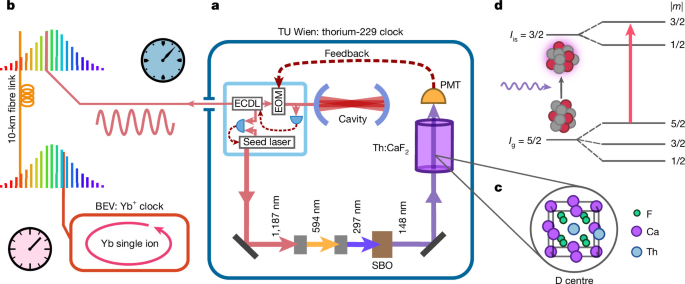
The foundational concept was first proposed in 2003 by Ekkehard Peik and Christian Tamm, setting off a two-decade search to pinpoint the exact resonance frequency. That search saw major breakthroughs in 2024, when researchers successfully drove the transition directly with laser light and measured its frequency with high precision.
To build their operating clock, the Tsinghua University team—led by associate professor Ding Shiqian—developed the world’s first continuous-wave vacuum ultraviolet laser operating at 148.4 nanometers. Collaborating partners also fabricated a thorium-229-doped calcium fluoride crystal using just 1.4 micrograms of thorium-229.
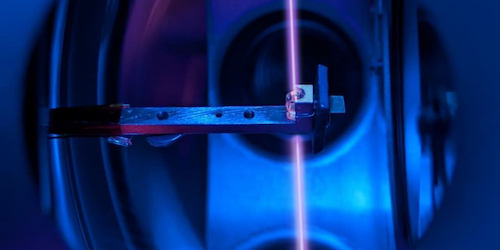
“A traditional pendulum clock swings about once a second, and we can tell how much time has passed by counting those swings. Our nuclear optical clock instead uses the rhythm of an atomic nucleus as its ‘pendulum.’ That rhythm is, of course, much faster than that of a wall clock, at about 2 quadrillion cycles per second. It divides time into extremely fine intervals, allowing us to measure time precisely by counting those cycles,”
Ding Shiqian, associate professor in the Department of Physics at Tsinghua University
Beijing Clock Outperforms Vienna Instrument in Stability
Initial data from the world’s first two working nuclear clocks reveal distinct performance profiles. According to papers out of Nature, the Beijing-built timepiece demonstrated roughly six times the stability of the European instrument built by researchers at Vienna’s TU Wien. Measured instabilities translate into an accumulated error of gaining or losing one second over 19 million years for the Chinese clock, compared to 3 million years for the European clock. By comparison, top-tier optical atomic clocks gain or lose only one second over tens of billions of years.
Beyond raw stability, the Tsinghua researchers demonstrated that two separately grown crystals kept identical time, proving that such devices can be reliably reproduced, while the laser stayed locked to the thorium-229 nucleus and kept steady time, reaching a precision of about one part in a quadrillion ($10^{-15}$) over the test period. Meanwhile, the Vienna team utilized its operating clock to hunt for dark matter, though without yielding a positive detection.
“The successful development and stable operation of the nuclear clock means that the capability of quantum manipulation has extended to the nuclear scale,”
Zhai Hui, head of the Department of Physics at Tsinghua University
Solid-State Design Enables Precise Satellite and Spacecraft Positioning
While the devices remain laboratory instruments, their solid-state design offers practical advantages in engineering and miniaturization that atomic clocks—constrained by complex vacuum and laser apparatuses—struggle to match. Researchers note that once miniaturized, nuclear clocks could transform industries requiring absolute precision.
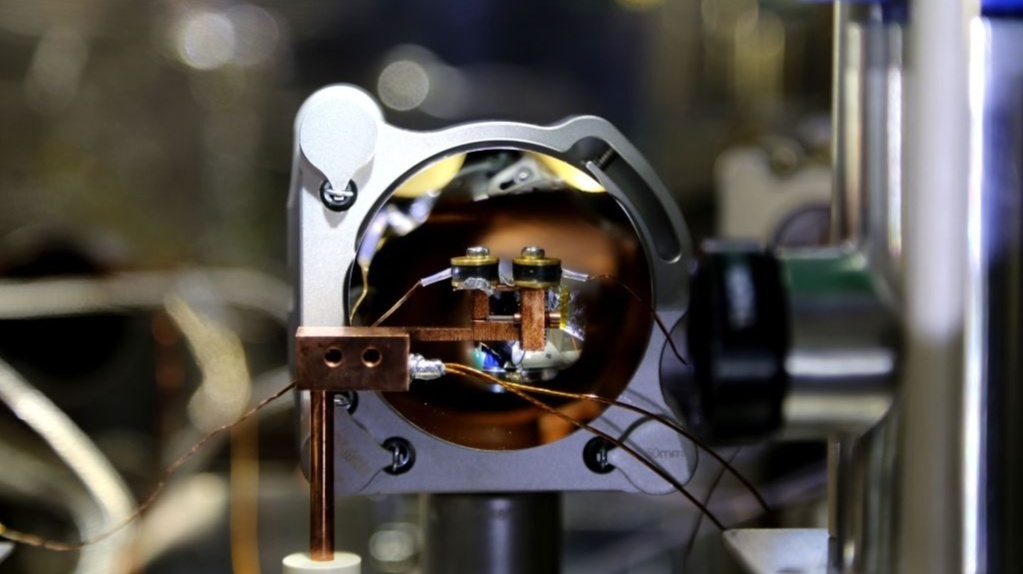
Potential real-world applications include providing more precise positioning and distance measurements for satellites and spacecraft, enhancing terrestrial telecommunications, and enabling deep-space exploration. The extreme sensitivity of nuclear transitions to fundamental physical constants provides researchers with a novel instrument to test the limits of the standard model of particle physics. As the sources point out, the devices could also be important in fundamental physics, unlocking its fundamentals, though the paper does not specify the exact use cases.
Reflecting on the rapid evolution of the field since 2003, Ekkehard Peik noted that he was absolutely delighted
by the speed of progress and surprised by the unexpected robustness of the operating clocks.
- Zaamwani: Namibia Opts for FMD Vaccinations as Culling Window Expires
- UCC Launches Campaign After Survey Shows 88.5% Face Digital Harms
- Nuclear Clock vs. Atomic Clock: What Vienna and Beijing Actually Built (daybreakwire.com)
- Jeremy Clarkson to Build Jaguar F-Type Using Farm-Grown Materials in Prime Video Special (archyde.com)

Zaamwani: Namibia Opts for FMD Vaccinations as Culling Window Expires
Namibia is bypassing culling for cattle infected with foot-and-mouth disease, using instead a 100,000-dose vaccination campaign after a...

UCC Launches Campaign After Survey Shows 88.5% Face Digital Harms
The Uganda Communications Commission launched a nationwide Child Online Protection Campaign at Kololo Secondary School following a survey...

COSATU Launches Nationwide Strikes Amid 43.8% Unemployment Rate
While foreign exchange markets showed little change early in the week—with the rand trading at 16.6325 against the...

UK Police Arrest Seventh Suspect in Investigation Near RAF Fairford
Following a suspected plot near RAF Fairford, British police have arrested a suspect on suspicion of preparing terrorist...