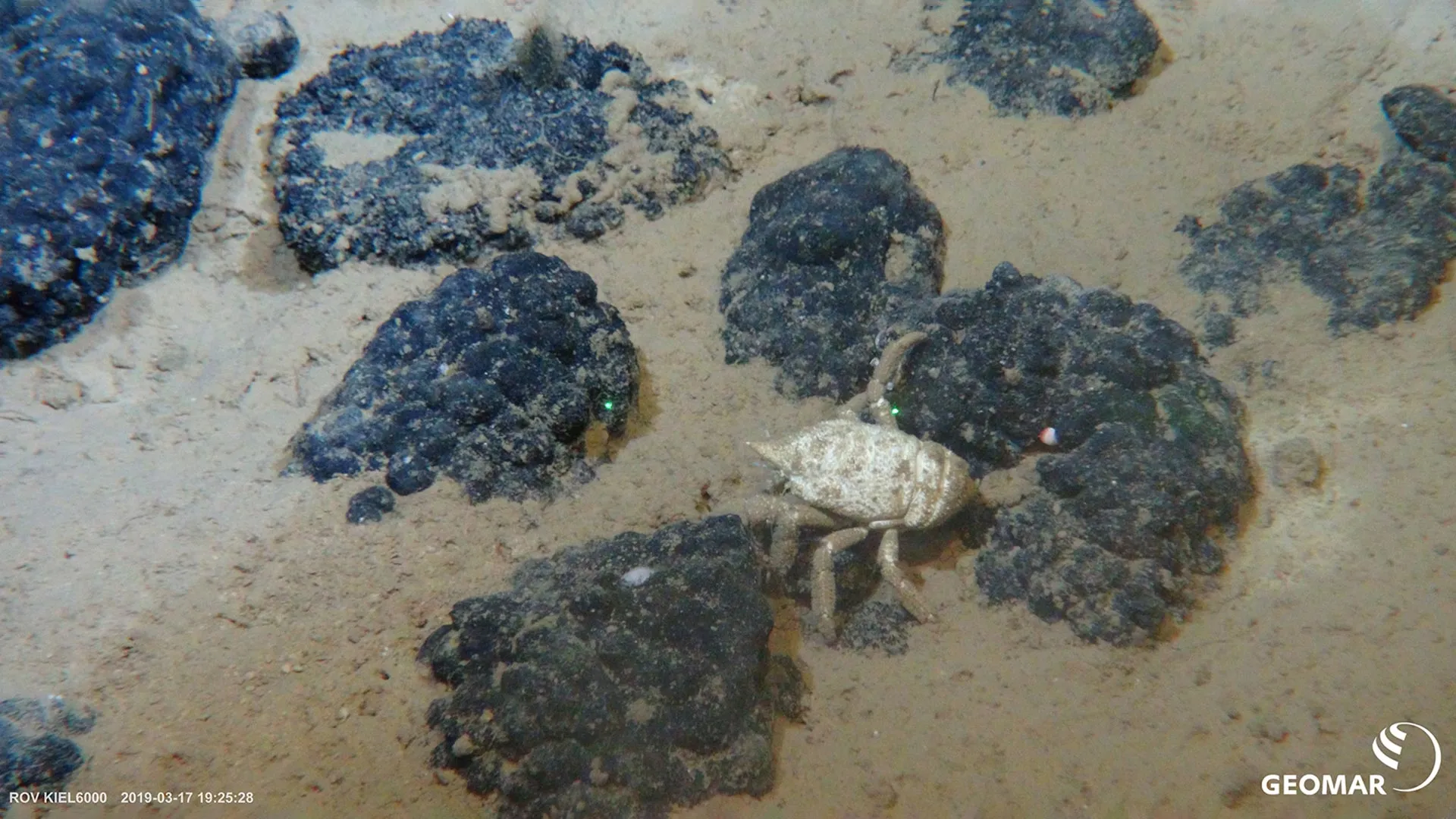
Scientists cracked open potato-sized rocks from the Pacific seabed and found thousands of microscopic animals living inside their cracks — a habitat that would vanish if miners haul the nodules to the surface.
The study, published November 11 in Scientific Reports, examined 244 polymetallic nodules collected from the Clarion–Clipperton Zone, a stretch of abyssal plain between Mexico and Hawaii where commercial miners hope to harvest manganese, cobalt, copper and nickel. Across the sample, researchers counted 4,139 individual animals — an average of 17 per nodule — with one rock sheltering 245 creatures, all smaller than a millimeter.
The nodules form over millions of years as dissolved metals precipitate around a nucleus — a shark tooth, a shell fragment, a bit of ancient debris — adding only millimeters per million years. “Like a super slow game of Tetris,” one scientist described the process to Popular Mechanics in 2024. That glacial growth means the habitat is effectively non-renewable on human timescales.
Distinct communities, not just passengers
The animals inside the nodules — nematodes, copepods, and a single-celled “armored amoeba” called Thurammina sp. 1 — form communities genetically similar to each other across distances of 1,000 kilometers, yet distinct from the fauna in the surrounding mud. That distinction matters. The surrounding sediment holds more individuals overall, but the nodule crevices host species that appear to depend on the hard, structured microhabitat. Remove the nodules, and there is no equivalent refuge nearby.
For tiny crustaceans (copepods), the figure was about 25%. “What surprised us most was how different the communities living inside nodules were from those in nearby sediments,” Diaz-Recio Lorenzo said. It was how different the communities inside the rocks were from those living in the nearby mud.

One example is the single-celled species Thurammina sp. 1, which is particularly common in the nodules. This species appears to be perfectly adapted to the sheltered spaces within the nodules. If the nodules were extracted, there would be no replacement for these specialized inhabitants.
Mining timeline sharpens the stakes
The findings arrive as the regulatory picture shifts. The International Seabed Authority (ISA), the UN-backed body that governs mineral extraction in international waters, has yet to finalize exploitation rules — it delayed them again in July. Meanwhile, the United States, which is not an ISA member, is moving on its own track.
Under the Deep Seabed Hard Mineral Resources Act, NOAA has received over ten applications since a January 2026 rule created a consolidated permit process. The Metals Company (TMC) USA has submitted two exploration license applications and expects a commercial recovery permit before the end of the first quarter of 2027, according to its own forecast; NOAA must still finalize an environmental impact statement.
“Our findings point out that commercial mining may result in an irreversible loss of undescribed and unique biodiversity associated to nodules,” Sabine Gollner, also from the Royal Netherlands Institute for Sea Research and senior author of the study, said.”
They contain manganese, cobalt, copper, zinc and iron, metals used in emerging technologies. “Large-scale nodule removal could therefore result” in irreversible loss of these unique ecosystems.
What we still don’t know
Whether the loss of these nodule-dwelling communities would translate to global extinctions remains an open question. Dr. Stratmann is currently on a new expedition to the Clarion–Clipperton Zone, funded through the JPI Oceans MiningImpact 2 and 3 projects, to investigate further.
A separate 2024 finding — that nodules may produce “dark oxygen” without sunlight — is also under renewed study, though the mining company that initially funded that research and other scientists have disputed the results.
For now, the rocks sit at 4,000 to 6,000 meters depth, each one a miniature apartment block built over epochs. The decision to mine them is, in effect, a decision about whether habitats that took millions of years to form can be sacrificed for metals needed today.

Planet Fitness to Open 4 New Long Island Gyms, Relocate 2
Planet Fitness is staking out nearly 108,400 square feet of new Long Island real estate, opening four clubs...

First Lady Araneta-Marcos Backs Stalled Child Safety Bills at Manila Forum
Manila hosted a diplomatic gathering on child online safety. First Lady Louise "Liza" Araneta-Marcos stood before the spouses...

GTA 6 New Zealand Time Trick Lets Xbox, PS5 Users Play Hours Early
Rockstar Games confirmed that Grand Theft Auto VI unlocks at midnight local time on November 19, meaning New...

The Best and Worst Gluten-Free BBQ Potato Chips Ranked
Amy Bell surveyed 16 gluten-free BBQ potato chips for Tasting Table and found that most fell short of...