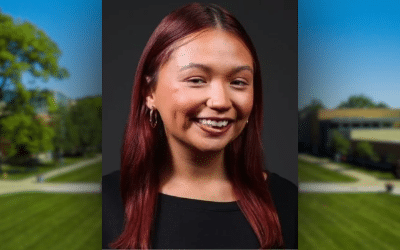
CoCo Rosales Finds Her Future at Manchester
When CoCo Rosales first stepped onto the campus of Manchester University during her senior year of high school, she was not even planning to visit the school that day. A last-minute change of plans brought her to North Manchester, Indiana, where a walk across the grounds turned a casual stop into a life-changing decision. As she later recalled, “I still have pictures I sent to my family from that visit. I was like, ‘I really love it here.’ It just felt very homey.”
For Rosales, now a member of the Class of 2028 and a junior from Plymouth, Indiana, that initial impression served as the foundation for a deeply involved undergraduate career. According to a recent feature from Manchester University, her path reflects a broader trend in higher education where campus environment and student engagement play as much of a role in retention as classroom instruction. While many students at larger institutions report feeling like a number, Rosales has spent her time at Manchester building a diverse portfolio of leadership roles and professional opportunities.
A Curriculum Beyond the Classroom
Rosales is currently pursuing a double major in psychology and peace studies, complemented by a minor in criminology. Her academic focus is anchored in a long-term goal of advocating for crime victims and marginalized communities. However, the university experience that has defined her time in North Manchester extends far beyond her degree requirements. She currently serves as the president of the Honors Program Student Leadership Council and the president of United Sexualities and Genders (USG).
Her involvement is not limited to student governance. She participates in the Kenapocomoco Peace Coalition, engages in environmental studies initiatives, and serves as the Head Ambassador in Admissions. Through her work with USG, Rosales helped organize a campus drag show that successfully raised funds for the Indiana Youth Group, an organization dedicated to supporting LGBTQ+ youth across the state. These co-curricular activities serve as more than just résumé additions; they function as a primary method for fostering a sense of belonging on campus.
The Impact of Faculty Mentorship
The academic environment at Manchester is characterized by a high degree of faculty accessibility, a factor that has proven essential for Rosales. When she traveled to Nepal for a university-sponsored travel course, it was Peace Studies Professor Katy Gray Brown who alerted her to an environmental policy internship. Despite the 10-hour time difference, Rosales interviewed for the position from her hotel room and secured the role. This paid internship with Earth Charter Indiana allowed her to help organize an environmental conference hosted at Manchester University.

“I wouldn’t have gotten opportunities like that somewhere else. The connections here are so valuable.” — CoCo Rosales
This level of individualized attention is a cornerstone of the Manchester experience. While larger universities often struggle to provide similar hands-on professional development to undergraduates, Manchester’s model relies on these direct faculty-student relationships to open doors that might otherwise remain closed. For many students, this mentorship acts as a bridge between theoretical classroom knowledge and practical, real-world application.
The Economics of Campus Belonging
The broader question for higher education institutions in 2026 remains how to effectively attract and retain students in an increasingly competitive landscape. Data from the National Center for Education Statistics consistently highlights that students who feel connected to their campus community are significantly more likely to persist to graduation. For Manchester, the Manchester Fund plays a vital role in maintaining the physical and social infrastructure that facilitates these connections.
Critics of small private institutions often point to the higher tuition costs compared to state-funded alternatives. However, proponents argue that the return on investment for schools like Manchester is found in the density of opportunities for leadership and mentorship. When students are able to present research at conferences, lead organizations, and complete paid internships early in their academic careers, they graduate with a distinct competitive advantage in the workforce.
As Rosales looks toward her final years at Manchester, she remains focused on her goal of pursuing advocacy work. For her, the “Spartan” experience has been defined by the feeling that she is building herself into more than just a degree holder. As she noted, “I’m still figuring out exactly what path I’ll take. But I know I’m setting myself up for greatness.”

Gov.-elect Alan Wilson Outlines Policy Priorities and Transition Team
Governor-elect Alan Wilson and Lieutenant Governor-elect Mike Reichenbach moved quickly to set the tone for their upcoming administration...
Wilmington Honors Rhode Island Regiment and British Officers
Honoring 28 Rhode Island Regiment Soldiers in Wilmington Twenty-eight soldiers from the Rhode Island Regiment, half of them...

Northwestern Oklahoma State and opponent play tight volleyball match
Northwestern Oklahoma State and Opponent Navigate Tight Volleyball Matchup The volleyball match between Northwestern Oklahoma State and their...

North Dakota Republican Party faces financial and operational collapse
The North Dakota Republican Party’s Financial and Operational Collapse As the dust settles on the 2026 election cycle,...