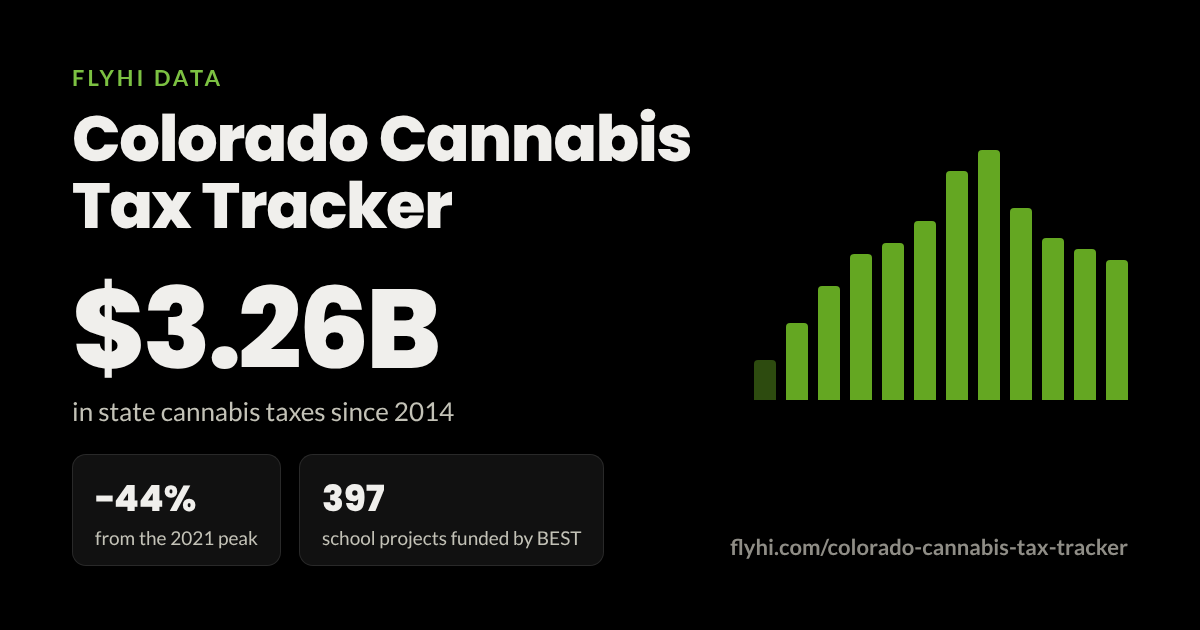
Since legal sales began in 2014, observers have tracked the impact of cannabis legalization as tax numbers and school funding have evolved. More than a decade later, the ledger reveals a more nuanced reality. State records compiled and tracked by Flyhi show that Colorado has collected state cannabis taxes and fees since legal sales began. That total, drawn straight from the Colorado Department of Revenue, tells the story of an economic boom that is now quietly sliding into a different era.
Every dollar collected has followed a complex maze of state mandates, funneled into everything from rural school construction to state-level behavioral health programs. Yet, the totals hide a pivotal shift happening right now. After climbing steadily year after year to reach a peak, the state’s annual cannabis tax haul has fallen every year since. Plummeting wholesale prices, market saturation, and the steady march of legalization in neighboring states have reshaped the marketplace.
The Anatomy of the Boom and the Slide
To understand where Colorado stands today, look at the trajectory of the numbers. State collections climbed every single year from 2014 until peaking, only to face a sustained downward slide. The revenue machine that once seemed invincible is feeling the friction of competing states opening their own markets and a domestic supply that routinely outpaces consumer demand.
The state splits these revenues into distinct buckets. The biggest share goes to the Marijuana Tax Cash Fund, which lawmakers spend each year on things like behavioral health, education about cannabis, regulation, and law enforcement. Schools get the next-biggest cut.
That excise tax goes straight to BEST—Building Excellent Schools Today—the state’s school construction grant program. Since 2014 it has put money into the BEST fund. It is worth noting that cannabis doesn’t shoulder this burden alone; the BEST fund also draws from State Land Board revenue, the Colorado Lottery, and interest. Still, cannabis has served as one of the program’s main funding sources, matched by local school districts chipping in their own funds.
Where the Local Cuts Land
For years, cities and counties enjoyed a predictable slice of the pie, receiving 10% of the state’s 15% retail cannabis sales tax. That safety net has frayed significantly. Lawmakers cut that to 3.5% starting in 2025. In 2026, a budget bill, HB26-1409, proposed ending it entirely.
Local governments retain the authority to levy their own municipal and county cannabis taxes on top of the state baseline, a separate revenue stream entirely excluded from state totals. Even so, the retreat of state-level sharing forces local officials in border towns—where out-of-state buyers historically drove massive sales volume—to reevaluate their municipal balance sheets.
When you look at legal cannabis sales by county, the border communities jump out immediately, especially when measured on a per-adult basis using 2024 population estimates from the State Demography Office. As more states adopt legal frameworks of their own, those cross-border shopping trips are naturally drying up, directly pulling down the sales figures tracked by the Colorado Department of Revenue.
The policy rules governing these distributions and the broader state budget framework stem directly from the Colorado Legislative Council Staff’s January 2026 memo on marijuana in the state budget. As the legislature weighs future cuts and grapples with declining revenues, the question facing lawmakers isn’t just how to spend a windfall anymore. It is how to manage a maturation market where the years of high growth are rapidly becoming history.
- Buckeye police say fiancé orchestrated attack on mother in home
- Mary Peltola Denies Knowledge of Ballot Rival Daniel J. Sullivan
- Microsoft Generated Billions More Free Cash Flow Than Alphabet, says Benzinga España (world-today-news.com)
- Legal Cannabis' 3.7% Yearly Heart Failure Gap Is About 8 Per 100,000 (daybreakwire.com)
Buckeye police say fiancé orchestrated attack on mother in home
A Buckeye, Arizona mother was attacked inside her home on October 16 in what local investigators describe as...

Mary Peltola Denies Knowledge of Ballot Rival Daniel J. Sullivan
Democratic Alaska Senate candidate Mary Peltola told supporters Thursday she is not interested in tricking voters, following two...

How to Maintain Your Fitness Routine During the Holiday Season
Huntsville Parks & Recreation is proving that everyday wellness and seasonal indulgence can coexist as the holiday season...

Cheyenne South to Field Only Sub-Varsity Football in 2027 Following Record Losing Streak
Cheyenne South Football Shifts to Sub-Varsity for 2027 Cheyenne South High School will not field a varsity football...