The DUP’s Tactical Withdrawal from Stormont Joint Engagements
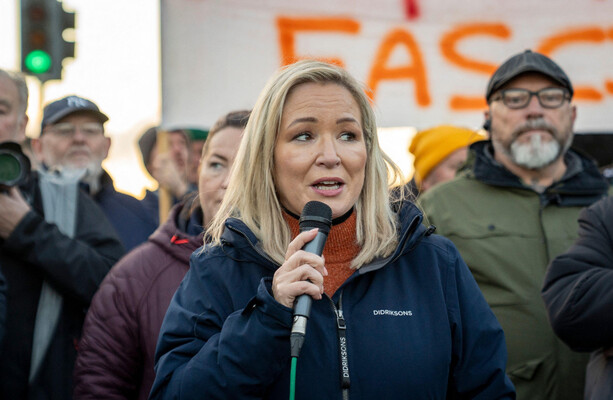
The delicate architecture of Northern Ireland’s power-sharing government faces a new period of instability after DUP leader Gavin Robinson announced that Deputy First Minister Emma Little-Pengelly will cease all joint engagements with First Minister Michelle O’Neill. This decision, confirmed by the DUP, follows a wave of internal party pressure regarding the Sinn Féin leader’s attendance at a contentious protest on the Garvaghy Road in Portadown last month.
The move represents a deliberate, albeit partial, withdrawal from the collaborative governance required by the Stormont Executive. While Robinson stopped short of the “nuclear option”—withdrawing Little-Pengelly from her post entirely, which would automatically trigger the collapse of the administration—he made it clear that the current status quo is no longer tenable for his party. According to reporting by RTE, Little-Pengelly formally withdrew her agreement for upcoming engagements, citing the “seriousness of the circumstances” surrounding the protest.
The Immediate Impact on Cross-Border Diplomacy
The fallout from this decision is immediate and high-profile. An upcoming economic event in Glasgow, where Stormont’s leaders were scheduled to meet with British Prime Minister Andy Burnham, Scottish First Minister John Swinney, and Welsh First Minister Rhun ap Iorwerth, will now proceed without the Northern Ireland Executive’s top representatives.
The deputy First Minister has decided to block representation from here at major political event, which would include meeting with the First Ministers of Scotland and Wales, and the British Prime Minister.It is for the people to decide who represents them as First Minister. Not… pic.twitter.com/PU6qzY1JQn
Furthermore, an already-postponed meeting with Irish President Catherine Connolly at Áras an Uachtaráin in Dublin has been cancelled. For the American reader, the stakes extend beyond regional politics; the impasse threatens the stability of a devolved government that serves as a cornerstone of the Good Friday Agreement. When the Executive cannot function, the ability to finalize budgets for public services, including healthcare and infrastructure, stalls, directly impacting the daily lives of citizens in the region.
Internal Pressures and Electoral Strategy
This political maneuvering occurs against the backdrop of an looming Assembly election in May 2027. Reporting from The Irish Times suggests that the DUP is grappling with a strategic bind: the party is attempting to energize its loyalist working-class base following a period of declining support and internal dissent. High-profile figures within the party, such as MP Carla Lockhart, have publicly pushed for more aggressive measures against Sinn Féin, with Lockhart reportedly resigning as a party officer last week due to a rift with the leadership over their approach.
“The First Minister needs to be held accountable for her actions and for her recklessness. We believe that while she and her colleagues should be punished, that does not include punishing the rest of Northern Ireland,” said DUP leader Gavin Robinson.
Sinn Féin has responded with sharp criticism. First Minister Michelle O’Neill characterized the move as a “reactive stunt” driven by the DUP’s internal electoral woes. On social media, O’Neill stated that the decision was “reckless and irresponsible,” arguing that it prevents the people of the north from being represented at vital economic forums.
The Legal and Political Tightrope
The core of the dispute rests on the actions of Sinn Féin politicians who attended the Garvaghy Road protest, which police are investigating as an unnotified, and therefore allegedly unlawful, event. While O’Neill has defended her presence as the “right thing to do,” the DUP has seized upon the investigation to highlight what they describe as “arrogance” and “lawlessness.”

The current situation creates an uncomfortable paradox. As noted by The Irish Times, the DUP is effectively attempting to maintain a position as a “tough watchdog” while simultaneously serving in a joint office with the very party they are accusing of illegal behavior. This creates a difficult narrative for the DUP to manage, as they must balance the demands of their hardline base with the reality of maintaining a functional, power-sharing government.
As the PSNI continues to interview those suspected of participating in the protest, including Sinn Féin TDs Pearse Doherty and Matt Carthy, the political temperature at Stormont is unlikely to cool. With the May election on the horizon, every decision made in the corridors of the Parliament Buildings is now filtered through the lens of electoral survival. For now, the Executive remains in place, but the “joint” nature of the office is effectively suspended, leaving the future of the administration in a state of precarious limbo.
Related reading
Russia pitches floating nuclear plants to African nations at summit
Moscow Pursues Floating Nuclear Plants as Russia-Africa Summit Closes Russia is positioning itself to become the world's first...

Subsea Cable Vulnerability: Geopolitical Threats and the Cost of Regulatory Bifurcation
The Deep-Sea Chokepoint Threatening Trans-Pacific Data Networks Trans-Pacific undersea cables have rapidly evolved from background utility infrastructure into...

Ireland Must Prepare Pathway for Britain to Rejoin European Union
The Republic of Ireland Must Pave Britain’s Road Back to the European Union, Says Minister The Republic of...

Rare public sighting of A-listers’ 31yo son
Tom Cruise and Nicole Kidman’s son Connor, 31, made a rare public appearance at the 2026 World Series,...