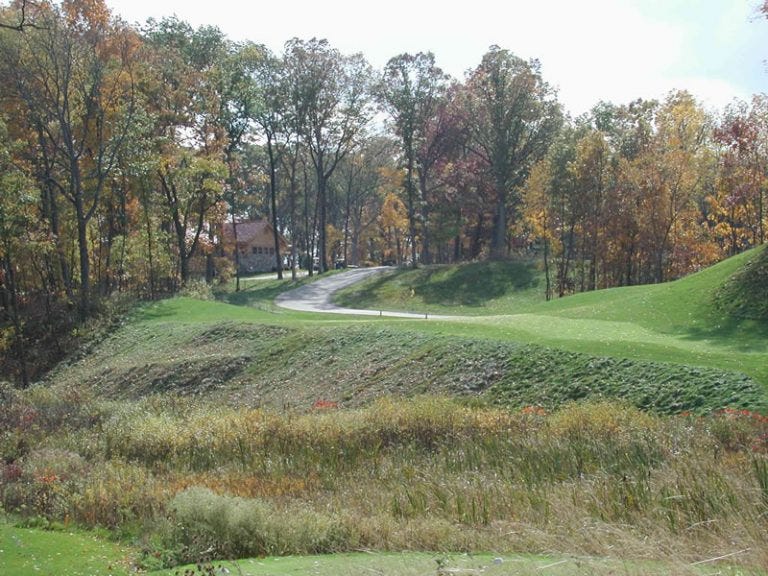
Craig LeVasseur presents a compilation of the scariest golf holes in Michigan, noting that a challenging hole can be fun when the challenge is mostly mental. LeVasseur identifies several holes across the state where poor routing, hazardous surroundings, and illogical layouts transform a game of skill into a nightmare of potential property damage or lost equipment.
The Danger of Property Damage
For LeVasseur, the most terrifying element of a golf hole isn’t water or bunkers, but the prospect of causing property damage. He highlights the 4th hole at Plum Hollow as a primary example, describing a long par-4 where the fairway is tightly hemmed in by trees with 9 Mile Road running parallel to the right. LeVasseur writes that he witnessed a playing partner hit a ball onto the road during a summer round, leading him to intentionally aim for a different fairway entirely to avoid the risk.
Similar risks appear at Manistee Golf & Country Club, where LeVasseur notes at least three different opportunities for a golfer who slices the ball to inflict property damage. At the 1st hole of Rackham, the danger shifts to the left, where LeVasseur claims the number of moving objects in play is among the highest a golfer will encounter on a single shot.
The risks extend to major infrastructure as well. LeVasseur points to the front nine at Edgewood Country Club, where he argues the routing is flawed because it presents out-of-bounds hazards down the left side of the entire stretch, creating the risk of a tee ball landing on I-696.
Design Flaws and Environmental Hazards
Beyond the risk of hitting a car or a house, LeVasseur identifies several holes that he considers fundamentally broken in their design.
Other holes are criticized for their reliance on “marsh hopping,” a feature LeVasseur dislikes. At Moose Ridge, the 9th hole requires a 175-plus yard carry over a marsh and a steep ridge. LeVasseur reports that he has personally recovered more than a dozen balls from the ridge, noting that the “bailout” strategy suggested by the course—hitting the ball past the green—is unrealistic for the average Detroit public golfer.
Some holes have proven so problematic they were eventually changed. LeVasseur mentions the former 6th hole at Petoskey-Bay View, which featured a road directly in the landing area. He describes the layout as a nightmare that was eventually eliminated when the club rerouted holes 6 through 8.
The Psychological Toll of the ‘Monster’
Some holes are scary because they are marketed as such or because they force a specific, high-risk decision. LeVasseur identifies the 18th hole at Brae Burn as a top contender, noting that the course promotes itself as “Home of the Monster.” The hole is a 666-yard double dogleg par 5 featuring a blind water hazard inhabited by a snapping turtle.
The 18th hole at the University of Michigan GC is featured on a list of the scariest golf holes in Michigan.
The closing stretch of the PohlCat is also highlighted, specifically the 18th hole. Brendan Aumann, a co-author and member of the Fresh Coast Flock, describes it as one of the worst 18th holes in the state. Aumann argues that players must either lay back or hit a drive from right to left to avoid the clubhouse or the driving range, calling the final three holes “90’s golf at its finest” due to their forced carries and target-golf nature.
While some holes like the 16th at Diamond Springs are praised for forcing a series of difficult decisions around a deep ravine, others, such as the 11th at Crystal Downs, are noted for their extreme slopes. LeVasseur mentions that recreating the 11th in a simulator required a complete overhaul of the LiDAR elevation data just to keep virtual balls on the green.
Worth a look

Maine Department of Labor reports 4,720 approved paid leave claims
Thousands of Maine workers are now accessing paid time off for childbirth, serious illness, and family care thanks...
Odenton MARC Station Breaks Ground on $56M Commuter Garage
Governor Wes Moore, County Executive Steuart Pittman, and regional transit leaders broke ground on October 28, 2026, for...

Frankfort vs. Independence: Win Streak Meets Stout Defense
The Class AA No. 1 Frankfort Falcons enter Friday night's matchup against the No. 6 Independence Patriots. With...

Masterson and Holscher battle over property tax relief in Kansas race
Kansas voters will decide between different approaches to addressing surging property taxes across the state. Republican gubernatorial nominee...