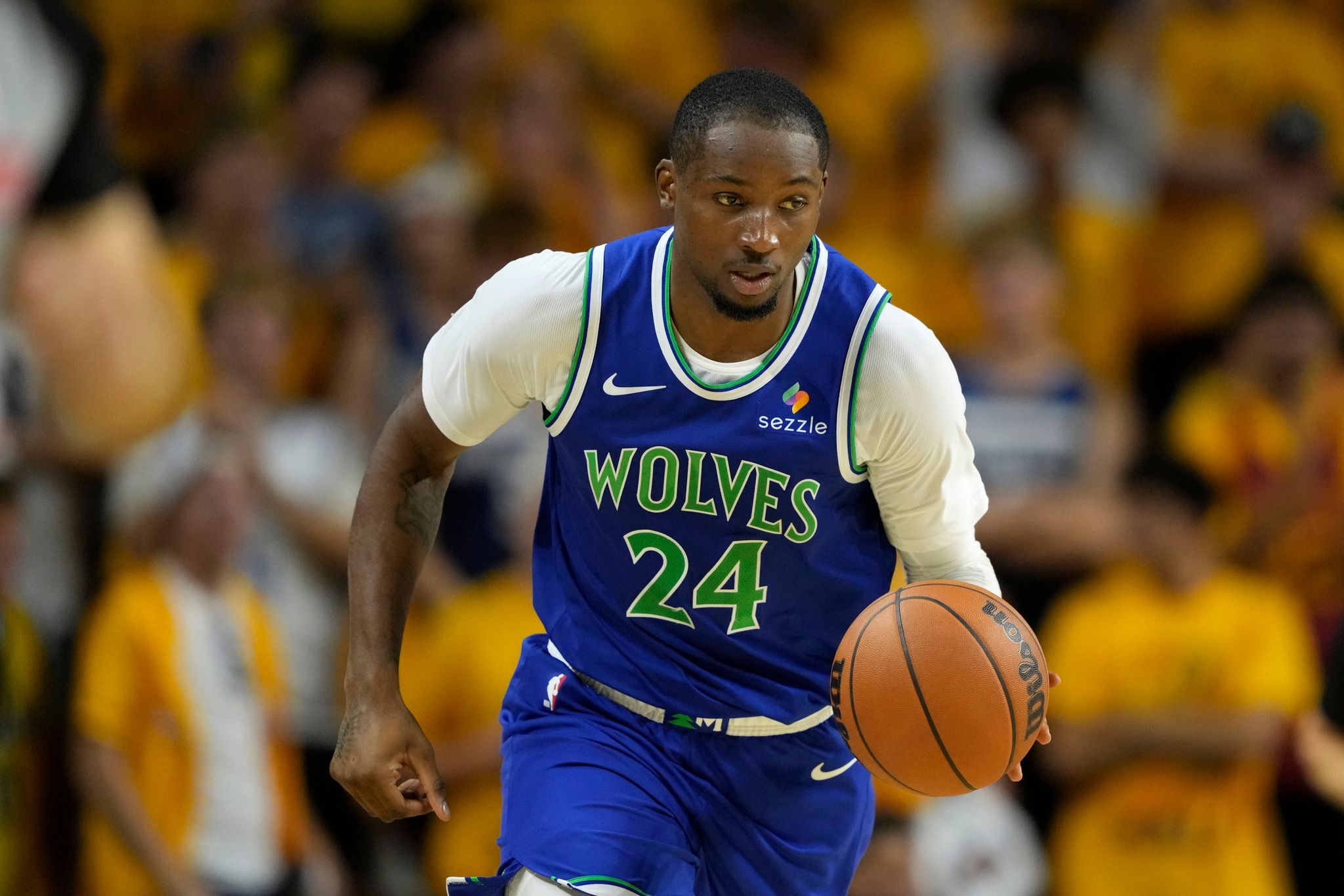
Jonathan Kuminga has found the one thing that eluded him for five years in the Bay Area: a consistent role. After signing a two-year, $13 million “prove-it” deal with the Minnesota Timberwolves this summer, the 23-year-old forward is operating as a streamlined secondary offensive valve and a lockdown defender, averaging 11.5 points and 5.8 rebounds through his first four games. The transition marks the definitive end of the Golden State Warriors’ “two-timeline” experiment, as Kuminga now thrives in a system that values his raw power over the rigid tactical discipline demanded by Steve Kerr.
The contrast is stark. In Golden State, Kuminga was a square peg in a round hole, often relegated to the sidelines or thrust into inconsistent minutes. In Minnesota, under coach Chris Finch, he is a primary engine of aggression. As reported by the San Francisco Chronicle, Kuminga has already become a defensive menace, surrendering just a 37.5% field goal percentage as a primary defender. He isn’t just playing; he’s fitting into a flow that the Warriors could never quite engineer for him.
The friction of the two-timeline approach
For years, the Warriors tried to balance a championship-caliber core around Stephen Curry while simultaneously developing young talent like Kuminga. The result was a fundamental disconnect in philosophy. While Kuminga possessed 1% athleticism and unstoppable driving ability, he struggled with the “invisible” parts of the Warriors’ offense—the pin-ins, the decoy runs, and the off-ball movement.

“What I would tell him all the time is like, ‘You gotta do some of the things that you don’t want to do to do the things that you want to do,’” Warriors assistant Kris Weems told the Chronicle. “JK just was like, ‘Just give me the ball, man.’”
This wasn’t just a tactical disagreement; it was a financial one. By 2025, the relationship hit a wall over a proposed two-year, $46.8 million extension. Kuminga and the Warriors front office simply could not agree on his market value. That impasse led to his unceremonious exit in February, when he was shipped to Atlanta in a trade for Kristaps Porzingis—a move that now looks like a gamble on a fragile asset, given Porzingis played only 15 regular-season games last year.
The “so what” of this situation extends beyond one player’s stats. It serves as a cautionary tale for NBA front offices attempting to develop young stars while chasing immediate titles. When a team prioritizes the present over the future, development often becomes a casualty. A Warriors source put it bluntly: “If you can win a title, you just win a title. F— development.”
A new environment in Minneapolis
In Minnesota, the atmosphere is different. Kuminga is paired with the exuberant Anthony Edwards, who welcomed him in September with a viral video declaring that the struggle was “over.” Rather than being asked to be a decoy, Kuminga is being asked to be a weapon. Coach Chris Finch has praised Kuminga for embracing the “dirty work”—the hustle plays and the defensive grit—that previously strained his relationship with the Warriors’ staff.
The effectiveness of this shift is visible in the numbers. Kuminga is currently shooting 47% from three-point range, proving he can be more than just a rim-attacker. He is no longer fighting for a defined role; he has carved one out as a two-way wing on a Western Conference contender.
The Golden State Warriors will face Jonathan Kuminga on Wednesday, their former first-round pick ascending with the Minnesota Timberwolves and set for a bigger role with Anthony Edwards out. https://t.co/c2jJzsP3nq
Some suggest that Kuminga has found a better fit in Minnesota under head coach Chris Finch after proving to be a “square-peg, round-hole” fit with Steve Kerr and the Golden State Warriors’ system. Warriors assistant Kris Weems noted that Kuminga did not always absorb the importance of playing off the ball and resisted doing things he did not want to do to achieve his goals.
The collision course on Wednesday
The narrative comes full circle this Wednesday, as the Timberwolves face the Warriors. The game carries a heavy dose of irony. Kuminga will likely spend significant time defending Yaxel Lendeborg, the Warriors’ 2026 first-round pick. Lendeborg, who is only a month older than Kuminga, has already seized a level of trust from Steve Kerr that Kuminga never achieved. In just his second NBA game, Lendeborg played 37 minutes—a milestone Kuminga didn’t reach until his second season.
The stakes are heightened by the news that Anthony Edwards will miss extended time following a knee procedure. With the Timberwolves’ primary star sidelined, the offense will necessarily shift. Kuminga will be forced to move from a secondary valve to a primary creator. It is the exact scenario he begged for in the Bay Area, and now he has the platform to prove he can handle it.
Whether Kuminga becomes a perennial All-Star or remains a high-end complementary piece depends on his ability to maintain this consistency. For the Warriors, the loss is twofold: they lost a dynamic young talent and traded him for a veteran whose health is a constant question mark. For Kuminga, the question is no longer whether he belongs in the league, but how high his ceiling actually goes when the leash is finally off.

Maine Department of Labor reports 4,720 approved paid leave claims
Thousands of Maine workers are now accessing paid time off for childbirth, serious illness, and family care thanks...
Odenton MARC Station Breaks Ground on $56M Commuter Garage
Governor Wes Moore, County Executive Steuart Pittman, and regional transit leaders broke ground on October 28, 2026, for...

Frankfort vs. Independence: Win Streak Meets Stout Defense
The Class AA No. 1 Frankfort Falcons enter Friday night's matchup against the No. 6 Independence Patriots. With...

Masterson and Holscher battle over property tax relief in Kansas race
Kansas voters will decide between different approaches to addressing surging property taxes across the state. Republican gubernatorial nominee...