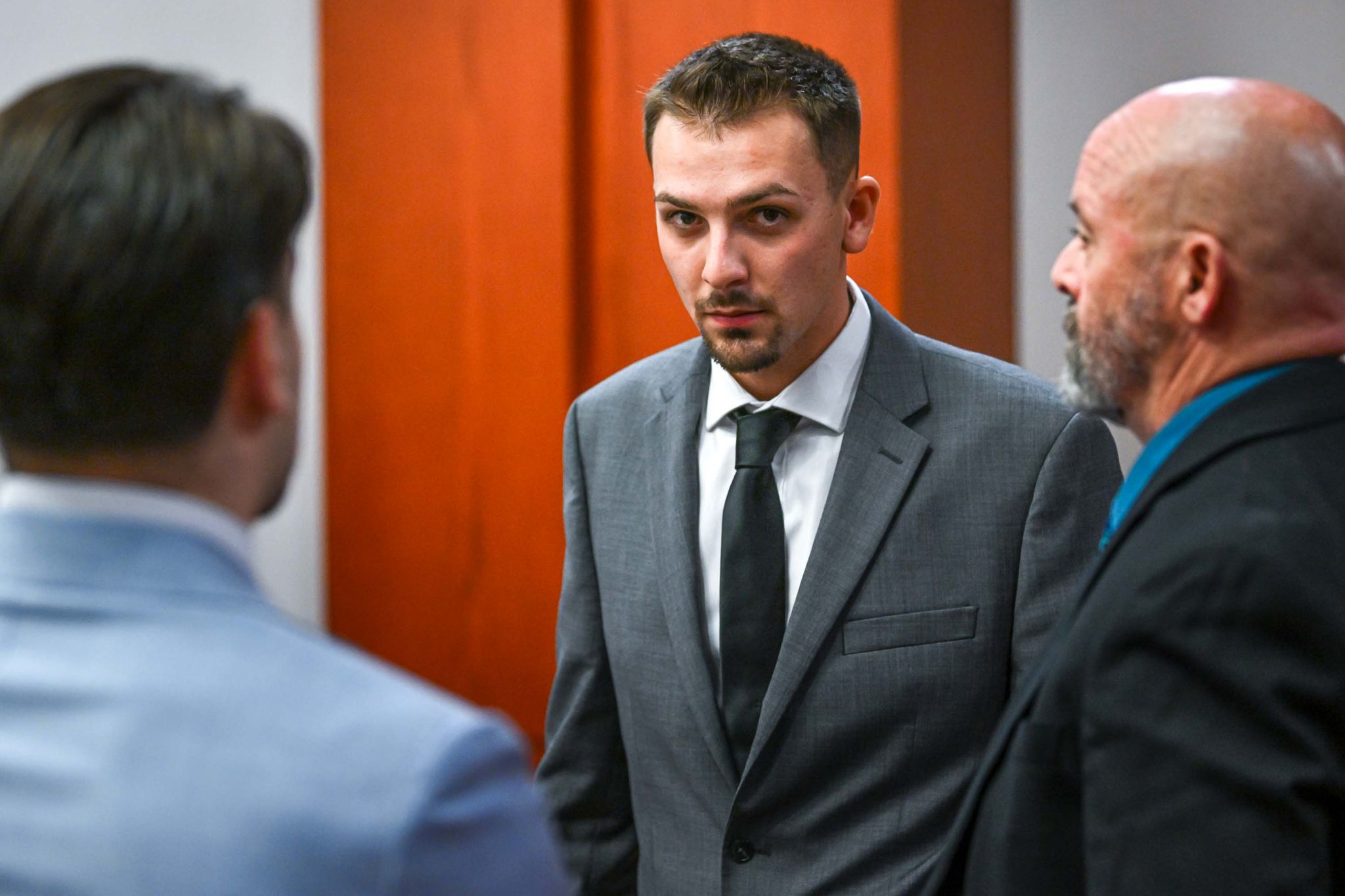
NEW BRITAIN — The state police detective heading the probe into 17-year-old Sophie Ringquist’s death testified Wednesday and soon had to justify a choice central to the manslaughter trial: no one ever tested the driver, Timothy Ouellette, for alcohol or drugs, despite police believing he had consumed alcohol at an underage gathering hours before Ringquist died.
Trooper Ryan Slaiby, appearing for the defense, said he felt that by the time he reached Ouellette’s home on May 21, 2023, too much time had elapsed for a blood test to be useful. Defense attorney Martin Minnella pressed him on the point, asking whether determining if Ouellette was under the influence of liquor or drugs was important. Slaiby agreed it was — but stood by his judgment at the time.
Police said Ringquist, a Burlington resident, died after leaving an underage drinking party in Terryville the night before. While she was taking a selfie video later that night, the truck door opened and Ouellette “suddenly stomped on the gas pedal,” sending Ringquist to the ground, according to an arrest warrant. Ouellette is believed to have dragged the girl back into the truck before driving off with her. Body-worn camera footage played for the jury Thursday captured Ouellette saying Ringquist opened the door while the truck was moving because she had to throw up.
A Question of Timing and Judgment
The cross-examination turned combative almost immediately. Minnella’s direct examination of Slaiby was cut short after the trooper confirmed he had taken notes during the investigation and brought them to court — notes Minnella said he was entitled to review. As questioning grew contentious, Judge Chris Pelosi stepped in and told both Minnella and New Britain State’s Attorney Christian Watson that the court would not allow “any bantering between” them.
Under cross-examination, Sophie's mother was asked if Sophie had a drinking problem. She said no. A text message from that night was read aloud. Lynne Ringquist texted 17-year-old Sophie, "Try to control your drinking tonight." The reason for these questions is that Cooper…
The absence of a toxicology test leaves the jury to weigh competing explanations for what happened that night. The prosecution’s case rests heavily on digital evidence: earlier Wednesday, jurors watched an hourlong forensic animation reconstructing the hours before Ringquist’s separation from the pickup truck. The animation was built by Mark Sanders, a criminal intelligence analyst with the New England State Police Information Network, who reviewed cellphone records and Life360 location data obtained through search warrants and mapped them in Google Earth. Sanders said he validated his speed calculations by testing them in a Tesla Model 3, comparing the vehicle’s displayed speed against readings from an iPhone running Life360.
Defense Challenges the Digital Evidence
However, Jeff Martin of Evidence Solutions, the defense’s opening witness, gave virtual testimony that Life360 data is unable to reliably determine a vehicle’s speed or position. Martin drew a distinction between GPS technology, which communicates directly with satellites and can pinpoint location and speed, and Life360, which instead derives location from the phone’s signal strength — the biggest factor, he said, in determining accuracy.

That dispute matters because the prosecution rested its case shortly after Sanders testified, leaving the reliability of the location timeline as one of the central questions for the jury. If Life360’s data is imprecise, the animation built on it is only as strong as its weakest data point — and if Ouellette was never tested, the state has no chemical evidence of impairment to fall back on.
The case now turns on whether jurors believe the digital reconstruction and the warrant affidavit’s account of Ouellette’s actions, or the gaps the defense has highlighted: no intoxication test, and location data of disputed precision. For Ringquist’s family in Burlington, the trial is the first public accounting of the night their daughter left a party in Terryville and never came home.
More on Sophie Ringquist
Worth a look

Milwaukee County Discovers $4.56 Million Budget Error Due to Formula Mistake
Milwaukee County's proposed 2027 budget is short $4.56 million because of an automated calculation error, officials disclosed Wednesday,...

West Virginia Attorney General Sues TikTok Over Child Safety Concerns
CHARLESTON — When TikTok tells parents its platform is built with their children's safety in mind, West Virginia...

Emergency Responders Honor Fallen Soldier Pte. Aidan Goulding
Remains of North Vancouver Soldier Pte. Aidan Goulding Pass Through Richmond as Emergency Crews Salute Wednesday afternoon brought...
Local guide reveals 6 hidden gems beyond Olympia ruins (4 Nov 2026)
Ancient Olympia Rewards the Traveler Who Stays Past the Stones Most visitors treat Ancient Olympia as a checkbox:...