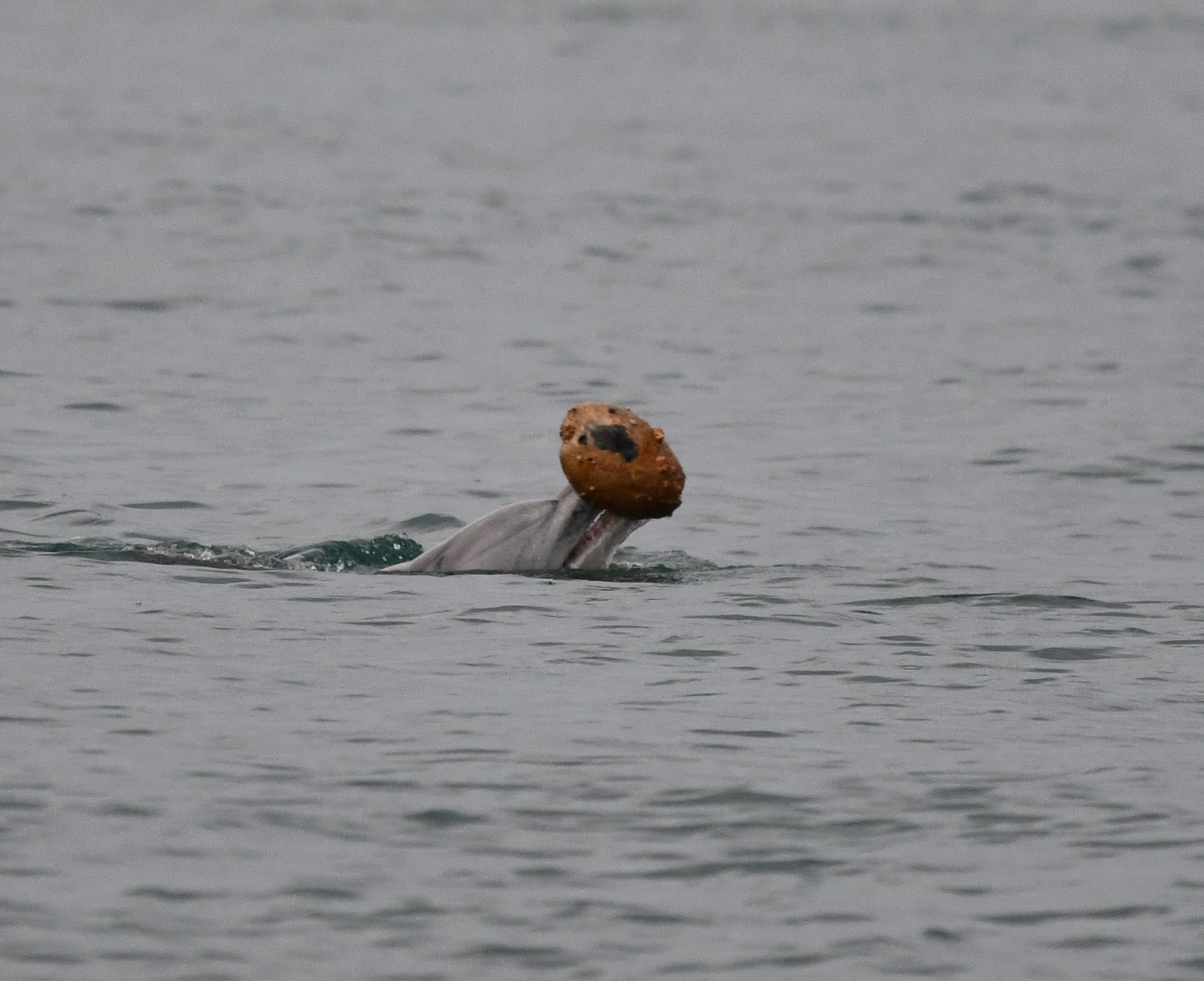
Marine biologists have documented Indo-Pacific bottlenose dolphins using large sea shells to hunt fish off Queensland, Australia, marking only the second known location worldwide for this rare behavior. Researchers recorded two shelling events in 2025 and captured footage suggesting the complex foraging skill is passed directly from mother to calf.
Rare Foraging Behavior Documented in Hervey Bay
Researchers studying local dolphin populations in Queensland’s Great Sandy Marine Park have recorded a remarkable foraging tactic known as shelling. The behavior involves a dolphin chasing a fish into a large, empty sea snail shell, carrying the object to the water’s surface, and shaking it upside down to tip the trapped meal directly into its mouth. Shelling involves a dolphin lifting a large, empty gastropod shell — in this case the bailer shell (Melo amphora), a species that can grow to the size of a football — to the water’s surface and tipping it to drain out a fish hiding inside. The behavior is considered a form of tool use, a rare trait among animals that has drawn scientific interest for what it might reveal about cognition and culture in the wild.
Scientists confirmed the activity in Hervey Bay, making it only the second place in the world where shelling has ever been documented. Before this discovery, the sole published evidence of the tactic came from a distinct dolphin population more than 3,000 kilometres away in Shark Bay, Western Australia, the only other location where the tactic had previously been confirmed. The new observations were made in Hervey Bay, part of the Great Sandy Marine Park, far from Shark Bay in Western Australia. The researchers were able to record footage and take photographs of dolphins shelling in the Great Sandy Marine Park, which is the first published record of it on the east coast of Australia.
“We were on a research boat off Hervey Bay when we spotted a dolphin raising something large out of the water. I started screaming because I know what shelling looks like,”
Dr. Alexis Levengood, a researcher at the University of the Sunshine Coast, via SCI
It’s a hunting behavior where dolphins chase fish into large empty shells, bring the shell to the surface and then shake it to drain the fish into their mouths. Alexis Levengood
A Decade of Local Sightings and Scientific Confirmation
While local tour operators in Hervey Bay reported observing dolphins using bailer shells as early as 2013, limited research in the region meant the practice had not been scientifically recorded until recently. The research team officially documented two shelling events in 2025 alongside older photographs supplied by a local whale-watching operator dating back to 2013.
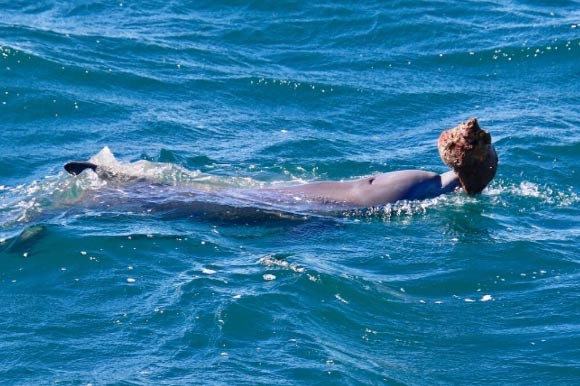
In the first confirmed sighting on July 6, 2025, a lone adult female nicknamed Stevie Nicks was seen maneuvering a bailer shell at the surface before eventually dropping it. A second sighting on October 1, 2025, was more revealing: a mother dolphin named Maserati surfaced with a bailer shell containing a fish, then dropped the shell to chase her prey; minutes later, in the same spot, her calf, Bentley, was seen picking up the shell and mimicking the behavior. The sequence offers the first evidence suggestive of the skill being passed down directly from mother to calf, a pattern known as vertical social transmission.
“We saw the mother surface with a shell, the fish inside escaped and the dolphin dropped the shell to chase the fish. Then, minutes afterwards, the dolphin calf picked up the shell and held it the same way as its mother.”
Dr. Alexis Levengood, University of the Sunshine Coast
Our footage provides the first potential evidence of maternal social transmission — a process by which offspring learn behavior by observing the actions of its mother.
Challenging Peer Learning Beliefs Through Maternal Transmission
The October 2025 footage offers the first potential evidence of maternal social transmission, showing offspring learning tool use by observing their mothers rather than acquiring the skill through horizontal peer learning within their social network. Previously, scientists believed dolphins acquired shelling primarily through vertical or horizontal peer learning – watching friends in their social network rather than direct maternal instruction.
“Our footage challenges the belief that dolphins learn this tool strictly from their peers. These findings highlight just how smart, clever, and innovative dolphins are.”
Dr Alexis Levengood, animal behaviourist and lead author, via Oceanographic Magazine
Researchers noted that further research was needed to understand the nuances of shelling and to provide clarity on transmission pathways and links to ecology, cognition, culture and evolution. A paper on the findings was published August 8, 2026, in the journal Marine Mammal Science, authored by Alexis L. Levengood and colleagues under the title Observations of Shelling Behavior and Potential Evidence of Vertical Social Learning by Bottlenose Dolphins in the Great Sandy Marine Park, Queensland, Australia.
Related reading

NASA Roman Telescope Powers Up 300-Megapixel Instrument in Space
NASA’s Nancy Grace Roman Space Telescope launched aboard a SpaceX Falcon Heavy rocket and has now successfully powered...

Perseverance Rover Finds Volcanic Rocks at Mars’ Jezero Crater Rim
NASA’s Perseverance rover found volcanic igneous rocks instead of expected sedimentary layers along the inner rim of Mars’...

SpaceX Targets First Orbital Flight for Starship on September 28, 2026
SpaceX is targeting September 28, 2026, for Starship's 14th test flight from Starbase, Texas, with a 75-minute window...
ETH Zurich Researchers Link Asteroid Bennu to Inner Solar System Transition Zone
Researchers analyzing titanium, chromium, and iron isotopes in samples returned by NASA's OSIRIS-REx mission have discovered that asteroid...