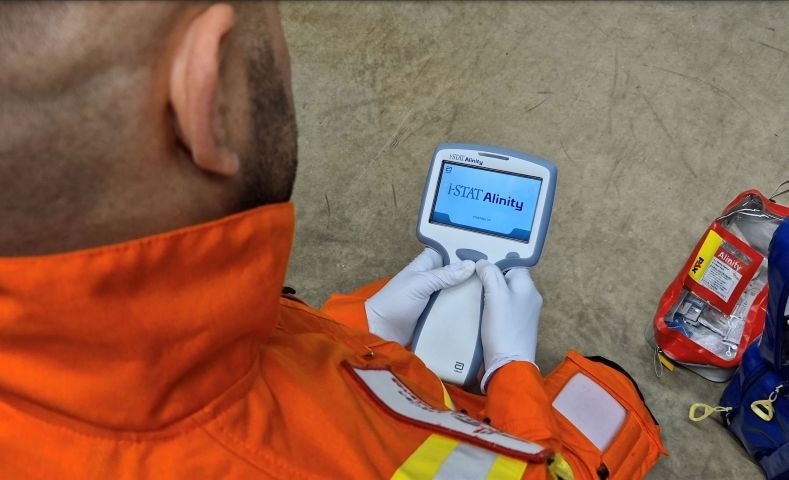
When a helicopter crew reaches someone with a suspected head injury, the clock is already running. East Anglian Air Ambulance has been trialing a handheld blood test that can say, within minutes and still at the scene, whether a patient likely has bleeding on the brain — and in its first published cohort, it caught every single case, News-Medical reported.
That matters because until now, paramedics and doctors in the field have had to judge the risk of an intracranial hemorrhage from a patient’s history, physical exam, and clinical signs alone. A definitive answer has meant a CT scan back at the hospital, which can cost precious time if the nearest hospital isn’t the right one.
The program is called BRAIN-FIRST, and it runs on a portable analyzer — the i-STAT Alinity, made by Abbott Point of Care Inc. — that reads two brain biomarkers, GFAP and UCH-L1, from a small blood sample. Those molecules spill into the bloodstream when brain cells are injured, so a quick read can signal a serious bleed before anyone reaches an emergency department.
Every Case Caught in the First Cohort
The headline finding is blunt: among the first group of East Anglian Air Ambulance patients tested, the analyzer correctly identified every intracranial hemorrhage that occurred, without missing a single case, according to the charity’s own report on its website, eaaa.org.uk. That is the kind of result that changes how crews think at the roadside — they now carry biological information about a possible brain injury while still standing next to the patient.
Dr. James Price, a HEMS consultant and clinical lead for research and development at East Anglian Air Ambulance, said:
“BRAIN-FIRST represents a major step forward in pre-hospital emergency medicine. For the first time, we can obtain biological information about possible brain injury while we are still at the patient’s side. Our first published results are extremely encouraging. Earlier identification of patients at high risk of a serious bleed on the brain has the potential to reduce delays to specialist treatment, avoid unnecessary secondary transfers between hospitals, and help ensure patients reach the right care, in the right place, as quickly as possible.”
A suspected brain bleed sometimes sends a patient first to a hospital without neurosurgical services, only to require a second transfer to a major neuroscience center. If the blood test flags high risk at the scene, crews can pick the right destination from the outset.
From Trial to 200 Patients and Beyond
The test is no longer a lab curiosity. East Anglian Air Ambulance’s critical care teams have now used it with more than 200 patients with suspected serious brain injury, and the charity is working with other UK and international ambulance services to test the approach in a larger, more diverse population. The full initial results are due to appear in JAMA Network Open, the peer-reviewed journal of the American Medical Association, according to eaaa.org.uk.
Money made it possible. Dr. Price noted that the project was funded through the generous support of Tony and Maggie Abel of Abel Homes — philanthropic backing that the charity says it is enormously grateful for.
BRAIN-FIRST2 will explore how the brain biomarkers can be combined with clinical information to support more personalized, precision-based decisions for suspected brain injury before a patient ever reaches a hospital.
Recognition on December 3
The program has also been shortlisted for an Air Ambulance UK Award of Excellence 2026 in the Innovation of the Year category. The awards take place Thursday, December 3, at the Air Ambulance UK Conference at Telford International Centre — the next dated milestone on the calendar for this work.
For now, the first cohort says the biomarkers do what they were hoped to do: give crews minutes of hard biological signal at the moment it counts most.

SC Seeks Response From Centre and ECI on Plea Challenging Blanket Immunity for Election Commissioners
On Wednesday, November 4, 2026, the Supreme Court of India issued notice to the Union government and the...

Indonesia to showcase three climate bills, energy transition plans at COP31 in Türkiye
When world leaders gather in Antalya, Türkiye, on November 9 for the 31st United Nations Climate Change Conference,...

Potassium-Enriched Salt Could Prevent 3 Million Annual Deaths
Replacing ordinary table salt with a potassium-enriched alternative could prevent nearly three million deaths globally every year, according...

Sudipen Launches Paleng-QR PH Plus Program at Public Market
Market vendors in Sudipen, La Union, are trading the familiar clink of coins and crisp folds of peso...