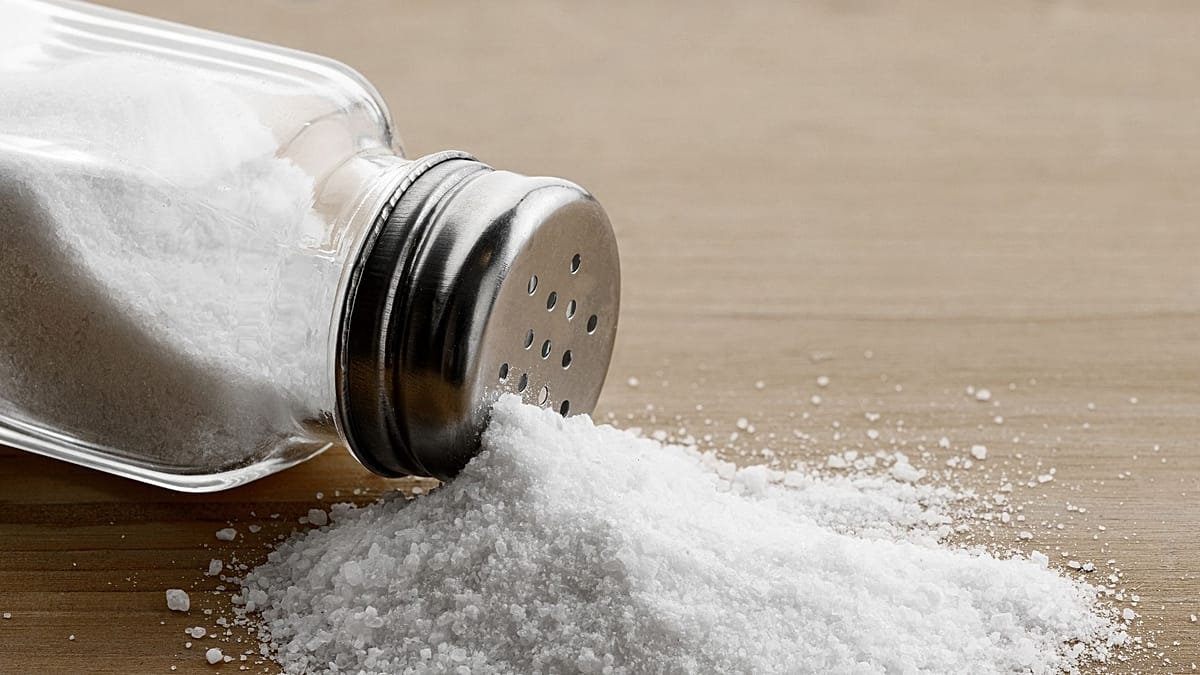
Replacing ordinary table salt with a potassium-enriched alternative could prevent nearly three million deaths globally every year, according to new research out of Australia. The analysis, led by researchers at The George Institute for Global Health, mapped out the potential public health impacts of a widespread dietary switch across 193 countries. The math points to a stark reality: if global kitchens and food manufacturers swap traditional sodium chloride for a potassium-enriched substitute, the world could sidestep 2.96 million deaths and 10.17 million new cases of cardiovascular and chronic kidney disease annually.
The mechanism behind the numbers is straightforward biochemistry. Consuming too much sodium and not enough potassium are well-established drivers of high blood pressure, which acts as a major risk factor for strokes, heart attacks, and kidney disease. Conventional table salt contains sodium chloride. Potassium-enriched alternatives swap a portion of that sodium for potassium chloride, mimicking the look, taste, and cooking properties of standard salt while simultaneously hitting both dietary targets.
“Consuming too much sodium and not enough potassium are well established causes of high blood pressure – a major risk factor for life threatening conditions like strokes, heart attacks and kidney disease,” Bruce Neal, senior professorial fellow at The George Institute, said in a press release.
High blood pressure is hardly a niche problem. Around one in three adults aged 30 to 79 worldwide—roughly 1.4 billion people—live with hypertension, according to World Health Organization figures. Meanwhile, cardiovascular disease remains the leading global cause of death and disability, racking up 19.2 million deaths in 2023 alone.
Where the Dietary Shifts Would Matter Most
The geographical distribution of potential saved lives mirrors global population densities and existing disease burdens. China leads the projections, where a complete national switch to potassium-enriched salt could prevent an estimated 1.08 million deaths annually. India follows, with nearly 400,000 averted deaths per year.
Closer to home, the numbers shift based on how populations acquire their daily sodium. In the United Kingdom, researchers estimate that replacing all conventional salt could prevent nearly 13,000 deaths and roughly 60,000 cases of cardiovascular and kidney disease each year. Yet capturing those gains requires looking past the household salt shaker.
In Europe and North America, more than 70% of total dietary salt intake comes from processed foods and restaurant meals rather than salt added during home cooking. Neal noted that realizing the maximum benefits in these regions depends on the food industry in Europe and North America getting on board.
To quantify the impact of targeting different sectors, the research team examined distinct transition scenarios. An estimated 1.85 million deaths and 6.19 million cases of cardiovascular and kidney disease could be averted each year simply by substituting salt used within households. Shifting the salt used in processed foods and restaurant meals could prevent a further 1.56 million deaths and 5.46 million cases.
Managing the Clinical Risks of Potassium Intake
A broad pivot toward potassium enrichment is not entirely without clinical hazards. People with advanced kidney disease, along with patients taking specific medications that elevate blood potassium levels, face vulnerabilities to hyperkalaemia—an excessive concentration of potassium in the blood.
Addressing those concerns requires structured safety measures. Vivek Jha, a nephrologist and senior professorial fellow at The George Institute in India, emphasized that risks for vulnerable populations can be managed effectively through patient education, clear product labelling, and direct clinical oversight.
In 2025, the World Health Organization gave its backing to potassium-enriched salt as a method for lowering blood pressure and mitigating cardiovascular disease hazards. Even so, it was acknowledged that achieving a worldwide transition remains an ambitious undertaking, particularly given the need to expand production of potassium chloride to meet demand.
While moving globally from standard salt to a potassium-rich option is an ambitious goal, researchers framed it as an initial step to prompt nations to consider the opportunity—offering far greater potential and a much cheaper price tag than numerous pharmaceutical interventions.
Related reading

East Anglian Air Ambulance blood test confirms brain bleeds in minutes in first trial cohort
When a helicopter crew reaches someone with a suspected head injury, the clock is already running. East Anglian...

Indonesia to showcase three climate bills, energy transition plans at COP31 in Türkiye
When world leaders gather in Antalya, Türkiye, on November 9 for the 31st United Nations Climate Change Conference,...

Sudipen Launches Paleng-QR PH Plus Program at Public Market
Market vendors in Sudipen, La Union, are trading the familiar clink of coins and crisp folds of peso...

Australian Survey: 57% of 18-35 Year Olds Report Sexual Strangulation
More than half of young adults surveyed in Australia recently reported experiencing sexual strangulation, a startling statistic that...